Norm of a Linear Transformation .... Junghenn Propn 9.2.3 ....

Click For Summary
SUMMARY

The discussion centers on Proposition 9.2.3 from Hugo D. Junghenn's "A Course in Real Analysis," specifically regarding the proof involving the norm of a linear transformation. Participants clarify the homogeneity property of norms, demonstrating that if \( \mathbf{x} \neq \mathbf{0} \), then \( \| \mathbf{x} \|^{-1} \| T \mathbf{x} \| = \| T ( \| \mathbf{x} \|^{-1} \mathbf{x} ) \| \) holds true. The conversation also highlights the necessity of rescaling the operator \( T \) to ensure its norm is 1, as failing to do so can lead to incorrect conclusions, particularly when using diagonal matrices.

PREREQUISITES
  • Understanding of linear transformations and their properties
  • Familiarity with norms, specifically the 2-norm in \( \mathbb{R}^n \)
  • Knowledge of propositions and definitions in real analysis
  • Ability to manipulate mathematical inequalities and understand homogeneity
NEXT STEPS
  • Study the concept of operator norms in linear algebra
  • Learn about the properties of linear transformations in \( \mathbb{R}^n \)
  • Explore the implications of homogeneity in mathematical proofs
  • Investigate the role of rescaling in linear transformations and its effects on norms
USEFUL FOR

Students and professionals in mathematics, particularly those studying real analysis, linear algebra, or anyone involved in proofs related to linear transformations and their properties.

Math Amateur
Gold Member
MHB
Messages
3,920
Reaction score
48
I am reading Hugo D. Junghenn's book: "A Course in Real Analysis" ...

I am currently focused on Chapter 9: "Differentiation on ##\mathbb{R}^n##"

I need some help with the proof of Proposition 9.2.3 ...

Proposition 9.2.3 and the preceding relevant Definition 9.2.2 read as follows:
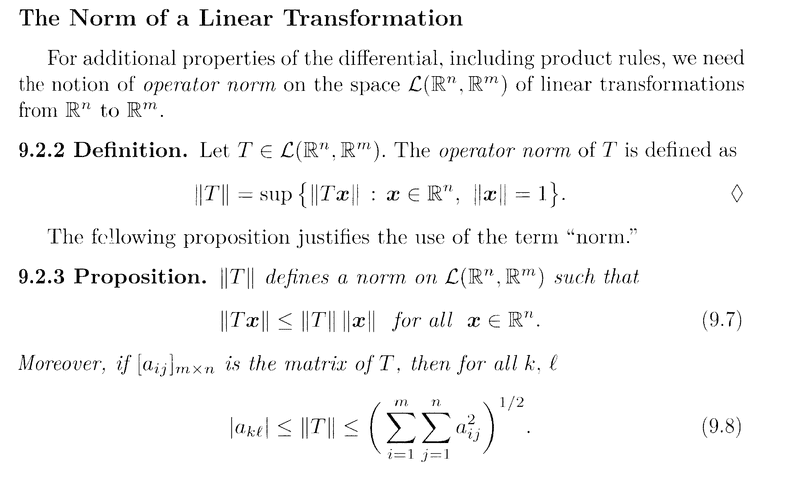
Junghenn - 1 -  Proposition 9.2.3   ... PART 1  ... .png

Junghenn - 2 -  Proposition 9.2.3   ... PART 2   ... .png

In the above proof we read the following:

" ... ... If ##\mathbf{x} \neq \mathbf{0} \text{ then } \| \mathbf{x} \|^{-1} \mathbf{x}## has a norm ##1##, hence

##\| \mathbf{x} \|^{-1} \| T \mathbf{x} \| = \| T ( \| \mathbf{x} \|^{-1} \mathbf{x} ) \| \le 1## ... ... "
Now I know that ##T( c \mathbf{x} ) = c T( \mathbf{x} )##

... BUT ...

... how do we know that this works "under the norm sign" ...

... that is, how do we know ...##\| \mathbf{x} \|^{-1} \| T \mathbf{x} \| = \| T ( \| \mathbf{x} \|^{-1} \mathbf{x} ) \|##... and further ... how do we know that ...##\| T ( \| \mathbf{x} \|^{-1} \mathbf{x} ) \| \le 1##

Help will be appreciated ...

Peter
 

Attachments

  • Junghenn - 1 -  Proposition 9.2.3   ... PART 1  ... .png
    Junghenn - 1 - Proposition 9.2.3 ... PART 1 ... .png
    27.5 KB · Views: 1,284
  • Junghenn - 2 -  Proposition 9.2.3   ... PART 2   ... .png
    Junghenn - 2 - Proposition 9.2.3 ... PART 2 ... .png
    34.3 KB · Views: 1,120
Physics news on Phys.org
Math Amateur said:
Now I know that ##T( c \mathbf{x} ) = c T( \mathbf{x} )##

... BUT ...

... how do we know that this works "under the norm sign" ...

... that is, how do we know ...##\| \mathbf{x} \|^{-1} \| T \mathbf{x} \| = \| T ( \| \mathbf{x} \|^{-1} \mathbf{x} ) \|##

The idea is homogeneity of the the exponent.

Look at the 2 norm of some vector ##\mathbf v## (it can be any vector, including perhaps ##\mathbf v := T \mathbf x##

##\big \Vert \mathbf v \big \Vert_2 = \big(\sum_{i=1}^n v_i^2\big)^\frac{1}{2}##

thus, in your case with some ##c \gt 0##

##c \big \Vert \mathbf v \big \Vert_2 = c \big(\sum_i v_i^2\big)^\frac{1}{2} = \big(\sum_i c^2 v_i^2\big)^\frac{1}{2} = \big(\sum_i (c v_i)^2\big)^\frac{1}{2} = \big \Vert c \mathbf v \big \Vert_2##

Keep an eye for this sort of homogeneity -- it comes up all the time in inequalities.
Math Amateur said:
... and further ... how do we know that ...

##\| T ( \| \mathbf{x} \|^{-1} \mathbf{x} ) \| \le 1##

I either didn't read the question close enough, or something is missing. My inference is they rescaled such that ##T## has an operator norm of 1 here -- but I didn't catch where that was done. If said rescaling wasn't done, the statement in general is not true. For example, consider a diagonal matrix ##T## where ##T_{1,1} = 5## and all other diagonal entries are one -- then apply the argument where ##\mathbf x = \mathbf e_1## i.e. the first standard basis vector -- the result is 5, not 1. But again I think there was a rescaling / Without Loss of Generality assumption that I missed somewhere.
 
  • Like
Likes   Reactions: Math Amateur
StoneTemplePython said:
The idea is homogeneity of the the exponent.

Look at the 2 norm of some vector ##\mathbf v## (it can be any vector, including perhaps ##\mathbf v := T \mathbf x##

##\big \Vert \mathbf v \big \Vert_2 = \big(\sum_{i=1}^n v_i^2\big)^\frac{1}{2}##

thus, in your case with some ##c \gt 0##

##c \big \Vert \mathbf v \big \Vert_2 = c \big(\sum_i v_i^2\big)^\frac{1}{2} = \big(\sum_i c^2 v_i^2\big)^\frac{1}{2} = \big(\sum_i (c v_i)^2\big)^\frac{1}{2} = \big \Vert c \mathbf v \big \Vert_2##

Keep an eye for this sort of homogeneity -- it comes up all the time in inequalities.

I either didn't read the question close enough, or something is missing. My inference is they rescaled such that ##T## has an operator norm of 1 here -- but I didn't catch where that was done. If said rescaling wasn't done, the statement in general is not true. For example, consider a diagonal matrix ##T## where ##T_{1,1} = 5## and all other diagonal entries are one -- then apply the argument where ##\mathbf x = \mathbf e_1## i.e. the first standard basis vector -- the result is 5, not 1. But again I think there was a rescaling / Without Loss of Generality assumption that I missed somewhere.
Thanks StoneTemplePython ...

Appreciate your help ...

Peter
 
Math Amateur said:
I am reading Hugo D. Junghenn's book: "A Course in Real Analysis" ...

I am currently focused on Chapter 9: "Differentiation on ##\mathbb{R}^n##"

I need some help with the proof of Proposition 9.2.3 ...

Proposition 9.2.3 and the preceding relevant Definition 9.2.2 read as follows:
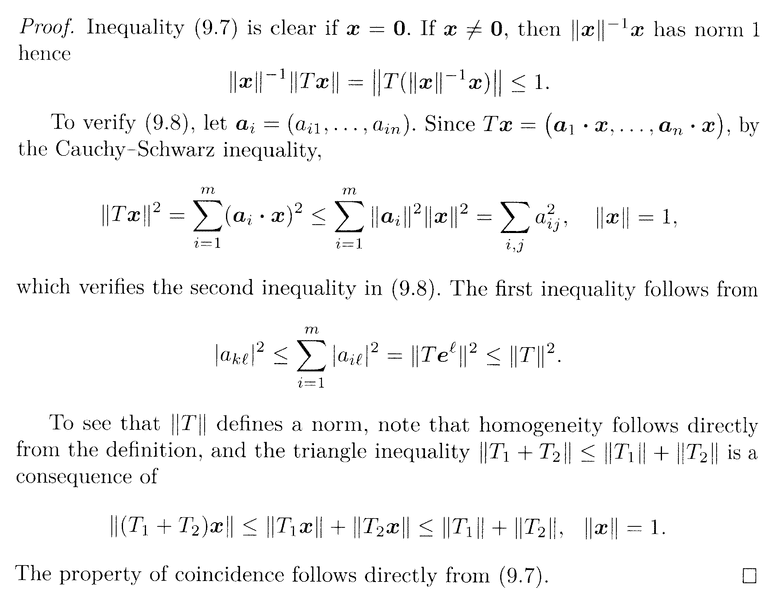
View attachment 221315
View attachment 221316
In the above proof we read the following:

" ... ... If ##\mathbf{x} \neq \mathbf{0} \text{ then } \| \mathbf{x} \|^{-1} \mathbf{x}## has a norm ##1##, hence

##\| \mathbf{x} \|^{-1} \| T \mathbf{x} \| = \| T ( \| \mathbf{x} \|^{-1} \mathbf{x} ) \| \le 1## ... ... "
Now I know that ##T( c \mathbf{x} ) = c T( \mathbf{x} )##

... BUT ...

... how do we know that this works "under the norm sign" ...

... that is, how do we know ...##\| \mathbf{x} \|^{-1} \| T \mathbf{x} \| = \| T ( \| \mathbf{x} \|^{-1} \mathbf{x} ) \|##..Peter

Aren't we working with the set of x with ||x||=1 ? Seems like subbing this in would show equality, if I did not miss something obvious.
 

Similar threads

Replies
5
Views
2K
Replies
2
Views
1K
  • · Replies 7 ·
Replies
7
Views
3K
Replies
2
Views
2K
  • · Replies 24 ·
Replies
24
Views
4K
  • · Replies 2 ·
Replies
2
Views
1K
  • · Replies 3 ·
Replies
3
Views
2K
  • · Replies 4 ·
Replies
4
Views
3K
  • · Replies 12 ·
Replies
12
Views
2K
  • · Replies 29 ·
Replies
29
Views
2K