Norm of a Linear Transformation .... Another question ....

Math Amateur
Gold Member
MHB
Messages
3,920
Reaction score
48
I am reading Hugo D. Junghenn's book: "A Course in Real Analysis" ...

I am currently focused on Chapter 9: "Differentiation on ##\mathbb{R}^n##"

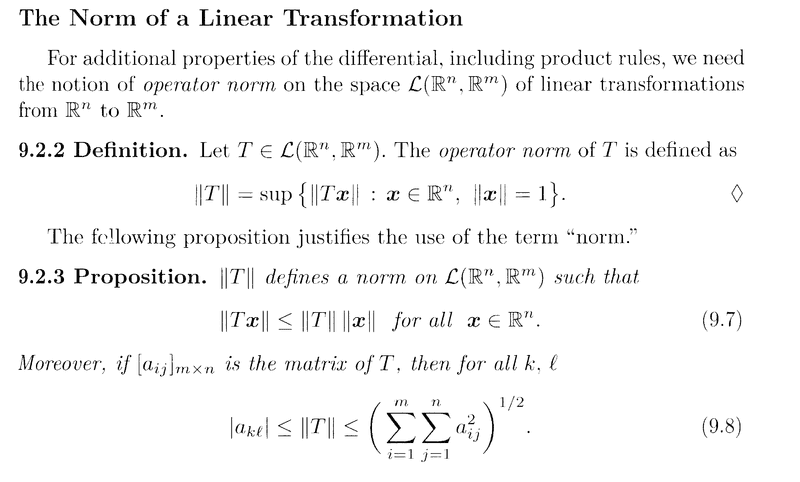
I need some help with the proof of Proposition 9.2.3 ...

Proposition 9.2.3 and the preceding relevant Definition 9.2.2 read as follows:
Junghenn - 1 -  Proposition 9.2.3   ... PART 1  ... .png

Junghenn - 2 -  Proposition 9.2.3   ... PART 2   ... .png


In the above proof Junghenn let's ##\mathbf{a}_i = ( a_{i1}, a_{i2}, \ ... \ ... \ , a_{in} ) ##

and then states that##T \mathbf{x} = ( \mathbf{a}_1 \cdot \mathbf{x}, \mathbf{a}_2 \cdot \mathbf{x}, \ ... \ ... \ , \mathbf{a}_n \cdot \mathbf{x} ) ## where ##\mathbf{x} = ( x_1, x_2, \ ... \ ... \ x_n )##(Note: Junghenn defines vectors in ##\mathbb{R}^n## as row vectors ... ... )Now I believe I can show ##T \mathbf{x}^t = [a_{ij} ]_{ m \times n } \mathbf{x}^t = ( \mathbf{a}_1 \cdot \mathbf{x}, \mathbf{a}_2 \cdot \mathbf{x}, \ ... \ ... \ , \mathbf{a}_n \cdot \mathbf{x} )^t ## ...

... ... as follows:##T \mathbf{x}^t = [a_{ij} ]_{ m \times n } \mathbf{x}^t = \begin{pmatrix} a_{11} & a_{12} & ... & ... & a_{1n} \\ a_{21} & a_{22} & ... & ... & a_{2n} \\ ... & ... & ... & ... & ... \\ ... & ... & ... & ... & ... \\ a_{m1} & a_{m2} & ... & ... & a_{mn} \end{pmatrix} \begin{pmatrix} x_1 \\ x_2 \\ . \\ . \\ x_n \end{pmatrix}####= \begin{pmatrix} a_{11} x_1 + a_{12} x_2 + \ ... \ ... \ + a_{1n} x_n \\ a_{21} x_1 + a_{22} x_2 + \ ... \ ... \ + a_{2n} x_n \\ ... \\ ... \\ a_{m1} x_1 + a_{m2} x_2 + \ ... \ ... \ + a_{mn} x_n \end{pmatrix}####= \begin{pmatrix} \mathbf{a}_1 \cdot \mathbf{x} \\ \mathbf{a}_2 \cdot \mathbf{x} \\ . \\ . \\ \mathbf{a}_n \cdot \mathbf{x} \end{pmatrix}##

##= ( \mathbf{a}_1 \cdot \mathbf{x}, \mathbf{a}_2 \cdot \mathbf{x}, \ ... \ ... \ , \mathbf{a}_n \cdot \mathbf{x} )^t ##

So ... I have shown##T \mathbf{x}^t = [a_{ij} ]_{ m \times n } \mathbf{x}^t = ( \mathbf{a}_1 \cdot \mathbf{x}, \mathbf{a}_2 \cdot \mathbf{x}, \ ... \ ... \ , \mathbf{a}_n \cdot \mathbf{x} )^t##...How do I reconcile or 'square' that with Junghenn's statement that##T \mathbf{x} = ( \mathbf{a}_1 \cdot \mathbf{x}, \mathbf{a}_2 \cdot \mathbf{x}, \ ... \ ... \ , \mathbf{a}_n \cdot \mathbf{x} )## where ##\mathbf{x} = ( x_1, x_2, \ ... \ ... \ x_n )##(Note: I don't think that taking the transpose of both sides works ... ?)
Hope someone can help ...

Peter
 

Attachments

  • Junghenn - 1 -  Proposition 9.2.3   ... PART 1  ... .png
    Junghenn - 1 - Proposition 9.2.3 ... PART 1 ... .png
    27.5 KB · Views: 1,346
  • Junghenn - 2 -  Proposition 9.2.3   ... PART 2   ... .png
    Junghenn - 2 - Proposition 9.2.3 ... PART 2 ... .png
    34.3 KB · Views: 1,282
Last edited:
Physics news on Phys.org
Math Amateur said:
I am reading Hugo D. Junghenn's book: "A Course in Real Analysis" ...

I am currently focused on Chapter 9: "Differentiation on ##\mathbb{R}^n##"

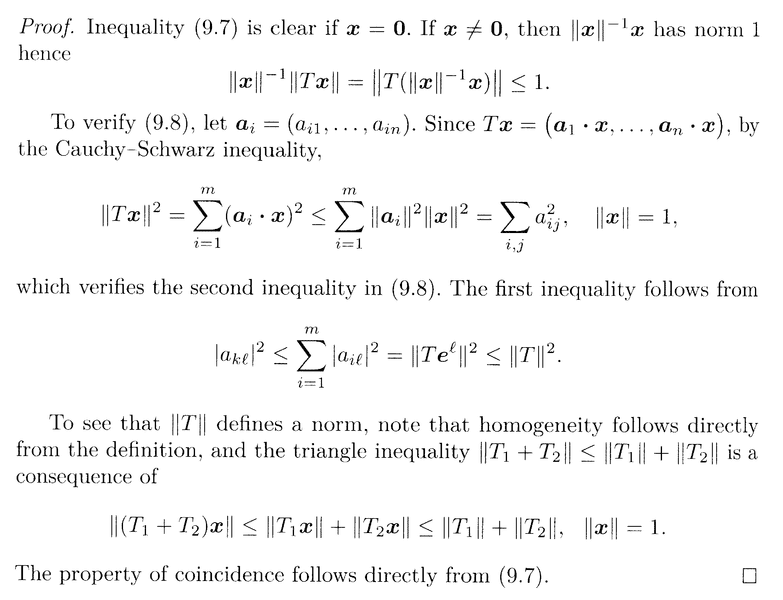
I need some help with the proof of Proposition 9.2.3 ...

Proposition 9.2.3 and the preceding relevant Definition 9.2.2 read as follows:
View attachment 221403
View attachment 221404

In the above proof Junghenn let's ##\mathbf{a}_i = ( a_{i1}, a_{i2}, \ ... \ ... \ , a_{in} ) ##

and then states that##T \mathbf{x} = ( \mathbf{a}_1 \cdot \mathbf{x}, \mathbf{a}_2 \cdot \mathbf{x}, \ ... \ ... \ , \mathbf{a}_n \cdot \mathbf{x} ) ## where ##\mathbf{x} = ( x_1, x_2, \ ... \ ... \ x_n )##(Note: Junghenn defines vectors in ##\mathbb{R}^n## as row vectors ... ... )Now I believe I can show ##T \mathbf{x}^t = [a_{ij} ]_{ m \times n } \mathbf{x}^t = ( \mathbf{a}_1 \cdot \mathbf{x}, \mathbf{a}_2 \cdot \mathbf{x}, \ ... \ ... \ , \mathbf{a}_n \cdot \mathbf{x} )^t ## ...

... ... as follows:##T \mathbf{x}^t = [a_{ij} ]_{ m \times n } \mathbf{x}^t = \begin{pmatrix} a_{11} & a_{12} & ... & ... & a_{1n} \\ a_{21} & a_{22} & ... & ... & a_{2n} \\ ... & ... & ... & ... & ... \\ ... & ... & ... & ... & ... \\ a_{m1} & a_{m2} & ... & ... & a_{mn} \end{pmatrix} \begin{pmatrix} x_1 \\ x_2 \\ . \\ . \\ x_n \end{pmatrix}####= \begin{pmatrix} a_{11} x_1 + a_{12} x_2 + \ ... \ ... \ + a_{1n} x_n \\ a_{21} x_1 + a_{22} x_2 + \ ... \ ... \ + a_{2n} x_n \\ ... \\ ... \\ a_{m1} x_1 + a_{m2} x_2 + \ ... \ ... \ + a_{mn} x_n \end{pmatrix}####= \begin{pmatrix} \mathbf{a}_1 \cdot \mathbf{x} \\ \mathbf{a}_2 \cdot \mathbf{x} \\ . \\ . \\ \mathbf{a}_n \cdot \mathbf{x} \end{pmatrix}##

##= ( \mathbf{a}_1 \cdot \mathbf{x}, \mathbf{a}_2 \cdot \mathbf{x}, \ ... \ ... \ , \mathbf{a}_n \cdot \mathbf{x} )^t ##

So ... I have shown##T \mathbf{x}^t = [a_{ij} ]_{ m \times n } \mathbf{x}^t = ( \mathbf{a}_1 \cdot \mathbf{x}, \mathbf{a}_2 \cdot \mathbf{x}, \ ... \ ... \ , \mathbf{a}_n \cdot \mathbf{x} )^t##...How do I reconcile or 'square' that with Junghenn's statement that##T \mathbf{x} = ( \mathbf{a}_1 \cdot \mathbf{x}, \mathbf{a}_2 \cdot \mathbf{x}, \ ... \ ... \ , \mathbf{a}_n \cdot \mathbf{x} )## where ##\mathbf{x} = ( x_1, x_2, \ ... \ ... \ x_n )##(Note: I don't think that taking the transpose of both sides works ... ?)
Hope someone can help ...

Peter
Proposition 9.2.3 does not seem to be displayed ... so I am reloading the image... as follows
Junghenn - 1 -  Proposition 9.2.3   ... PART 1  ... .png

Junghenn - 2 -  Proposition 9.2.3   ... PART 2   ... .png

Peter
 

Attachments

  • Junghenn - 1 -  Proposition 9.2.3   ... PART 1  ... .png
    Junghenn - 1 - Proposition 9.2.3 ... PART 1 ... .png
    29.9 KB · Views: 718
  • Junghenn - 2 -  Proposition 9.2.3   ... PART 2   ... .png
    Junghenn - 2 - Proposition 9.2.3 ... PART 2 ... .png
    35.9 KB · Views: 655
What you have written is correct. The mistake is not your calculation, but the interpretation of the text.
##T \in \mathcal{L}(\mathbb{R}^n,\mathbb{R}^m)## which says nothing about basis, coordinates or matrices. If we want to write it as such, with matrices and vectors, we have to make a choice:

Case 1:
$$ x \longmapsto x \cdot T = (x_1,\ldots ,x_n) \cdot \begin{bmatrix} a_{11} &\ldots &a_{1m} \\ \vdots && \vdots \\a_{n1} & \ldots & a_{nm} \end{bmatrix} = [x \cdot \begin{bmatrix}a_{1i} \\ \vdots \\ a_{ni}\end{bmatrix}]_i= \text{ row times column }$$

Case 2: $$ x \longmapsto T \cdot x = \begin{bmatrix} a_{11} &\ldots &a_{1n} \\ \vdots && \vdots \\a_{m1} & \ldots & a_{mn} \end{bmatrix} \cdot \begin{bmatrix} x_1 \\ \vdots \\ x_n \end{bmatrix}= [(a_{i1}, \ldots , a_{in}) \cdot x ]_i= \text{ row times column }$$

In both cases we have "row times column", because this is how matrices are multiplied. It doesn't change.

In the first case, we have ##T \in \mathbb{M}(n,m,\mathbb{R})##, i.e.##T## is represented by an ##(n \times m)-## matrix, if we apply row vectors from the left on the matrix of ##T##. Some authors prefer this convention as ##\mathcal{L}(\mathbb{R}^n,\mathbb{R}^m)## has the same order as ##\mathbb{M}(n,m,\mathbb{R})\,.##

In the second case, we have ##T \in \mathbb{M}(m,n,\mathbb{R})##, i.e.##T## is represented by an ##(m \times n)-## matrix, if we apply column vectors from the right on the matrix of ##T##. This is the more common notations, although ##\mathcal{L}(\mathbb{R}^n,\mathbb{R}^m)## and ##\mathbb{M}(m,n,\mathbb{R})## reversed the order of ##n## and ##m##.

The difference is not ##T##, because we haven't changed the linear transformation at all. The difference is how we write it in matrix form, how ##T## is represented by a matrix.

Now Junghenn writes it the same way as you did: vectors on the right, but as column. He did not choose row vectors here, in fact he didn't even care about it. On the right ##x## is automatically a column, and ##x^\tau## a row. Even the notation ##\mathbf{a_i} \cdot \mathbf{x}## is row times column, so it should have been ##\mathbf{a_i}^\tau \cdot \mathbf{x}##, resp. vice versa if really written as rows with probably hundreds of ##{}^\tau## throughout the book, but as it is clear, I'd say it's a forgivable sloppiness here. As long as you write ##T\cdot x## then it better should be meant as a column, for otherwise it would have to be ##T\cdot x^\tau##. However, here's the crux: As long as I write ##Tx## I have no matrices nor vector components, only a linear transformation on an element of a vector space, so I don't have to bother, how you like to represent them in coordinates: the transposition mark isn't needed! But the proof is about coordinates, so the point at which it switches from a general concept to a coordinate based concept isn't quite clear and some transposition marks may have been forgotten.

Long story short:
  • your calculation is right
  • it's always row times column
  • we have a choice whether ##x \mapsto T(x)## is represented by "coordinates of ##T##" times "coordinates of ##x##" or by "coordinates of ##x##" times "coordinates of ##T##"
  • ##x \mapsto T \cdot x## in coordinates means ##x## is a column vector
  • strictly speaking we have a little sloppy notation as the vector product is ##a_i \cdot x := \langle a_i ,x \rangle = a_i^\tau \cdot x## with columns
  • ##(T\cdot x)^\tau = x^\tau T^\tau \neq x^\tau T##
And now I hope I haven't confused ##n,m##, left, right, row, column, ##{}^\tau,{}^{no\,\, \tau}## or anything else which can be confused. Btw. this is one reason why I don't like coordinates. Much too much business about nothingness!
 
Last edited:
  • Like
Likes   Reactions: Math Amateur
Thanks fresh_42 ...

Most helpful ... would never have understood that from the text ...

THanks again ...

Peter
 
Math Amateur said:
Thanks fresh_42 ...

Most helpful ... would never have understood that from the text ...

THanks again ...

Peter
I just saw, that I did confuse the notation a bit the way I wrote the vectors in the cases - of course o_O - and I hope I corrected it now without making even more mistakes. Now the rule for notation is: Case 1 means the vectors which are not explicitly written, i.e. only by ##"x"## are rows, and in case 2 they are columns.
 
Math Amateur said:
Thanks fresh_42 ...

Most helpful ... would never have understood that from the text ...

THanks again ...

Peter
Yes, you want the product ##VW## (with ##V,W## as ## n \times 1 ##, resp. ## 1 \times k ## matrices) to be a scalar. Then you want ##VW## to be a ## 1 \times 1 ## matrix. As Fresh pointed out, matrix dimension is given by ## (m \times n )(n \times p)##= ## m \times p ##.
 
  • Like
Likes   Reactions: Math Amateur
WWGD said:
A good trick is to use " Dimensionality": you want your product of matrices ( incl. vectors as ## n \times 1 ## matrices) to be a scalar. Then you want ##VW## to be a ## 1 \times 1 ## matrix.
... and ##(n \times m) \cdot (m \times p) = (n \times p)##.
 
  • Like
Likes   Reactions: Math Amateur
fresh_42 said:
... and ##(n \times m) \cdot (m \times p) = (n \times p)##.
Yes, sorry, I was about to edit that in.
 
  • Like
Likes   Reactions: Math Amateur

Similar threads

Replies
2
Views
2K
Replies
5
Views
2K
  • · Replies 3 ·
Replies
3
Views
2K
Replies
19
Views
3K
  • · Replies 3 ·
Replies
3
Views
3K
  • · Replies 4 ·
Replies
4
Views
2K
  • · Replies 2 ·
Replies
2
Views
4K
  • · Replies 9 ·
Replies
9
Views
2K
Replies
2
Views
2K
  • · Replies 3 ·
Replies
3
Views
2K