Norm of a Linear Transformation .... Junghenn Propn 9.2.3 ....

Click For Summary

Discussion Overview

The discussion revolves around the proof of Proposition 9.2.3 from Hugo D. Junghenn's "A Course in Real Analysis," specifically focusing on the properties of norms in the context of linear transformations and the implications of homogeneity. Participants seek clarification on the relationships between norms and linear transformations, particularly in the context of rescaling and operator norms.

Discussion Character

  • Technical explanation
  • Conceptual clarification
  • Debate/contested

Main Points Raised

  • One participant questions how the equality ##\| \mathbf{x} \|^{-1} \| T \mathbf{x} \| = \| T ( \| \mathbf{x} \|^{-1} \mathbf{x} ) \|## holds under the norm sign, suggesting that the homogeneity of the exponent might play a role.
  • Another participant elaborates on the homogeneity of the 2-norm, providing a detailed breakdown of how scaling a vector by a constant affects its norm.
  • Concerns are raised regarding the assumption that the operator norm of ##T## is 1, with a participant providing a counterexample involving a diagonal matrix to illustrate that the statement may not hold without this assumption.
  • A later reply suggests that if the discussion is limited to vectors with norm 1, then substituting these vectors might clarify the equality in question.

Areas of Agreement / Disagreement

Participants express differing views on the validity of the statements regarding norms and linear transformations, with no consensus reached on the assumptions necessary for the propositions to hold true.

Contextual Notes

There are unresolved assumptions regarding the operator norm of the transformation ##T## and the conditions under which the equality involving norms is valid. The discussion highlights the need for clarity on these points.

Math Amateur
Gold Member
MHB
Messages
3,920
Reaction score
48
I am reading Hugo D. Junghenn's book: "A Course in Real Analysis" ...

I am currently focused on Chapter 9: "Differentiation on ##\mathbb{R}^n##"

I need some help with the proof of Proposition 9.2.3 ...

Proposition 9.2.3 and the preceding relevant Definition 9.2.2 read as follows:
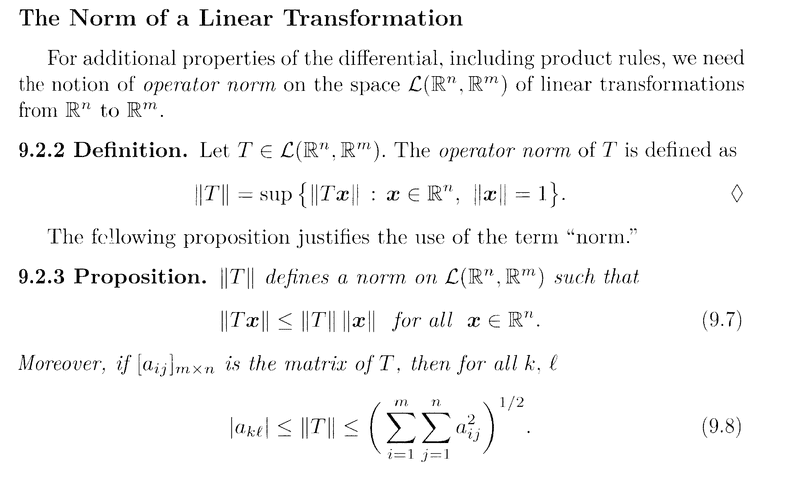
Junghenn - 1 -  Proposition 9.2.3   ... PART 1  ... .png

Junghenn - 2 -  Proposition 9.2.3   ... PART 2   ... .png

In the above proof we read the following:

" ... ... If ##\mathbf{x} \neq \mathbf{0} \text{ then } \| \mathbf{x} \|^{-1} \mathbf{x}## has a norm ##1##, hence

##\| \mathbf{x} \|^{-1} \| T \mathbf{x} \| = \| T ( \| \mathbf{x} \|^{-1} \mathbf{x} ) \| \le 1## ... ... "
Now I know that ##T( c \mathbf{x} ) = c T( \mathbf{x} )##

... BUT ...

... how do we know that this works "under the norm sign" ...

... that is, how do we know ...##\| \mathbf{x} \|^{-1} \| T \mathbf{x} \| = \| T ( \| \mathbf{x} \|^{-1} \mathbf{x} ) \|##... and further ... how do we know that ...##\| T ( \| \mathbf{x} \|^{-1} \mathbf{x} ) \| \le 1##

Help will be appreciated ...

Peter
 

Attachments

  • Junghenn - 1 -  Proposition 9.2.3   ... PART 1  ... .png
    Junghenn - 1 - Proposition 9.2.3 ... PART 1 ... .png
    27.5 KB · Views: 1,297
  • Junghenn - 2 -  Proposition 9.2.3   ... PART 2   ... .png
    Junghenn - 2 - Proposition 9.2.3 ... PART 2 ... .png
    34.3 KB · Views: 1,142
Physics news on Phys.org
Math Amateur said:
Now I know that ##T( c \mathbf{x} ) = c T( \mathbf{x} )##

... BUT ...

... how do we know that this works "under the norm sign" ...

... that is, how do we know ...##\| \mathbf{x} \|^{-1} \| T \mathbf{x} \| = \| T ( \| \mathbf{x} \|^{-1} \mathbf{x} ) \|##

The idea is homogeneity of the the exponent.

Look at the 2 norm of some vector ##\mathbf v## (it can be any vector, including perhaps ##\mathbf v := T \mathbf x##

##\big \Vert \mathbf v \big \Vert_2 = \big(\sum_{i=1}^n v_i^2\big)^\frac{1}{2}##

thus, in your case with some ##c \gt 0##

##c \big \Vert \mathbf v \big \Vert_2 = c \big(\sum_i v_i^2\big)^\frac{1}{2} = \big(\sum_i c^2 v_i^2\big)^\frac{1}{2} = \big(\sum_i (c v_i)^2\big)^\frac{1}{2} = \big \Vert c \mathbf v \big \Vert_2##

Keep an eye for this sort of homogeneity -- it comes up all the time in inequalities.
Math Amateur said:
... and further ... how do we know that ...

##\| T ( \| \mathbf{x} \|^{-1} \mathbf{x} ) \| \le 1##

I either didn't read the question close enough, or something is missing. My inference is they rescaled such that ##T## has an operator norm of 1 here -- but I didn't catch where that was done. If said rescaling wasn't done, the statement in general is not true. For example, consider a diagonal matrix ##T## where ##T_{1,1} = 5## and all other diagonal entries are one -- then apply the argument where ##\mathbf x = \mathbf e_1## i.e. the first standard basis vector -- the result is 5, not 1. But again I think there was a rescaling / Without Loss of Generality assumption that I missed somewhere.
 
  • Like
Likes   Reactions: Math Amateur
StoneTemplePython said:
The idea is homogeneity of the the exponent.

Look at the 2 norm of some vector ##\mathbf v## (it can be any vector, including perhaps ##\mathbf v := T \mathbf x##

##\big \Vert \mathbf v \big \Vert_2 = \big(\sum_{i=1}^n v_i^2\big)^\frac{1}{2}##

thus, in your case with some ##c \gt 0##

##c \big \Vert \mathbf v \big \Vert_2 = c \big(\sum_i v_i^2\big)^\frac{1}{2} = \big(\sum_i c^2 v_i^2\big)^\frac{1}{2} = \big(\sum_i (c v_i)^2\big)^\frac{1}{2} = \big \Vert c \mathbf v \big \Vert_2##

Keep an eye for this sort of homogeneity -- it comes up all the time in inequalities.

I either didn't read the question close enough, or something is missing. My inference is they rescaled such that ##T## has an operator norm of 1 here -- but I didn't catch where that was done. If said rescaling wasn't done, the statement in general is not true. For example, consider a diagonal matrix ##T## where ##T_{1,1} = 5## and all other diagonal entries are one -- then apply the argument where ##\mathbf x = \mathbf e_1## i.e. the first standard basis vector -- the result is 5, not 1. But again I think there was a rescaling / Without Loss of Generality assumption that I missed somewhere.
Thanks StoneTemplePython ...

Appreciate your help ...

Peter
 
Math Amateur said:
I am reading Hugo D. Junghenn's book: "A Course in Real Analysis" ...

I am currently focused on Chapter 9: "Differentiation on ##\mathbb{R}^n##"

I need some help with the proof of Proposition 9.2.3 ...

Proposition 9.2.3 and the preceding relevant Definition 9.2.2 read as follows:
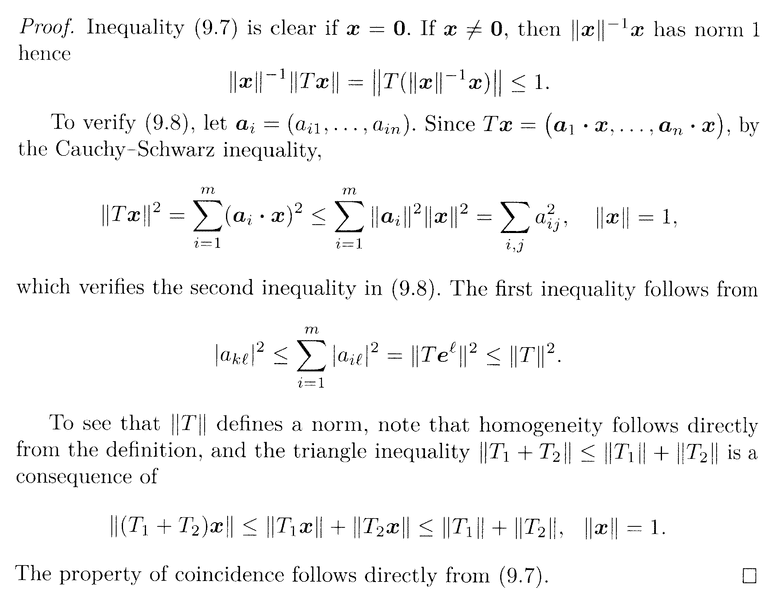
View attachment 221315
View attachment 221316
In the above proof we read the following:

" ... ... If ##\mathbf{x} \neq \mathbf{0} \text{ then } \| \mathbf{x} \|^{-1} \mathbf{x}## has a norm ##1##, hence

##\| \mathbf{x} \|^{-1} \| T \mathbf{x} \| = \| T ( \| \mathbf{x} \|^{-1} \mathbf{x} ) \| \le 1## ... ... "
Now I know that ##T( c \mathbf{x} ) = c T( \mathbf{x} )##

... BUT ...

... how do we know that this works "under the norm sign" ...

... that is, how do we know ...##\| \mathbf{x} \|^{-1} \| T \mathbf{x} \| = \| T ( \| \mathbf{x} \|^{-1} \mathbf{x} ) \|##..Peter

Aren't we working with the set of x with ||x||=1 ? Seems like subbing this in would show equality, if I did not miss something obvious.
 

Similar threads

Replies
5
Views
2K
Replies
2
Views
2K
  • · Replies 7 ·
Replies
7
Views
3K
Replies
2
Views
2K
  • · Replies 24 ·
Replies
24
Views
5K
  • · Replies 2 ·
Replies
2
Views
1K
  • · Replies 3 ·
Replies
3
Views
3K
  • · Replies 4 ·
Replies
4
Views
3K
  • · Replies 12 ·
Replies
12
Views
3K
  • · Replies 29 ·
Replies
29
Views
2K