Norm of a linear transformation under scalar multiplication

Join the discussion
Registration is free. Start your own thread to ask a follow-up.
3 replies · 2K views
Math Amateur
Gold Member
MHB
Messages
3,920
Reaction score
48
I am reading Hugo D. Junghenn's book: "A Course in Real Analysis" ...

I am currently focused on Chapter 9: "Differentiation on ##\mathbb{R}^n##"

I need some help with the proof of Proposition 9.2.3 ...

Proposition 9.2.3 and the preceding relevant Definition 9.2.2 read as follows:
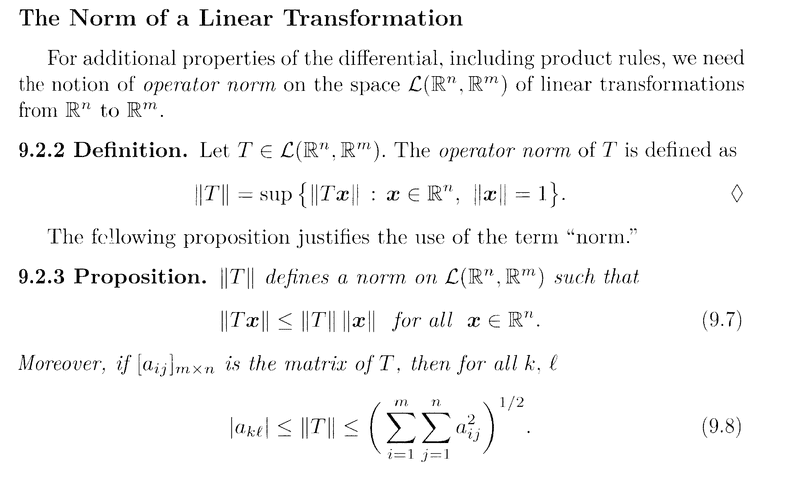
Junghenn - 1 -  Proposition 9.2.3   ... PART 1  ... .png

Junghenn - 2 -  Proposition 9.2.3   ... PART 2   ... .png

In the above proof we read the following:

" ... ... If ##\mathbf{x} \neq \mathbf{0} \text{ then } \| \mathbf{x} \|^{-1} \mathbf{x}## has a norm ##1##, hence

##\| \mathbf{x} \|^{-1} \| T \mathbf{x} \| = \| T ( \| \mathbf{x} \|^{-1} \mathbf{x} ) \| \le 1## ... ... "
Now I know that ##T( c \mathbf{x} ) = c T( \mathbf{x} )##

... BUT ...

... how do we know that this works "under the norm sign" ...

... that is, how do we know ...##\| \mathbf{x} \|^{-1} \| T \mathbf{x} \| = \| T ( \| \mathbf{x} \|^{-1} \mathbf{x} ) \|##... and further ... how do we know that ...##\| T ( \| \mathbf{x} \|^{-1} \mathbf{x} ) \| \le 1##

Help will be appreciated ...

Peter
 

Attachments

  • Junghenn - 1 -  Proposition 9.2.3   ... PART 1  ... .png
    Junghenn - 1 - Proposition 9.2.3 ... PART 1 ... .png
    27.5 KB · Views: 1,314
  • Junghenn - 2 -  Proposition 9.2.3   ... PART 2   ... .png
    Junghenn - 2 - Proposition 9.2.3 ... PART 2 ... .png
    34.3 KB · Views: 1,163
Physics news on Phys.org
Math Amateur said:
Now I know that ##T( c \mathbf{x} ) = c T( \mathbf{x} )##

... BUT ...

... how do we know that this works "under the norm sign" ...

... that is, how do we know ...##\| \mathbf{x} \|^{-1} \| T \mathbf{x} \| = \| T ( \| \mathbf{x} \|^{-1} \mathbf{x} ) \|##

The idea is homogeneity of the the exponent.

Look at the 2 norm of some vector ##\mathbf v## (it can be any vector, including perhaps ##\mathbf v := T \mathbf x##

##\big \Vert \mathbf v \big \Vert_2 = \big(\sum_{i=1}^n v_i^2\big)^\frac{1}{2}##

thus, in your case with some ##c \gt 0##

##c \big \Vert \mathbf v \big \Vert_2 = c \big(\sum_i v_i^2\big)^\frac{1}{2} = \big(\sum_i c^2 v_i^2\big)^\frac{1}{2} = \big(\sum_i (c v_i)^2\big)^\frac{1}{2} = \big \Vert c \mathbf v \big \Vert_2##

Keep an eye for this sort of homogeneity -- it comes up all the time in inequalities.
Math Amateur said:
... and further ... how do we know that ...

##\| T ( \| \mathbf{x} \|^{-1} \mathbf{x} ) \| \le 1##

I either didn't read the question close enough, or something is missing. My inference is they rescaled such that ##T## has an operator norm of 1 here -- but I didn't catch where that was done. If said rescaling wasn't done, the statement in general is not true. For example, consider a diagonal matrix ##T## where ##T_{1,1} = 5## and all other diagonal entries are one -- then apply the argument where ##\mathbf x = \mathbf e_1## i.e. the first standard basis vector -- the result is 5, not 1. But again I think there was a rescaling / Without Loss of Generality assumption that I missed somewhere.
 
  • Like
Likes   Reactions: Math Amateur
StoneTemplePython said:
The idea is homogeneity of the the exponent.

Look at the 2 norm of some vector ##\mathbf v## (it can be any vector, including perhaps ##\mathbf v := T \mathbf x##

##\big \Vert \mathbf v \big \Vert_2 = \big(\sum_{i=1}^n v_i^2\big)^\frac{1}{2}##

thus, in your case with some ##c \gt 0##

##c \big \Vert \mathbf v \big \Vert_2 = c \big(\sum_i v_i^2\big)^\frac{1}{2} = \big(\sum_i c^2 v_i^2\big)^\frac{1}{2} = \big(\sum_i (c v_i)^2\big)^\frac{1}{2} = \big \Vert c \mathbf v \big \Vert_2##

Keep an eye for this sort of homogeneity -- it comes up all the time in inequalities.

I either didn't read the question close enough, or something is missing. My inference is they rescaled such that ##T## has an operator norm of 1 here -- but I didn't catch where that was done. If said rescaling wasn't done, the statement in general is not true. For example, consider a diagonal matrix ##T## where ##T_{1,1} = 5## and all other diagonal entries are one -- then apply the argument where ##\mathbf x = \mathbf e_1## i.e. the first standard basis vector -- the result is 5, not 1. But again I think there was a rescaling / Without Loss of Generality assumption that I missed somewhere.
Thanks StoneTemplePython ...

Appreciate your help ...

Peter
 
Math Amateur said:
I am reading Hugo D. Junghenn's book: "A Course in Real Analysis" ...

I am currently focused on Chapter 9: "Differentiation on ##\mathbb{R}^n##"

I need some help with the proof of Proposition 9.2.3 ...

Proposition 9.2.3 and the preceding relevant Definition 9.2.2 read as follows:
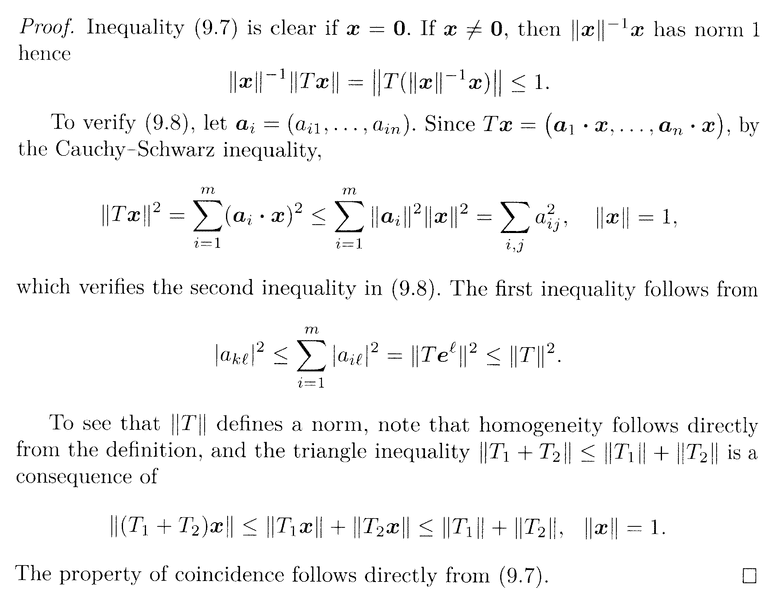
View attachment 221315
View attachment 221316
In the above proof we read the following:

" ... ... If ##\mathbf{x} \neq \mathbf{0} \text{ then } \| \mathbf{x} \|^{-1} \mathbf{x}## has a norm ##1##, hence

##\| \mathbf{x} \|^{-1} \| T \mathbf{x} \| = \| T ( \| \mathbf{x} \|^{-1} \mathbf{x} ) \| \le 1## ... ... "
Now I know that ##T( c \mathbf{x} ) = c T( \mathbf{x} )##

... BUT ...

... how do we know that this works "under the norm sign" ...

... that is, how do we know ...##\| \mathbf{x} \|^{-1} \| T \mathbf{x} \| = \| T ( \| \mathbf{x} \|^{-1} \mathbf{x} ) \|##..Peter

Aren't we working with the set of x with ||x||=1 ? Seems like subbing this in would show equality, if I did not miss something obvious.