Nuclear Spin and Selection Rules

Click For Summary

Discussion Overview

The discussion revolves around the selection rules for nuclear spin and electronic transitions, particularly in the context of angular momentum coupling. Participants explore the implications of these selection rules when considering transitions that involve both nuclear and electronic angular momentum, including specific examples and hypothetical scenarios.

Discussion Character

  • Debate/contested
  • Technical explanation
  • Conceptual clarification

Main Points Raised

  • Some participants propose that nuclear and electronic transitions are governed by different selection rules, suggesting that satisfying the nuclear selection rules does not necessarily imply that electronic selection rules must also be satisfied.
  • Others argue that in the presence of hyperfine interactions, the magnetic quantum number for electronic angular momentum (M_J) is not a good quantum number, complicating the discussion of its selection rules.
  • A participant points out that even states resulting from hyperfine splitting can be expressed as superpositions of M_J eigenstates, which individually fulfill the selection rules.
  • Another participant emphasizes that if a transition is allowed based on ΔM_F, it should also be allowed based on ΔM_J due to superposition, although this raises questions about specific cases where this may not hold true.
  • One participant introduces a scenario involving nuclear magnetic resonance, where transitions do not involve electronic changes, thus only the selection rules for nuclear spin apply.
  • Further discussion includes a detailed examination of specific absorption transitions, analyzing the implications of selection rules for both M_J and M_I quantum numbers.
  • Participants express confusion regarding the physical interpretation of selection rules when they appear to be satisfied for one quantum number but not the other in superposition states.

Areas of Agreement / Disagreement

Participants do not reach a consensus on whether the selection rules for nuclear and electronic transitions must be satisfied simultaneously. Multiple competing views remain regarding the implications of hyperfine interactions and the nature of superposition in relation to selection rules.

Contextual Notes

There are limitations in the discussion regarding the assumptions made about the independence of nuclear and electronic transitions, as well as the implications of hyperfine interactions on the validity of quantum numbers. The discussion also highlights the complexity of multi-step absorption processes and the role of superposition in satisfying selection rules.

Tainty
Messages
27
Reaction score
1
Suppose we define the total angular momentum as F = I+J where I is the nuclear spin angular momentum and J is the total electronic angular momentum. mF and mJ are the respective magnetic quantum numbers.

The relevant F selection rules are delta_mF = 0, 1 and -1, delta_F = 0, 1 and -1.
And similarly, the J selection rules are delta_mJ = 0, 1 and -1, delta_J = 0, 1 and -1.

My question is, when considering a transition involving nuclear spin, in addition to satisfying the delta_F and delta_mF selection rules, do we have to also satisfy the delta_J and delta_mJ selection rules at the same time?

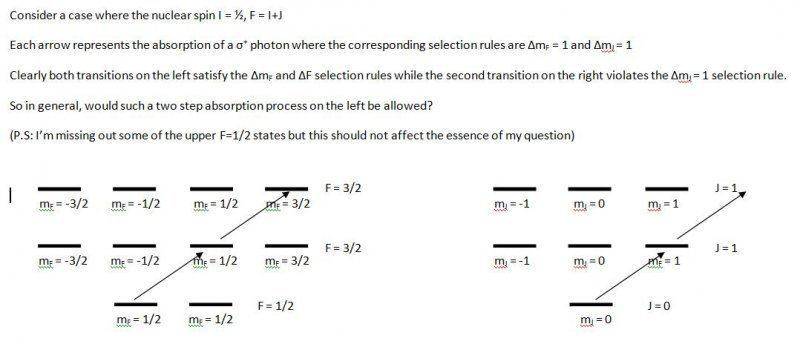
A specific example involving two successive transitions is attached. The transitions satisfy the delta_F and delta_mF selection rules but violate the delta_mJ selection rules. Would such a two step process be allowed or forbidden? I'd appreciate any insight. Thank you!
Untitled.jpg
 
I don't think so. Nuclear and electronic absorption are due to coupling of the em field to different systems (nuclear vs. electronic). Coupling to the nuclear part will in general not change the electronic wavefunction and vice versa.
 
In the presence of the hyperfine interaction, ##M_J## is no longer a good quantum number, i.e., you can't use it to label an eigenstate of the Hamiltonian. Therefore, it is meaningless to discuss ##\Delta M_J##. For instance, in your diagram on the right, absorption of a ##\sigma^+## photon does not anymore correspond to a ##\Delta M_J = +1## transition: because of the hyperfine interaction, you will get a mixture of ##M_J##'s.
 
But even the states resulting from hyperfine splitting can be written as superpositions of M_J eigenstates. These eigenstates then fulfill individually the selection rules.
 
DrDu said:
But even the states resulting from hyperfine splitting can be written as superpositions of M_J eigenstates. These eigenstates then fulfill individually the selection rules.
Yes, but the atom will generally be found in a superposition of ##M_J##'s to start with.

To make things clearer: if the transition is allowed when considering ##\Delta M_F##, it has to be allowed when considering ##\Delta M_J##. Within the ##| J, M_J \rangle## states that make up the initial state ##| F, M_F \rangle##, and within the ##| J', M_J' \rangle## states that make up the final state ##| F', M_F' \rangle##, if the transition has ##\Delta M_F =0,\pm1##, then there is at least one pair of ##| J, M_J \rangle## and ##| J', M_J' \rangle## for which ##\Delta M_J=0,\pm1##.
 
Thank you very much for those replies. Both of you hit the nail on the head in terms what I have been confused about.

I agree that if the transition is ΔmF allowed it should be automatically ΔmJ allowed based on superposition even though J and mJ are strictly no longer good quantum numbers. But this appears to contradict the scenario in the diagram I earlier attached. For a system with nuclear spin, the left figure would be ΔmF (+1) allowed but not correspondingly (right figure) ΔmJ allowed. Where is the flaw in my argument?

Thanks again!
 
Let's consider something simple, like nuclear magnetic resonance. There J and M_J doesn't change as there is no electronic transition at all, and ##\Delta F=\Delta I## with selection rules only for F and I. What I meant before, is that the interaction is proportional to ##d\cdot E## for electronic transitions and ##I\cdot B## for nuclear transitions, each with it's own selection rules for J and I, respectively. A transition is due to either the first or the second term, but not both of them at the same time.
 
Lets consider the first absorption. The atom goes from ##|F=1/2, M_F=-1/2\rangle## to ##|F=3/2, M_F=1/2\rangle##. Using the notation ##|I,M_I,J,M_J\rangle##, we have
\begin{align*}
|F=1/2, M_F=-1/2\rangle &= |1/2, -1/2, 0 , 0\rangle \\
|F=3/2, M_F=1/2\rangle &= \frac{1}{\sqrt{3}} |1/2, -1/2, 1 , 1\rangle + \sqrt{\frac{2}{3}} |1/2, 1/2, 1 , 0\rangle
\end{align*}
which is allowed since we have ##\Delta M_J = +1## from ##|1/2, -1/2, 0 , 0\rangle## to ##|1/2, -1/2, 1 , 1\rangle##.

In the second step, we have
\begin{align*}
|F=3/2, M_F=1/2\rangle &= \frac{1}{\sqrt{3}} |1/2, -1/2, 1 , 1\rangle + \sqrt{\frac{2}{3}} |1/2, 1/2, 1 , 0\rangle \\
|F=3/2, M_F=3/2\rangle &= |1/2, 1/2, 1 , 1\rangle \\
\end{align*}
which is allowed since we have ##\Delta M_J = +1## from ##|1/2, 1/2, 1 , 0\rangle## to ##|1/2, 1/2, 1 , 1\rangle##.

What you have to consider is that while you are doing only ##\sigma^+## transitions, the atom will not end up in purely the ##|1/2, -1/2, 1 , 1\rangle## state, as it is coupled by hyperfine interaction to ##|1/2, 1/2, 1 , 0\rangle##. Even if you were to prepare the atom in the state ##|1/2, -1/2, 1 , 1\rangle##, after a certain time you will have a significant superposition of the two states.
 
  • Like
Likes   Reactions: vanhees71
  • #10
That makes a lot of sense! Thanks folks. I will try to digest and understand this further.
 
  • #11
After further thought, I realize I have some difficulty reconciling a few issues, particularly with regards to a physical understanding of the entire picture.

Firstly, I realize that in my initial query, I had omitted any mention of the mI quantum number. Does its selection rules echo that of the mJ quantum number? (I am assuming that the answer to this is yes for the questions that follow, otherwise just ignore them.)

Secondly, I also realize that even though the mJ and mI selection rules are automatically satisfied due to superposition, each eigenstate does not satisfy BOTH at the same time, which is what DrDu pointed out earlier. This perhaps has been the real source of 'discomfort' and confusion for me. In some sense, i have difficulty accepting the fact that the selection rules are truly satisfied. This problem (or rather confusion) is exacerbated when i consider a multiple step absorption process, where, as DrClaude shows in his response to my example, the eigenstate that satisfies ΔmJ=+1 in the first step is NOT the eigenstate that satisfies ΔmJ=+1 in the second step.

Could any of you assist in providing further physical insight? Thank you!
 
  • #12
Maybe you could explain in some more detail which kind of experiment or system you are referring too?
 
  • #13
Hi DrDu, I am just trying to test my understanding of this topic, which pertains to the broader field of spin polarization, through various thought experiments. These questions arise as I try to improve my fundamental understanding of the topic.
 
  • #14
Yes, but I think it would be appropriate to analyze a concrete example (of your choice).
 
  • #15
Ok, suppose we consider the example that DrClaude expanded upon.

DrClaude said:
Lets consider the first absorption. The atom goes from |F=1/2,MF=−1/2⟩|F=1/2, M_F=-1/2\rangle to |F=3/2,MF=1/2⟩|F=3/2, M_F=1/2\rangle. Using the notation |I,MI,J,MJ⟩|I,M_I,J,M_J\rangle, we have
|F=1/2,MF=−1/2⟩|F=3/2,MF=1/2⟩=|1/2,−1/2,0,0⟩=13√|1/2,−1/2,1,1⟩+23−−√|1/2,1/2,1,0⟩​
\begin{align*} |F=1/2, M_F=-1/2\rangle &= |1/2, -1/2, 0 , 0\rangle \\ |F=3/2, M_F=1/2\rangle &= \frac{1}{\sqrt{3}} |1/2, -1/2, 1 , 1\rangle + \sqrt{\frac{2}{3}} |1/2, 1/2, 1 , 0\rangle \end{align*}
 
  • #16
In the 2nd equation, the first term (eigenstate) on the RHS satisfies ΔmJ=+1 but not ΔmI=+1 whereas the second term (eigenstate) on the RHS satisfies ΔmI=+1 but not ΔmJ=+1. In other words, the selection rules for both mJ and mI are not satisfied at the same time for each eigenstate. If this statement is true, what is the physical interpretation?

(P.S: Like I mentioned earlier, I'm assuming that the selection rules for mI are the same as those for mJ.)
 
  • #17
Tainty said:
In the 2nd equation, the first term (eigenstate) on the RHS satisfies ΔmJ=+1 but not ΔmI=+1 whereas the second term (eigenstate) on the RHS satisfies ΔmI=+1 but not ΔmJ=+1. In other words, the selection rules for both mJ and mI are not satisfied at the same time for each eigenstate. If this statement is true, what is the physical interpretation?

(P.S: Like I mentioned earlier, I'm assuming that the selection rules for mI are the same as those for mJ.)
The selection rule comes from conservation of angular momentum. If both ##M_I## and ##M_J## were changing here, then angular momentum would not be conserved. Only one ##\Delta M## can have a value of +1.
 

Similar threads

  • · Replies 18 ·
Replies
18
Views
2K
  • · Replies 11 ·
Replies
11
Views
2K
  • · Replies 3 ·
Replies
3
Views
4K
  • · Replies 6 ·
Replies
6
Views
2K
  • · Replies 7 ·
Replies
7
Views
2K
  • · Replies 4 ·
Replies
4
Views
4K
  • · Replies 1 ·
Replies
1
Views
2K
  • · Replies 1 ·
Replies
1
Views
2K
  • · Replies 2 ·
Replies
2
Views
1K
  • · Replies 5 ·
Replies
5
Views
1K