You need is not look at Surface Finish. You need to control of Form Error
We need to control Form Error caused by the production process. This is critical with respect to hydraulic seals, bearing load surfaces, mating surfaces of high accuracy, precision metal parts. Every ID and OD made by a machine tool will deviate from perfect roundness to some degree. You can expect lobing errors from 2 to 9 or more around the circumference of a production part. The spacing and number of lobes can be odd or even, regular or irregular and the height will vary as well.
Causes of Form Error - All surfaces of a typical OD are generated with reference to fixed points, axes or lines of contact in the machine tool, be it centerless grinding, lathe centers, steady rests, regulating wheels, tool edges, grinding wheel surfaces. These points of contact are constantly changing. Tool holders flex, there is imperfect rotation, erratic cutting dynamics, tooling wear, lubrication, rotational imbalance and wear, improper machine tool geometry, all contribute to error. Tool holders and holding fixtures slip, belts wear, drive rollers misalign, chucks distort, localized heating, excessive feed rates, and warped out of round stock all add to the mix.
Finally, it seems that the most common machine tool used, “centerless” Machine tools were designed to make out of round parts! They contact the production part at three points and almost always generate a 3,5 or 7 lobe part.
It should be noted that one could not effectively measure SIZE of high precision parts without knowing the Shape …i.e. effects of form deviation due to lobing error generated during the machining process. Knowing Form Error is mandatory, when assembling tight tolerance precision parts. The time-honored mistake of “ tightening up the Tolerance” will not cure the problem. Control of Form Error will reduce scrap, reduce rework, eliminate waste and save time and money.
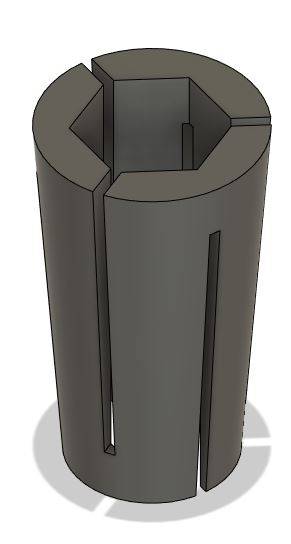
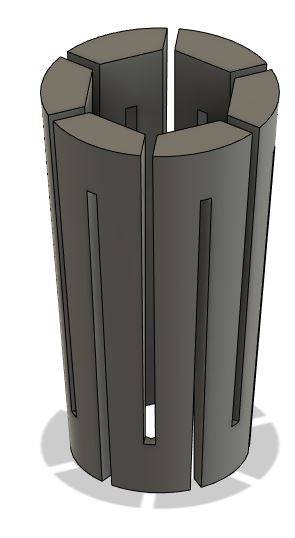
Short answer - the more slots in a collet will mean less deformation during the machining process and learn how to measure form error correctly. Micrometers and V blocks won't do it. Long answer is understand form error and this requires your additional work.