Obtaining a variable value from a 5-th degree polynomial in the tangent form

  • Context: Graduate 
  • Thread starter Thread starter baby_1
  • Start date Start date
  • Tags Tags
    Derivation Integral
Click For Summary

Discussion Overview

The discussion centers on obtaining the variable value ##\rho (\phi)## from a 5-th degree polynomial expressed in tangent form. Participants explore the methods for calculating ##\rho (\phi)## after determining the coefficients ##c_0## to ##c_5## of the polynomial ##\sigma (\phi)##, including the challenges associated with the integration required to solve the equation.

Discussion Character

  • Exploratory, Technical explanation, Debate/contested

Main Points Raised

  • One participant expresses difficulty in calculating ##\rho (\phi)## from the given equation, particularly in performing the integral.
  • Another participant suggests that the authors' implication of easily finding ##\rho (\phi)## may refer to numerical integration rather than analytical solutions.
  • There is a clarification regarding the FDIWO technique, with one participant stating it is an optimization algorithm rather than a numerical technique related to finite-difference or finite-element methods.
  • Participants discuss the possibility of using numerical methods to generate a table of ##\rho (\phi)## values for various ##\phi## values.
  • One participant confirms that the optimization is performed numerically, indicating a preference for numerical integration over analytical methods.

Areas of Agreement / Disagreement

Participants generally agree on the use of numerical methods for integration but express uncertainty regarding the authors' intended approach to obtaining ##\rho (\phi)##. The discussion reflects multiple viewpoints on the integration process and the nature of the FDIWO technique.

Contextual Notes

Participants note the need for limits of integration and the potential complexity of performing the integral for multiple values of ##\phi##. There is an acknowledgment of the challenges in obtaining a closed-form solution.

baby_1
Messages
159
Reaction score
16
TL;DR
The integral of a 5-th polynomial in the tangent form
Hello,

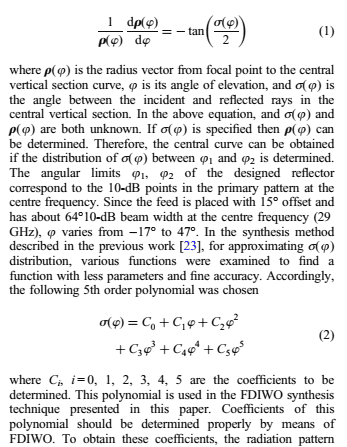
Please see this part of the article.
Pb4u7.png


I need to obtain the ##\rho (\phi)## value after obtaining the c0 to c5 constants of the ##\sigma (\phi)##. But as you can see after finding the coefficients, solving Eq.(1) could be a demanding job(I wasn't able to calculate the integral of Eq(1) and obtain the ##\rho (\phi)## ). I need to know how to find ##\rho (\phi)## values for different ##\phi## values.

$$\frac{1}{\rho (\phi )}\frac{d\rho (\phi)}{d\phi}= \\
tan(\frac{c_{0}+c_{1}\phi+c_{2}\phi^2+c_{3}\phi^3+c_{4}\phi^4+c_{5}\phi^5}{2})=>
\\ln(\rho (\phi ))=\int (tan(\frac{c_{0}+c_{1}\phi+c_{2}\phi^2+c_{3}\phi^3+c_{4}\phi^4+c_{5}\phi^5}{2})d\phi)$$

Or, I follow the wrong way.

The writers implied that after finding the ##\sigma (\phi)## the ##\rho (\phi)## could find easily.
 
Physics news on Phys.org
baby_1 said:
The writers implied that after finding the ##\sigma (\phi)## the ##\rho (\phi)## could find easily.
Your derived equation looks correct, provided you add the appropriate limits of integration. But I'm not convinced that the authors' "find easily" implication refers to performing the integration analytically in closed form. Instead, they may intend the integral to be performed numerically, which looks to be pretty straight forward once you have the values of the six C coefficients. The C's are apparently found from something called the "FDIWO synthesis technique". Is FDIWO a numerical technique involving something like FDTD or finite-elements? If so, that would suggest also using a numerical approach to evaluate your integral.
 
  • Like
Likes   Reactions: baby_1
I appreciate your help.
Yes, I don't understand how they obtain ##\rho (\phi)## for different values of ##\phi## -because this equation should be solved for many values of ##\phi##.

No, the FDIWO is the acronym of frequency-dependent IWO- an optimization algorithm to find the C0 to Cn values-.
 
Last edited:
baby_1 said:
Yes, I don't understand they obtain ##\rho (\phi)## for different values of ##\phi## -because this equation should be solved for many values of ##\phi##.
With a computer you can perform this integration repeatedly and rapidly to generate a numerical table of ##\rho (\phi)## values.
baby_1 said:
No, the FDIWO is the acronym of frequency-dependent IWO- an optimization algorithm to find the C0 to Cn values-.
But my question was how this optimization is performed: analytically or numerically? Either way, once you have the C's, use repeated numerical integration to get your table of values.
 
  • Like
Likes   Reactions: baby_1
Thank you very much for your response. Yes, the optimization is performed numerically. So it means I should use the numerical form of the above equation instead of the analytical form.
 
  • Like
Likes   Reactions: renormalize

Similar threads

  • · Replies 1 ·
Replies
1
Views
2K
  • · Replies 0 ·
Replies
0
Views
2K
  • · Replies 3 ·
Replies
3
Views
822
  • · Replies 5 ·
Replies
5
Views
1K
Replies
4
Views
2K
Replies
4
Views
839
  • · Replies 5 ·
Replies
5
Views
1K
  • · Replies 1 ·
Replies
1
Views
693
  • · Replies 33 ·
2
Replies
33
Views
3K
  • · Replies 34 ·
2
Replies
34
Views
3K