Obtaining the Orbit equation (Effective Potential) from the Newtonian metric

Click For Summary
SUMMARY

The discussion focuses on deriving the orbit equation and effective potential from the Newtonian metric, specifically the form $$ds^2 = -(1 - 2M/r)dt^2 + (1+2M/r)[dr^2 + r^2d\Omega^2]$$. Participants clarify the relationship between the Newtonian metric and the Schwarzschild metric, emphasizing the need to derive the effective potential energy using constants of motion such as energy per unit mass $$\tilde{E}$$ and angular momentum per unit mass $$\tilde{L}$$. The final solution simplifies the equation to $$-1 = -(1-2M/r)^{-1}e^2 + (1+2M/r)[(u^r)^2 + l^2/r^2]$$, allowing for further analysis of orbits in the Newtonian approximation.

PREREQUISITES
  • Understanding of the Schwarzschild metric and its implications in general relativity.
  • Familiarity with constants of motion in gravitational systems, specifically energy and angular momentum.
  • Knowledge of the Euler-Lagrange equations and their application in deriving equations of motion.
  • Basic understanding of effective potential energy in gravitational contexts.
NEXT STEPS
  • Study the derivation of orbits in the Schwarzschild metric using the effective potential approach.
  • Learn about the Euler-Lagrange equations and their application in general relativity.
  • Explore the concept of maximal aging and its relevance to geodesics in curved spacetime.
  • Review resources on gravitational orbits, such as the textbook "Gravitation" by Misner, Thorne, and Wheeler (MTW).
USEFUL FOR

Students and researchers in theoretical physics, particularly those focusing on general relativity, gravitational dynamics, and the mathematical formulation of orbits in curved spacetime.

Arman777
Insights Author
Gold Member
Messages
2,163
Reaction score
191
We can write the Newtonian metric in the form of

$$ds^2 = -(1 - 2M/r)dt^2 + (1+2M/r)[dr^2 + r^2d\Omega^2]$$

In order to obtain the orbit equation I have written the constant of motion,

$$e = (1 - 2M/r)(\frac{dt}{d\tau})$$

and

$$l = r^2sin^2(\theta)(\frac{d\phi}{d\tau})$$

I can divide the metric to $$d \tau^2$$ and write

$$(\frac{ds}{d\tau})^2 = -(1 - 2M/r)(\frac{dt}{d\tau})^2 + (1+2M/r)[(\frac{dr}{d\tau})^2 + r^2((\frac{d\theta}{d\tau})^2 + r^2sin^2(\theta)(\frac{d\phi}{d\tau})^2]$$

by using ##e## and ##l##, and from the initial conditions we know that ##(\frac{d\theta}{d\tau}) = 0## for ##\theta = \pi /2 ##

$$-1 = -(1-2M/r)^{-1}e^2 + (1+2M/r)[(u^r)^2 + l^2/r^2]$$

where ##(u^r)^2 = (\frac{dr}{d\tau})^2##

I want to format this equation in such a way that I would obtain similar to

$$ e^2 = \frac{1}{2} (u^r)^2 + \text{terms}$$

where some terms will give the effective potential energy.

Here is a version of it done for the Schwarzschild Metric
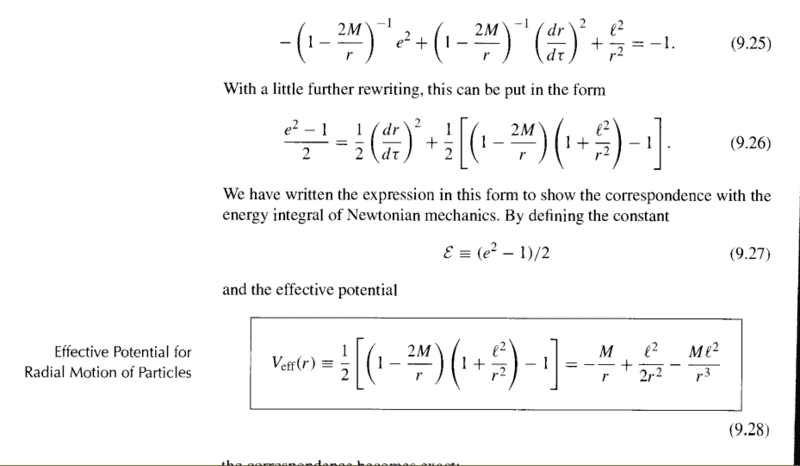
1621793523847.png
 
Last edited:
Physics news on Phys.org
Arman777 said:
We can write the Newtonian metric in the form of

$$ds^2 = -(1 - 2M/r)dt^2 + (1+2M/r)[dr^2 + r^2d\Omega^2]$$
Surely, that's the Schwarzschild metric?
Arman777 said:
In order to obtain the orbit equation I have written the constant of motion,

$$e = (1 - 2M/r)(\frac{dt}{d\tau})^2$$

and

$$l = r^2sin^2(\theta)(\frac{d\phi}{d\tau})^2$$
I believe that's also incorrect - it doesn't match my text.

$$\tilde{E} = (1-2M/r) \frac{dt}{d\tau} \quad \tilde{L} = r^2 \frac{d\phi}{d\tau}$$

Here ##\tilde{E}## is energy/unit mass, and ##\tilde{L}## is angular momentum per unit mass.

See for instance https://www.fourmilab.ch/gravitation/orbits/, or the textbook from which it is sourced, MTW's "Gravitation".

I'm also not quite sure of your question - if you fix these errors, you'll get motion in the Schwarzschild geometry, but you seem to be asking about a "Newtonian" something. So I wouldn't be surprised if you're struggling, but I don't know what you're looking for.
 
pervect said:
Surely, that's the Schwarzschild metric?
It's the Schwarzschild metric in isotropic coordinates in the "near Newtonian" limit, where we ignore terms of second or higher order in ##M / r## (which is assumed to be small).
 
  • Like
Likes   Reactions: vanhees71
Arman777 said:
We can write the Newtonian metric
Yes, we can, but why do you need to? This metric is just an approximation, but the exact metric in question, the Schwarzschild metric, can be solved exactly for orbit equations and effective potential, as you note in your post. So why not just do that?
 
  • Like
Likes   Reactions: vanhees71
pervect said:
Surely, that's the Schwarzschild metric?

I believe that's also incorrect - it doesn't match my text.

$$\tilde{E} = (1-2M/r) \frac{dt}{d\tau} \quad \tilde{L} = r^2 \frac{d\phi}{d\tau}$$

Here ##\tilde{E}## is energy/unit mass, and ##\tilde{L}## is angular momentum per unit mass.

See for instance https://www.fourmilab.ch/gravitation/orbits/, or the textbook from which it is sourced, MTW's "Gravitation".

I'm also not quite sure of your question - if you fix these errors, you'll get motion in the Schwarzschild geometry, but you seem to be asking about a "Newtonian" something. So I wouldn't be surprised if you're struggling, but I don't know what you're looking for.

I have fixed some of them. I am trying to find the Newtonian effective potential from the given Newtonian metric.
 
PeterDonis said:
Yes, we can, but why do you need to? This metric is just an approximation, but the exact metric in question, the Schwarzschild metric, can be solved exactly for orbit equations and effective potential, as you note in your post. So why not just do that?
It's kind o homework...I need to derive the photons and timelike particle's orbit in the Newtonian metric. I tried to calculate the timelike particles' orbit using the method that I did in post 1, but I am stuck.

I mean I need to follow the original steps..
 
You get the most simple form of the EoM in terms of arbitrary affine parameters using the Euler-Lagrange equations of the Lagrangian
$$L=\frac{1}{2} g_{\mu \nu} \dot{x}^{\mu} \dot{x}^{\nu}.$$
Then automatically ##L=\text{const}## along the world line. For massive particles you can choose this constant 1 (then the affine parameter is proper time). For massless "particles" ##L=0##, and you must live with an arbitrary affine parameter.
 
  • #10
Can you tell us where you're getting stuck exactly? It's literally the same procedure as you would for schwartzschild metric since you're using Killing Vectors, if you aren't comfortable with using them (which I believe you should be since you've identified them), then start here: http://sites.science.oregonstate.edu/physics/coursewikis/GGR/book/ggr/symmetries.html

Go through the examples, then hit up:
http://sites.science.oregonstate.edu/physics/coursewikis/GGR/book/ggr/orbits.html
http://sites.science.oregonstate.edu/physics/coursewikis/GGR/book/ggr/onull.html

If you've understood all this, then we'll need to know where exactly you're getting stuck since it really isn't obvious.

EDIT: Didn't see Vanhees reply, but that is a different way to derive the EOM (more efficient), but I prefer this way since it's more intuitive for me. But, don't feel like you have to use my way or his way, since you're young, try both!
 
  • #11
An alternative to Killing vectors for trajectories of massive objects (which must have timelike worldlines) is the slightly oversimplified idea of the principle of maximal aging, which happens to be one of my favorite approaches.

This ties into vanhees71's post as
$$g_{\mu\nu} \dot{x}^\mu \dot{x}^\nu$$

is the square of the proper time, with possible sign differfences depending on sign conventions. The Lagrangian for the case of a timelike worldline of a free particle is proportional to the proper time of the worldline. The proportionality constant is negative, so the principle of least action (most negative Lagrangian) becomes the principle of maximal aging, the maximum proper time.

There are some subtle points I've glossed over, involving why vanheese71 used the square of the proper time, and I did not. To gloss over and oversimplify, it turns out the math is a lot easier by taking the square of the proper time as the Lagrangian, and this is acceptable for an affinely paramaterized geodesic.

Energy and angular momentum conservation come into play when the equations of motion of the free particle have the specialized formulations ##dE/d\tau=0## and ##dL/d\tau=0##, which applies in the case we are considering, the Schwarzschild case.

I'm afraid that the multiplicity of possible approaches may confuse the OP, but I'm not sure what the best way to handle it is. It's a question of whether it's better to stick with an approach from a textbook and make it work, or to take possibly a different approach that may be more appealing and fit the OP's background better.

Maximal aging, more precisely extremal aging, is appealing for the relatively modest background knowledge requirments, but it may not match the OP's textbook reference.

E.F. Taylor has a webpage with some resources for the "action" approach to physics at https://www.eftaylor.com/leastaction.html. "Exploring black holes", of which Taylor is a co-author, uses the principle of maximal aging, though I don't own a copy.
 
  • Like
Likes   Reactions: vanhees71
  • #12
pervect said:
though I don't own a copy.
Free for download from Taylor's website if you want one. Fair warning - I think it's a scanned copy, so it's a big file.
 
  • Like
Likes   Reactions: vanhees71
  • #13
I solved the problem. Guys the solution is really simple.

$$-1 = -(1-2M/r)^{-1}e^2 + (1+2M/r)[(u^r)^2 + l^2/r^2]$$

just turn ##(1-2M/r)^{-1}## into ##(1+2M/r)## and proceed
 
  • Like
Likes   Reactions: vanhees71

Similar threads

  • · Replies 5 ·
Replies
5
Views
1K
  • · Replies 5 ·
Replies
5
Views
3K
  • · Replies 8 ·
Replies
8
Views
721
  • · Replies 8 ·
Replies
8
Views
3K
Replies
5
Views
876
  • · Replies 11 ·
Replies
11
Views
2K
  • · Replies 11 ·
Replies
11
Views
2K
  • · Replies 0 ·
Replies
0
Views
2K
  • · Replies 4 ·
Replies
4
Views
2K
  • · Replies 18 ·
Replies
18
Views
4K