Off-set Coaxial Cable - Capacitance

3 replies · 9K views · last reply
thedean515
Messages
11
Reaction score
0
Hi,

As you know the capacitance per unit length of a standard coaxial cable is

[tex]C_{coax} = \frac{2 \pi \varepsilon_{0} \varepsilon_{r}}{\ln{\frac{b}{a}}}[/tex]

where b is the radius of the cable and a is radius of the central conductor.
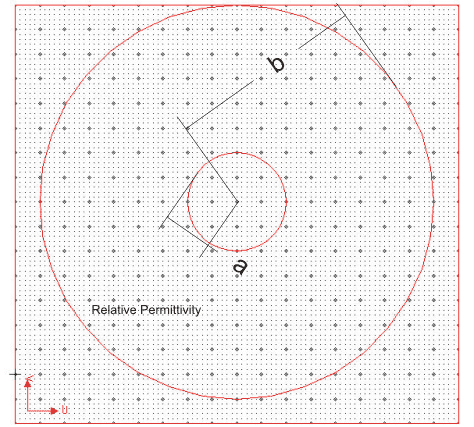
Cross-section of a coaxial cable with an off-centre inner conductor: a large red outer circle labelled b, a smaller red inner circle labelled a placed away from the centre, over a grid of dots marked Relative Permittivity.
.

If we only want to know the capacitance of a quarter of the cable, it is just [tex]\frac{1}{4}C_{coax}[/tex]

What if the cental conductor is off-set, how can we calculate the capacitance? Especiall I am interest to know the capacitance for only a quarter of the cable.

The off-set coax cable case is:
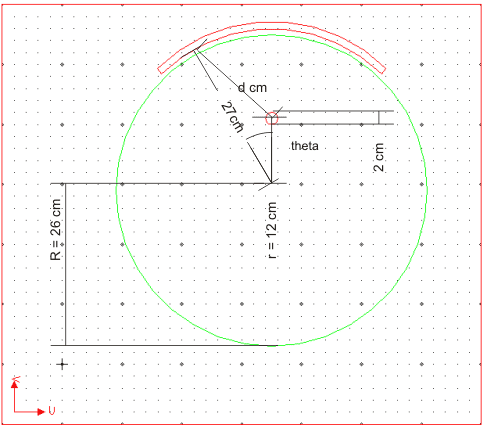
Cross-section diagram of an off-set coaxial cable on a dot grid: outer red circle of radius R = 26 cm, green inner conductor circle of radius r = 12 cm centred 2 cm off-centre, with d and theta marked from the outer centre to the inner centre, and a 27 cm dimension.
 
part soultion

Hi,

Just to remind you the calculation for the coaxial cable case.

The electric field of an infinite line of charge is given

[tex]E = \frac{D}{\epsilon_0 \epsilon_r} = \hat{r} \frac{\rho_l}{2 \pi \epsilon_0 \epsilon_r r}[/tex]

in radial direction.


[tex]V = -\int_a^b Edl = \frac{Q}{2 \pi \epsilon_0 \epsilon_r}ln \frac{b}{a}[/tex]

Finally,

[tex]C = \frac{Q}{V} = \frac{2 \pi \epsilon_0 \epsilon_r}{ln \frac{b}{a}}[/tex]
 
boy, that is difficult (for me anyway, I am probably at a similar level to you.)

As you said,

[tex]C = \frac{Q}{V}[/tex]

and, Q doesn't change depending on where you stick the inner conductor, right? I think this is right.

The trouble is really the voltage. The capacitance of a coax cable is the capacitance between the inner and outer conductors, right? The only reason you can say something as simple as, "this cable's capacitance is 6pF/meter.", is because the conductor is square in the middle.

Clearly, from the integral, Voltage (and therefore capacitance) changes as the conductors get further apart.

For this example, that means that the capacitance of the line will vary depending on how you're looking at it, do you know what I mean? You won't just be able to say, this is a 6pF line. If you draw the cable on a coordinate axis, the capacitance will vary in theta.

In short, find a function (of theta) that relates the distance from a to b. Integrate Edl from a to this function. the final answer will depend on theta.

I think.
 
Last edited: