On-Axis Field of a Uniformly Magnetized Sphere

  • Thread starter Thread starter Luke Tan
  • Start date Start date
  • Tags Tags
    Field Sphere
Click For Summary
SUMMARY

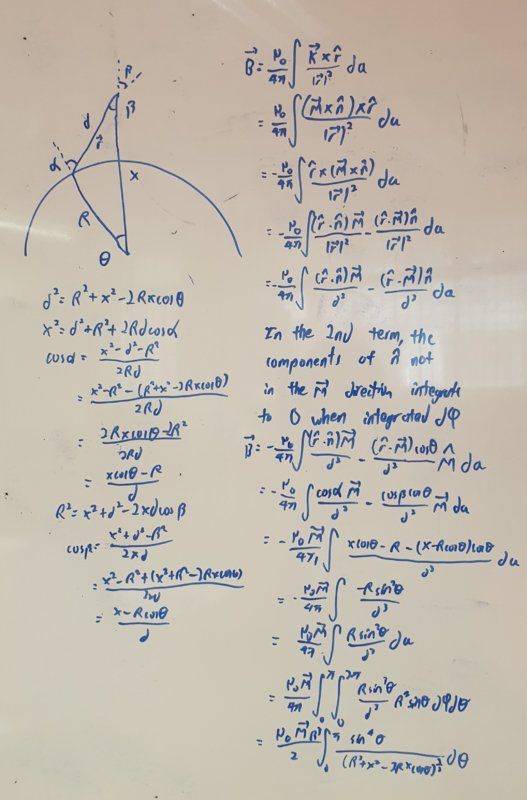
The discussion focuses on calculating the on-axis magnetic field of a uniformly magnetized sphere using the Biot-Savart law. The initial approach involved direct integration, which led to an elliptic integral solution, differing from the results presented in Griffiths' textbook. Key errors identified include a misrepresentation of the angle in the diagram and the incorrect use of the sine function's exponent, where ##\sin^3{\theta}## should replace ##\sin^4{\theta}##. Participants suggest that integrating by parts may resolve the remaining issues in the calculation.

PREREQUISITES
  • Understanding of the Biot-Savart law
  • Familiarity with elliptic integrals
  • Knowledge of vector calculus, specifically curl operations
  • Proficiency in using Mathematica for symbolic integration
NEXT STEPS
  • Study the derivation of the Biot-Savart law in electromagnetic theory
  • Learn about elliptic integrals and their applications in physics
  • Explore vector calculus techniques, particularly curl and divergence
  • Practice using Mathematica for solving complex integrals
USEFUL FOR

Physics students, electromagnetism researchers, and anyone involved in advanced calculations of magnetic fields in theoretical physics.

Luke Tan
Messages
29
Reaction score
2
Homework Statement
Find the magnetic field of a sphere along the axis of magnetization
Relevant Equations
$$\vec{B}=\frac{\mu_0}{4\pi}\int\frac{\vec{K}\times\hat{r}}{|\vec{r}|^2}da$$
$$\vec{K}=\vec{M}\times\hat{n}$$
Since I am only required to find the on-axis field, I tried directly integrating the biot savart to find the field, rather than integrating to find the vector potential before taking the curl.
20191126_142106.jpg

However, on integration (by mathematica) it seems that the solution is an elliptic integral, very different from what griffiths has found in his book. Can someone find the issue in my working? Thanks!
 
Physics news on Phys.org
I found one error on the left side. You got a little sloppy with your diagram. ## x \neq R \cos{\theta} ##. ## \ ## Edit: Scratch that. I need to study this more...## \\ ## I think your last line should have ## \sin^3{\theta} ##, instead of ## \sin^4{\theta} ##.## \\ ## Writing ##\sin^3{\theta} \, d \theta=(1-cos^2{\theta}) \, d(\cos{\theta})=(1-u^2) \, du ##,## \\ ## I think you will find the ## u^2/(denominator) ## can be integrated by parts. ## \\ ## Doing it slightly differently, I also got a ## \sin^3{\theta} ## instead of ## \sin^4{\theta} ##. That may be your only error.
 
Last edited:

Similar threads

  • · Replies 11 ·
Replies
11
Views
2K
Replies
2
Views
3K
  • · Replies 9 ·
Replies
9
Views
2K
  • · Replies 2 ·
Replies
2
Views
1K
Replies
17
Views
1K
  • · Replies 16 ·
Replies
16
Views
2K
Replies
6
Views
3K
Replies
3
Views
3K
  • · Replies 9 ·
Replies
9
Views
2K