One Loop Correction to a 4 pt. function in 3 dimensions

Click For Summary

Discussion Overview

The discussion revolves around the one-loop correction to the 4-point function in a Lagrangian involving a scalar field with a $\phi^6$ interaction in 3 dimensions. Participants explore the implications of the absence of a $\phi^4$ term and the nature of connected versus disconnected diagrams in the context of renormalization.

Discussion Character

  • Technical explanation
  • Debate/contested
  • Mathematical reasoning

Main Points Raised

  • One participant presents a Lagrangian and questions the representation of the 4-point function through a specific Feynman diagram, expressing uncertainty about its role as a correction.
  • Another participant notes that disconnected diagrams are unusual for this context and emphasizes that a $\phi^4$ term is necessary for renormalization due to the divergence of the loop in 3D.
  • A participant raises a question about whether one-loop corrections are typically associated with connected diagrams rather than disconnected ones.
  • Discussion on renormalization highlights the need to consider one-particle irreducible connected amputated diagrams and introduces the concept of superficial degree of divergence, providing a formula for it.
  • One participant seeks clarification on the finiteness of the one-loop diagram and references an integral that is expected to diverge linearly, expressing confusion over a previous assertion regarding its finiteness.
  • A later reply calculates the Euclidean integral and confirms that it diverges linearly with the cutoff, aligning with expectations for the scenario described.

Areas of Agreement / Disagreement

Participants express differing views on the treatment of disconnected diagrams and the necessity of a $\phi^4$ term for renormalization. The discussion on the finiteness of the one-loop integral also reveals uncertainty, with no consensus reached on the implications of the calculations presented.

Contextual Notes

The discussion includes unresolved mathematical steps regarding the divergence of integrals and the conditions under which the theory may be considered renormalizable. Specific assumptions about the nature of diagrams and the role of different terms in the Lagrangian are also highlighted.

QFT1995
Messages
29
Reaction score
1
If I have a Lagrangian of the form
\mathcal{L}=-\frac{1}{2} (\partial \phi)^2 - \frac{1}{2} m^2 \phi^2 - \frac{\lambda}{3!} \phi^6,
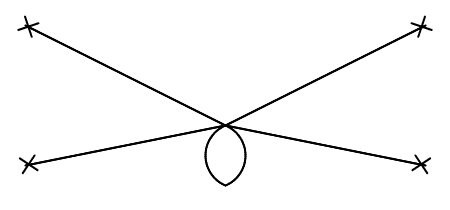
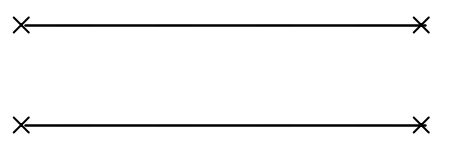
in 3 dimensions, what is the one-loop correction to the 4-point function? Am I correct in thinking that the following Feynman diagram is the representation of the 4 point function for this Lagrangian?
242549

The only one-loop diagram I can think of is

242550


however I'm struggling to see how this is explicitly a correction to the 4 point function I drew above.
 
Physics news on Phys.org
It's a bit unusual to consider disconnected diagrams (the first one you've drawn). For the connected diagrams the 2nd diagram is the leading-order contribution to the four-point function.

Since you Lagrangian has no ##\phi^4## term, at this point you'd have to introduce one, because this loop is (in 3D linearly) divergent and thus you need a ##\phi^4##-term in the Lagrangian to renormalize it.
 
  • Like
Likes   Reactions: QFT1995
Hi, this was an question from a problem set where there was no \phi^4 term. The question later asks whether the theory is renormalizable or not. When talking about one-loop order corrections, are the corrections always to the connected diagrams and not the disconnected ones?
 
For renormalization you only need to consider the even smaller subset of the one-particle irreducible connected amputated diagrams (the proper vertex functions).

To see whether ##\phi^6## theory is (Dyson-)renormalizable in ##d## spacetime dimensions we have to evaluate the "superficial degree of divergence". To that end note that any vertex simply provides just a constant, and any propagator with momentum ##p## goes like ##1/p^2## in the UV. Any loop adds integration over the corresponding loop momentum providing an integration over the momentum. Thus the superficial degree of divergence is
$$D_s=L d-2I,$$
where ##L## is the number of loops and ##I## the number of internal lines of the diagram.

Now consider a diagram with ##V## vertices (i.e., of order ##V## of perturbation theory) and ##E## external lines. At each vertex momentum conservation holds, i.e., the sum of all momenta running into or out of the vertex must be 0. Thus we have for the number of loops
$$L=I-V+1,$$
since only internal lines provide momenta over which we may have to integrate. At each vertex one momentum is fixed due to momentum conservation, but there's one overall conservation for all external momenta which doesn't constrain the independent momenta on internal lines.

Finally into each vertex run 6 lines. Each internal line connects two vertices, while the external lines don't count as internal lines by definition, thus we have
$$I=(6V-E)/2.$$
Note that in ##\phi^6## theory all proper vertex functions with an odd number of external lines vanish due to the symmetry of the theory under the "field reflection" ##\phi \rightarrow -\phi##, i.e., we have to consider only an even number for ##E##, and thus ##I## is always an integer number as it must be.

Now we can combine the three equations above:
$$D_s=d+\frac{2-d}{2} E +(2d-6)V.$$
For ##d=3## this gives
$$D_s=3-\frac{E}{2}.$$
Thus ##D_s \geq 0## for ##E \in \{0,2,4,6 \}## only and this means the theory is superficially renormalizable. Since there are no further symmetries providing Ward-Takahashi identities due to the BPHZ analysis the theory is thus (Dyson-)renormalizable, provided there's also a four-point vertex, such that the divergence of the four-point functions can be absorbed into the four-point coupling constant.
 
  • Like
Likes   Reactions: QFT1995 and dextercioby
Thank you for your help. Can you tell me if this is correct or not. Is the one loop diagram I drew above finite since
\int \frac{d^d k}{(2\pi)^d} \frac{1}{k^2 +m^2 -\imath \epsilon} \propto \Gamma\left(1-\frac{d}{2}\right)
is finite for d=3?

Edit: I just re-read your reply above saying that this integral should be linearly divergent so I don't know where I've gone wrong.
 
Let's calculate the Euclidean (Wick rotated) integral. Then with a cut-off ##|k|<\Lambda##
$$\int_{K_{\Lambda}} \frac{\mathrm{d}^3 k}{(2 \pi)^3}\frac{1}{k^2+m^2} = \frac{1}{2 \pi^2}\int_0^{\Lambda} \mathrm{d} k \frac{k^2}{k^2+m^2} = \Lambda - m \arctan(\Lambda/m),$$
and this diverges linearly with the cutoff as expected.
 

Similar threads

  • · Replies 4 ·
Replies
4
Views
3K
  • · Replies 0 ·
Replies
0
Views
1K
  • · Replies 1 ·
Replies
1
Views
2K
  • · Replies 5 ·
Replies
5
Views
1K
  • · Replies 2 ·
Replies
2
Views
2K
  • · Replies 1 ·
Replies
1
Views
2K
  • · Replies 1 ·
Replies
1
Views
2K
  • · Replies 1 ·
Replies
1
Views
2K
  • · Replies 0 ·
Replies
0
Views
1K
  • · Replies 2 ·
Replies
2
Views
973