- 2,180
- 2,721
I am studying QFT from the book A First Book of QFT. I am currently in the chapter of QED.
The authors have written down the interaction Lagrangian for QED. Thereafter, they have taken a special case of the electron, and written down the normal-ordered interaction Hamiltonian for this case: $$:\mathcal{H}_{\text{int}}: \ = \ -e:\bar{\psi} \gamma ^\mu \psi A_\mu:,$$ where ##\psi## and ##\bar{\psi}## are the free Dirac field operators, one for the particle and the other for the anit-particle, and ##A_\mu## is the operator of the free EM field.
Then the authors have decomposed each field operator in terms of their creation and annihilation parts, like ##\psi \ = \ \psi_+\ + \ \psi_-## where ##\psi_+## has the annihilation part, and ##\psi_-## has the creation part. Same goes for the other two operators.
If we write each field operator in terms of their creation and annihilation sub-parts, the interaction Hamiltonian has 8 terms. The authors have then said:
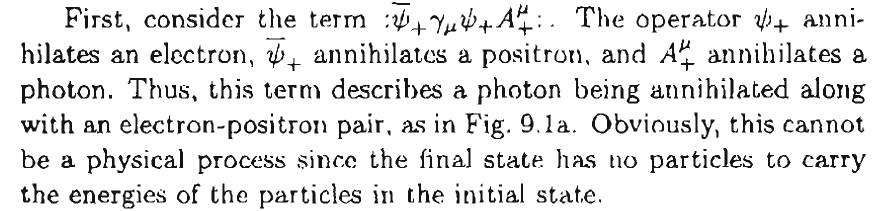
As you can see, thay have taken ##\bar{\psi}## for the positron and ##\psi## for the electron. Well and good, I have understood everything so far.
Soon after this, they have written,

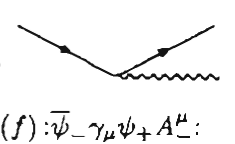
How can this be correct? If I follow the previous arguments, ##\psi_+## annihilates an electron, ##\bar{\psi}_-## creates a positron, not an electron, and ##A^\mu_-## creates a photon.
The corresponding Feynman diagram is:
Thereafter they have proceeded to show how none of the eight terms can represent physical processes if all particles are considered on-shell. But nothing about this has been mentioned elsewhere.
I checked out the errata of the book, but they have not written anything about this. Am I correct and the book is wrong, or am I missing something?
The authors have written down the interaction Lagrangian for QED. Thereafter, they have taken a special case of the electron, and written down the normal-ordered interaction Hamiltonian for this case: $$:\mathcal{H}_{\text{int}}: \ = \ -e:\bar{\psi} \gamma ^\mu \psi A_\mu:,$$ where ##\psi## and ##\bar{\psi}## are the free Dirac field operators, one for the particle and the other for the anit-particle, and ##A_\mu## is the operator of the free EM field.
Then the authors have decomposed each field operator in terms of their creation and annihilation parts, like ##\psi \ = \ \psi_+\ + \ \psi_-## where ##\psi_+## has the annihilation part, and ##\psi_-## has the creation part. Same goes for the other two operators.
If we write each field operator in terms of their creation and annihilation sub-parts, the interaction Hamiltonian has 8 terms. The authors have then said:
As you can see, thay have taken ##\bar{\psi}## for the positron and ##\psi## for the electron. Well and good, I have understood everything so far.
Soon after this, they have written,
How can this be correct? If I follow the previous arguments, ##\psi_+## annihilates an electron, ##\bar{\psi}_-## creates a positron, not an electron, and ##A^\mu_-## creates a photon.
The corresponding Feynman diagram is:
Thereafter they have proceeded to show how none of the eight terms can represent physical processes if all particles are considered on-shell. But nothing about this has been mentioned elsewhere.
I checked out the errata of the book, but they have not written anything about this. Am I correct and the book is wrong, or am I missing something?