One vertex interactions in QED - error in the book?

Click For Summary

Discussion Overview

The discussion revolves around the interpretation of the interaction Hamiltonian in Quantum Electrodynamics (QED) as presented in the book "A First Book of QFT." Participants examine the treatment of field operators, specifically the roles of the electron and positron operators in the context of virtual particle interactions and Feynman diagrams.

Discussion Character

  • Technical explanation
  • Debate/contested

Main Points Raised

  • One participant questions the correctness of the book's treatment of the interaction Hamiltonian, noting a potential inconsistency in the assignment of field operators for electrons and positrons.
  • Another participant asserts that the book is correct, emphasizing that the Feynman diagram represents virtual particles, which can be off-shell and do not need to adhere to the same constraints as physical particles.
  • A subsequent reply seeks clarification on whether the change in the assignment of field operators is valid due to the virtual nature of the particles involved.
  • A different participant elaborates on the structure of the field operators, explaining how they consist of both annihilation and creation operators, and discusses the implications for the microcausality constraint and the quantization of fermionic fields.
  • One participant acknowledges a misunderstanding regarding the field operator structure after receiving clarification from another participant.

Areas of Agreement / Disagreement

Participants express differing views on the interpretation of the field operators and their roles in the interaction Hamiltonian. While some assert the correctness of the book's approach, others raise questions about the consistency of the arguments presented. The discussion remains unresolved regarding the implications of virtual particles in this context.

Contextual Notes

Participants highlight the distinction between physical processes and the mathematical formalism used in QED, noting that the interaction vertex does not directly represent physical interactions due to energy-momentum conservation constraints.

Wrichik Basu
Science Advisor
Insights Author
Gold Member
Messages
2,186
Reaction score
2,694
I am studying QFT from the book A First Book of QFT. I am currently in the chapter of QED.

The authors have written down the interaction Lagrangian for QED. Thereafter, they have taken a special case of the electron, and written down the normal-ordered interaction Hamiltonian for this case: $$:\mathcal{H}_{\text{int}}: \ = \ -e:\bar{\psi} \gamma ^\mu \psi A_\mu:,$$ where ##\psi## and ##\bar{\psi}## are the free Dirac field operators, one for the particle and the other for the anit-particle, and ##A_\mu## is the operator of the free EM field.

Then the authors have decomposed each field operator in terms of their creation and annihilation parts, like ##\psi \ = \ \psi_+\ + \ \psi_-## where ##\psi_+## has the annihilation part, and ##\psi_-## has the creation part. Same goes for the other two operators.

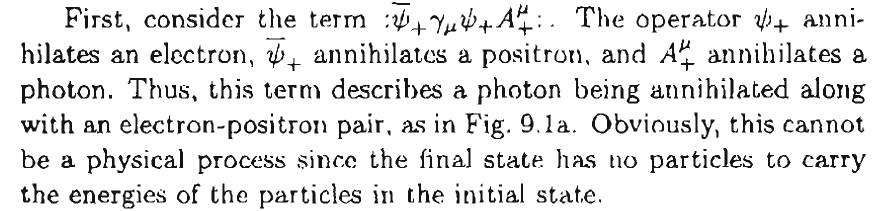
If we write each field operator in terms of their creation and annihilation sub-parts, the interaction Hamiltonian has 8 terms. The authors have then said:
245575


As you can see, thay have taken ##\bar{\psi}## for the positron and ##\psi## for the electron. Well and good, I have understood everything so far.

Soon after this, they have written,

245576


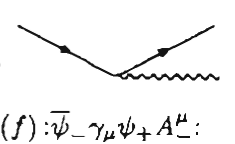
How can this be correct? If I follow the previous arguments, ##\psi_+## annihilates an electron, ##\bar{\psi}_-## creates a positron, not an electron, and ##A^\mu_-## creates a photon.

The corresponding Feynman diagram is:
245577


Thereafter they have proceeded to show how none of the eight terms can represent physical processes if all particles are considered on-shell. But nothing about this has been mentioned elsewhere.

I checked out the errata of the book, but they have not written anything about this. Am I correct and the book is wrong, or am I missing something?
 
Physics news on Phys.org
The book is right. The diagram represents an interaction of virtual particles only, which are not physical and hence can be off shell.
 
A. Neumaier said:
The book is right. The diagram represents an interaction of virtual particles only, which are not physical and hence can be off shell.
I understood that they can be off-shell. But tell me one thing: following the arguments of the authors, they first took ##\psi## for the electron and ##\bar{\psi}## for the positron, but soon after that, they took the reverse, that is, ##\psi## for the positron and ##\bar{\psi}## for the electron. Is this change correct because the particles are virtual?
 
The field operator ##\psi## is made up of annihilation operators for electrons (in front of the positive-frequency modes) and a creation operator for positrons (in front of the negative-frequence modes). Since annihilation and creation operators are adjoint to each other this implies that ##\bar{\psi} = \psi^{\dagger} \gamma^0## it's the other way: ##\bar{\psi}## consists of a creation operator for electrons and an annihilation operator for positrons.

This (and only this!) specific structure of the field operator makes a local realization of the proper orthochronous Poincare group and leads to a Hamilton density fulfilling the microcausality constraint. Together with the demand to have an energy spectrum that is bounded from below, you have to quantize the field as fermions (spin-statistics theorem).

Now the author splits the field operators (analogously for photons, only that there particle and antiparticle are identical and of course bosons) and analyzes the various combinations occurring in the elementary QED vertex. As far as I can see from what you've quoted this is all correct, but you must take it with a grain of salt. Since this elementary vertex doesn't depict any matrix elements of physical processes since all these formal processes given by the split of the field operators are forbidden due to energy-momentum conservation. This means the vertex is just a mathematical notation for the perturbative expansion but nothing directly physical. You can of course build Feynman diagrams from these building blocks which describe physical processes. There the external legs refer to the mode functions, the inner lines to Feynman (in the vacuum QFT we are discussing here identical with the time-ordered) propagators. The vertices stand for ##\mathrm{i} e \gamma^{\mu}##. If a process is allowed by all conservation laws you get S-matrix elements and cross sections from the formalism (in the perturbative approximation to an order in ##\alpha_{\text{em}}## given by the number of vertices in the diagram).
 
  • Informative
Likes   Reactions: Wrichik Basu
vanhees71 said:
The field operator ψψ\psi is made up of annihilation operators for electrons (in front of the positive-frequency modes) and a creation operator for positrons (in front of the negative-frequence modes).
Yes yes, I just missed that somehow. Thanks.
 

Similar threads

  • · Replies 1 ·
Replies
1
Views
1K
  • · Replies 1 ·
Replies
1
Views
1K
  • · Replies 3 ·
Replies
3
Views
2K
  • · Replies 4 ·
Replies
4
Views
2K
  • · Replies 4 ·
Replies
4
Views
1K
  • · Replies 4 ·
Replies
4
Views
3K
  • · Replies 2 ·
Replies
2
Views
2K
  • · Replies 6 ·
Replies
6
Views
2K
  • · Replies 2 ·
Replies
2
Views
2K
  • · Replies 9 ·
Replies
9
Views
2K