Op-Amps Circuits: Explaining Prof's Method

  • Context:
  • Thread starter Thread starter Dethrone
  • Start date Start date
  • Tags Tags
    Circuits
Join the discussion
Registration is free. Ask a follow-up in this thread, or start your own.
3 replies · 2K views
Dethrone
Messages
716
Reaction score
0
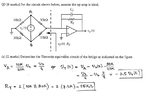
View attachment 4095

Can anyone explain to me what my professor did? I am able to get the same answer, but not without a page of nodal analysis. It seems quite elegant and none of my friends know what method she used. Thanks!
 

Attachments
  • Circuits.PNG
    Circuits.PNG
    21.6 KB · Views: 118
Mathematics news on Phys.org
Rido12 said:
Can anyone explain to me what my professor did? I am able to get the same answer, but not without a page of nodal analysis. It seems quite elegant and none of my friends know what method she used. Thanks!

The Thevenin equivalent of a linear electrical network is composed by a voltage generator $V_{T}$ in series with a resistor $R_{T}$...$V_{T}$ is the output voltage when the output node is open [output current is 0...], $I_{T}$ il the otput current when the output node il shorted to ground [output voltage is 0...] and finally $R_{T} = \frac{V_{T}}{I_{T}}$...

Kind regards

$\chi$ $\sigma$
 
Hi $\chi \sigma$,

I have done that and applied nodal analysis at node $V_T$ and at ground, but I am unable to follow the logic presented by my professor:

$$V_A=\frac{10}{40}V_s=\frac{V_s}{4}$$
How did she get this?
 
Rido12 said:
Hi $\chi \sigma$,

I have done that and applied nodal analysis at node $V_T$ and at ground, but I am unable to follow the logic presented by my professor:

$$V_A=\frac{10}{40}V_s=\frac{V_s}{4}$$
How did she get this?

If the output node is left open, then the current in the 10 k and 30 k resistors must be the same, and that means that the voltage on the 30 k resistor is three times the voltage on the 10 k resistor...

Kind regards

$\chi$ $\sigma$