Open string end points, their motion in spacetime

Click For Summary

Discussion Overview

This discussion revolves around the motion of open string endpoints in spacetime, particularly in relation to their implications for elementary particles in the Standard Model and concepts in electromagnetism. Participants explore theoretical connections between string theory, quantum electrodynamics, and the nature of photons and their properties.

Discussion Character

  • Exploratory
  • Technical explanation
  • Conceptual clarification
  • Debate/contested

Main Points Raised

  • One participant questions the significance of the endpoints of a string being at different positions on a brane and whether this affects the motion of a photon string through spacetime.
  • Another participant clarifies that open strings are associated with Yang-Mills gauge fields in their massless spectrum, contrasting them with closed strings that relate to gravity.
  • There is a discussion about the relationship between the charge of photon string ends and the oscillating nature of electromagnetic waves, with one participant asserting that these are fundamentally different concepts.
  • Participants explore whether quantities associated with photon strings can represent energy forms that are equally divided, referencing massless oscillations of open strings and their correspondence to electromagnetic field quanta.
  • One participant suggests that the string perturbation series can be linked to Feynman diagrams, indicating a parallel between off-shell virtual particles and string theory representations.
  • Another participant proposes a multi-level approach to understanding electromagnetism, suggesting a progression from classical electrodynamics to quantum electrodynamics and string theory, highlighting the complexity of energy definitions in these contexts.
  • A participant expresses a desire to connect the charged photon string ends to the four polarizations of a photon, indicating an exploratory mindset and openness to correction.

Areas of Agreement / Disagreement

Participants exhibit a mix of agreement and disagreement, particularly regarding the connections between string theory and electromagnetism. Some points remain unresolved, especially concerning the implications of string endpoints and their physical interpretations.

Contextual Notes

Participants acknowledge the complexity of the topics discussed, including the need for a deeper understanding of classical and quantum theories before fully grasping the implications of string theory. There are references to specific texts for further exploration, indicating that some assumptions may depend on prior knowledge of the mathematics involved.

Who May Find This Useful

This discussion may be of interest to those studying string theory, quantum electrodynamics, and the relationship between theoretical physics and elementary particle physics, particularly in the context of advanced theoretical frameworks.

Spinnor
Gold Member
Messages
2,231
Reaction score
419
I have some questions and refer you to the image below the caption of which states,

"D-branes may be of exceptional importance in the explanation of elementary particles of the Standard Model. However, it still remains to find a solid connection between the M-theory and the Standard Model."

From, http://www.diffusion.ens.fr/vip/pageJ03.html
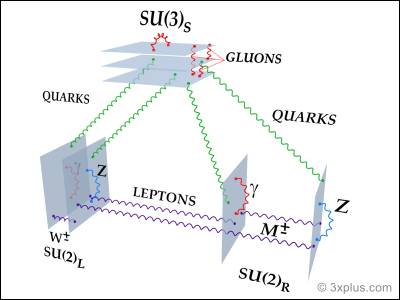
10-17-jpg-jpg.jpg
The string which is identified with a photon above is shown with the ends of the string at different positions on the brane, is there significance to this?

The string ends of an on mass-shell photon must move through space at the speed of light while attached to the brane?

We are told the photon string ends have opposite charge, can we make a connection to this idea and the oscillating nature of an electromagnetic wave?

An electromagnetic wave in free space has equal energy in the electric and magnetic fields. Are there quantities associated with the photon string which represent two forms of energy that are also equally divided?

Can a photon which is off mass shell be included in the image above, is there a representation of it?

Electrons and photons have different spin, does this fact follow from the image above somehow?

Thanks for any help!
 

Attachments

  • 10-17-jpg-jpg.jpg
    10-17-jpg-jpg.jpg
    15 KB · Views: 582
Physics news on Phys.org
Generally, these pictures serve to enconde basic information about choices of intersecting brane models for readers who already know the mathematics, they cannot explain how string theory works.

To see how a photon mode arises in the open quantum string check out any of the textbooks. Probably you'll like this one:

Luis Ibáñez, Angel Uranga, "String Theory and Particle Physics: An Introduction to String Phenomenology", Cambridge University Press 2012

where the derivation you need is section 3.3.1. The following section then discusses how strings whose endpoints may be attached to several coincident branes yield non-abelian gauge field modes, perturbatively. In the end there is no way except these mathematical formulas to see what's happening. On the other hand, it's really not hard maths, so you should give it a try.

Spinnor said:
shown with the ends of the string at different positions on the brane, is there significance to this?

Yes. This indicates that it is an "open" string. It is only the open strings which have YM-gauge fields in their massless spectrum (at least without KK-mechanism), the closed string carries the field of gravity and the axion field in its massless spectrum.

Spinnor said:
We are told the photon string ends have opposite charge, can we make a connection to this idea and the oscillating nature of an electromagnetic wave

No, that's two completely different things.

Spinnor said:
An electromagnetic wave in free space has equal energy in the electric and magnetic fields. Are there quantities associated with the photon string which represent two forms of energy that are also equally divided?

The massless oscillations of the open string make it look like quanta of the electromagnetic field (the vector potential) and in this way every statement about electromagnetic waves in perturbative QFT is reflected in a corresponding statement about massless excitations of open strings in perturbative string theory.

Spinnor said:
Can a photon which is off mass shell be included in the image above, is there a representation of it?

The string perturbation series is a straightforward modification of the Feynman perturbation series, and hence where you see off-shell virtual particle lines in Feynman diagrams, there is always the analogous lift to string theory (see here).
Spinnor said:
Electrons and photons have different spin, does this fact follow from the image above somehow?

Yes, the fermion quanta arise from massless fermionic excitations of the fermionic string (superstring) in analogy to how the gauge field quanta arise from the bosonic massless modes.This is also explained briefly but precisely in that section 3.3. of

Luis Ibáñez, Angel Uranga, "String Theory and Particle Physics: An Introduction to String Phenomenology", Cambridge University Press 2012
 
Last edited:
  • Like
Likes   Reactions: arivero and Spinnor
A few quick thoughts rather than proper answers:

The questions about electromagnetism are interesting but I believe they would be best answered by looking at some intermediate levels of description: classical electrodynamics, then quantum electrodynamics, then the Born-Infeld theory which happens to apply to gauge theories on the brane, and then perturbative string theory (with perhaps an excursion into string field theory if one can find relevant work).

For example, the question about energy in the electric and magnetic fields. First one should understand this in classical terms (energy density, Poynting vector), then try to understand what electric and magnetic field amplitudes are in terms of photon states, then perhaps look at the Poynting vector in Born-Infeld theory and in string theory.

Feynman has a good exposition (which is online) of energy density in classical electrodynamics, including the ambiguity in the definition of energy density and energy flow, and the observation that this could be settled empirically if it were possible to observe the gravitational force due to the electromagnetic energy density. I am not aware if there is a modern way of thinking about this issue (e.g. how does the ambiguity look in different gauges?), but as a matter of theory one could also ask how it works in string theory, which as a theory that includes gravity must imply a particular form of coupling between "electromagnetic field energy" and gravity.
 
  • Like
Likes   Reactions: Spinnor
Thanks Mitchell and Urs! I was trying to work forwards and backwards with the few factoids I have at my disposal with regards to the most "simple" part of Nature, electricity and magnetism. I thought that with the photon string ends being charged and with proper and particular motions in spacetime would yield the 4 polarizations of a photon. I am happy to be corrected o:).

Mindless work awaits me. Thanks!
 

Similar threads

  • · Replies 30 ·
2
Replies
30
Views
10K
  • · Replies 2 ·
Replies
2
Views
5K
  • · Replies 0 ·
Replies
0
Views
4K
  • · Replies 1 ·
Replies
1
Views
5K
  • · Replies 6 ·
Replies
6
Views
6K
  • · Replies 3 ·
Replies
3
Views
3K
  • · Replies 7 ·
Replies
7
Views
4K
  • · Replies 20 ·
Replies
20
Views
5K
  • · Replies 3 ·
Replies
3
Views
3K
  • · Replies 4 ·
Replies
4
Views
3K