Optics (dealing with 2 sources of wavelength)

Click For Summary
SUMMARY

This discussion focuses on the analysis of light interference patterns created by two wavelengths, specifically 400 nm and 600 nm, in a thin film setup. The key equation used is the condition for destructive interference, represented as 2nt = mλ, where n is the refractive index, t is the thickness of the film, and λ is the wavelength. The conversation emphasizes that the two wavelengths do not interfere with each other and suggests calculating the positions of the dark fringes for each wavelength separately to identify the second dark fringe from the contact point.

PREREQUISITES
  • Understanding of wave interference principles
  • Familiarity with the equation for destructive interference (2nt = mλ)
  • Knowledge of thin film optics and phase changes upon reflection
  • Basic skills in translating fringe orders into physical lengths
NEXT STEPS
  • Calculate dark fringe positions for 400 nm and 600 nm wavelengths using the formula 2nt = mλ
  • Explore the impact of varying film thickness on interference patterns
  • Investigate phase changes in reflections for different materials
  • Learn about multi-wavelength interference in thin films
USEFUL FOR

Students and professionals in optics, physicists studying wave phenomena, and anyone involved in experimental setups involving thin films and light interference.

jisbon
Messages
475
Reaction score
30
Homework Statement
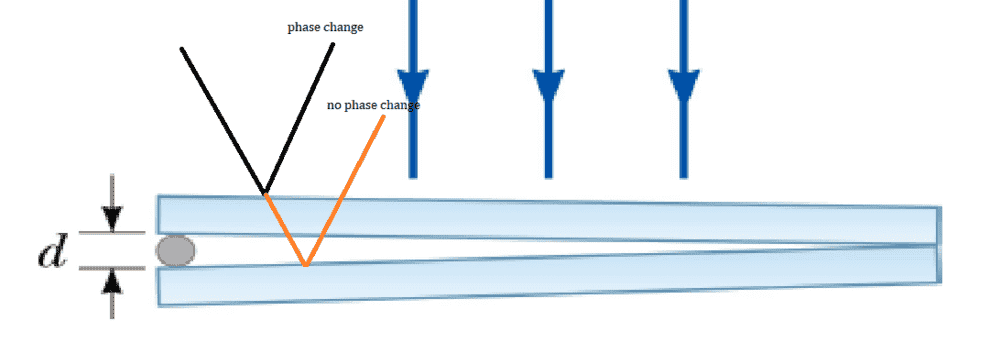
Two glass plates and a thread form an air wedge as shown below.
The glass plates are 10 cm long, and the thread is 0.05 mm in diameter.
When the wedge is illuminated by two wavelengths at 400 nm and 600 nm,
interference fringes appear. Determine the distance of the second dark fringe
from the contact point of the two glass plates
Relevant Equations
For phase change:
Destructive interference: ##2nt=m\lambda##
To start off, I dealt with questions similar to this, but it only involves one wavelength. Now that there's 2 wavelengths, I'm kind of stumped as to what I should do.

Since the question stated a second dark fringe, I can assume that it will be a destructive interference. Since the rays are being reflected off the wedge, as shown below, there will be a phase change for the first ray and no phase change for the second ray, hence Destructive interference: ##2nt=m\lambda##
1579081205463.png

Let's say I deal with them 1 by 1,

For 400nm,

##2nt=m\lambda##
##2*1*t=m(400nm)##

and vice versa.

What should I do?
 
Physics news on Phys.org
The 400 nm light does not interfere with the 600 nm light. Since you understand the single wavelength problem, find the positions along the bottom plate of the first (no more than two) dark fringes for each wavelength and see which one is the second from the contact point. Note that you need to translate the fringe order ##m## into a length.

Also, your picture is misleading. The reflection of the black ray should be drawn off the back surface of the top plate not the front. The "thin film" is the air gap between the plates.
 

Similar threads

Replies
3
Views
2K
  • · Replies 3 ·
Replies
3
Views
1K
Replies
7
Views
1K
  • · Replies 10 ·
Replies
10
Views
1K
  • · Replies 14 ·
Replies
14
Views
3K
Replies
4
Views
3K
  • · Replies 5 ·
Replies
5
Views
1K
  • · Replies 1 ·
Replies
1
Views
902
  • · Replies 2 ·
Replies
2
Views
2K
Replies
11
Views
3K