Orbit determination from radar readings of a satellite in orbit

Join the discussion
Registration is free. Start your own thread to ask a follow-up.
4 replies · 2K views
bwitt
Messages
3
Reaction score
1
Homework Statement
Radar readings determine that an object is located at 7,653.76km with a velocity of 3.1621I-2.3716K km/s. Determine p, e, u0, the longitude of ascending node, the argument of periapsis, the true anomaly at epoch, longitude at epoch, and the latitude of impact
Relevant Equations
see below
Hello everyone! This is from The Fundamentals of Astrodynamics Chapter 2 Questions. I'm doing this as a self-study (and never took Linear Algebra) so my "technique" might be a little sloppy 😖😖

gif.latex?%5Cmathbf%7Br%7D%20%3D%201.gif

DU%5Coplus.gif


Finding specific angular momentum
hbf%7Br%7D%20%5Ctimes%20%5Cmathbf%7Bv%7D%20%3D%200.gif


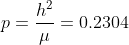
Finding the orbital parameter

gif.latex?%7C%7C%5Cmathbf%7Bh%7D%7C%7C%20%3D%200.gif

?p%20%3D%20%5Cfrac%7Bh%5E2%7D%7B%5Cmu%7D%20%3D%200.gif


Finding Eccentricity Vector
rac%7B1%7D%7B1.2%7D%29%5Cmathbf%7Br%7D%20-%20%28-0.gif

%3D%20%280.2712K%29%20+%200.36%280.4I%20-%200.gif
+%200.144I-0.108K%20%3D%200.144I%20+%200.gif


7D%7C%7C%20%3D%20%5Csqrt%7B0.144%5E2I%20+%200.gif

63424%7D%20%3D%20%5Csqrt%7B0.04737024%7D%20%3D%200.gif


This doesn't match with the textbook answer that e = 0.820748, I've done this question over and over many times and have never arrived at that answer. I'm looking mainly for hints at what might be going wrong here. Thanks for the help!
 
Physics news on Phys.org
Is the 7,653.76km the height above the Earth's surface, or the distance from the Earth's center? If it is a radar reading, I would think the first one. What did you assume?
 
I assumed it was from the Earth's center because in other questions it specified if it was relative to the radar station
 
How did you decide upon the direction of the position vector? It's not specified in your problem statement.

As for e, I think something's gone awry in your math there. You might find it simpler to use the following expression for the eccentricity vector:
$$\vec e = \frac{\vec v \times \vec h}{\mu} - \frac{\vec r}{r}$$

Edit: Fixed a missing \vec in the above expression.
 
Last edited:
gneill said:
How did you decide upon the direction of the position vector? It's not specified in your problem statement.

As for e, I think something's gone awry in your math there. You might find it simpler to use the following expression for the eccentricity vector:
$$e = \frac{\vec v \times \vec h}{\mu} - \frac{\vec r}{r}$$

Ope sorry, the problem statement actually said 7,653.76K km :-p

Wow that is a much simpler form, wish the authors presented it like that... thanks for the help :)
 
  • Like
Likes   Reactions: berkeman