Order of Galilean Boost / Translation on a wave-function (or fields)

Click For Summary
SUMMARY

The discussion focuses on the application of Galilean transformations in field theory, specifically regarding translations and boosts as described in Markus Scholle's 2004 paper, "Construction of Lagrangians continuum theories." The transformations are defined mathematically, with translations affecting the spatial coordinates and wavefunction, while boosts introduce additional terms to the wavefunction to maintain the invariance of the Schrödinger equation. The participants express confusion over the sequential application of these transformations and the implications for the wavefunction, emphasizing the need for careful consideration of how transformations act on wavefunction arguments.

PREREQUISITES
  • Understanding of Galilean transformations in physics
  • Familiarity with the Schrödinger equation and its invariance properties
  • Knowledge of wavefunction behavior under coordinate transformations
  • Basic concepts of quantum mechanics, particularly in field theory
NEXT STEPS
  • Study the mathematical formulation of Galilean transformations in field theory
  • Examine the covariance of the Schrödinger equation under boosts and translations
  • Explore the implications of phase factors in wavefunction transformations
  • Review Ballentine's Quantum Mechanics, particularly Chapter 3 on transformations
USEFUL FOR

Physicists, particularly those specializing in quantum mechanics and field theory, as well as students seeking to deepen their understanding of Galilean transformations and their effects on wavefunctions.

binbagsss
Messages
1,291
Reaction score
12
TL;DR
non-commutative properties in contrast to the Newtonian mechanics case
I am reading some literature which is considering translations and boosts in field theory. The reference is Construction of Lagrangians continuum theories, Markus Scholle, 2004, The Royal Society. I am wondering if anyone is able to help me understand applying the transformation. I can see what is done, but I do not understand why.


The translation is defined by:

##\vec{x} \to \vec{x} + \vec{s}##

##t \to t ##

##\psi \to \psi##

the boost by:

##\vec{x} \to \vec{x} - \vec{u_0}t##

##t \to t ##

##\psi \to \psi- \vec{u_0}.\vec{x}+\frac{1}{2}\vec{u_0^2}t##

(where this, the w.f transformation comes about by ensuring the Schrödinger equation is invariant w.r.t Galilean boosts

[1]the article then will now consider the translation followed by the Galilean and this is done by:

First I get :

1)##\vec{x} \to \vec{x} + \vec{s}, \psi \to \psi##

Then applying the boost to get:

2)##\vec{x} \to \vec{x} + \vec{s} - \vec{u_0}t, \psi \to \psi- \vec{u_0}.\vec{x}+\frac{1}{2}\vec{u_0^2}t##

[2]And now the Galilean boost then the translation:

Boost:

##\vec{x} \to \vec{x} - \vec{u_0}t##

##\psi \to \psi- \vec{u_0}.\vec{x}+\frac{1}{2}\vec{u_0^2}t##

And the translation then gives:

##\vec{x} \to \vec{x} - \vec{u_0}t-\vec{s}##

##\psi \to \psi- \vec{u_0}.(\vec{x}+\vec{s})+\frac{1}{2}\vec{u_0^2}t##

so the argument is that while ##\vec{x}## is the same ##\psi## differs...( that is, in contrast to Newtonian mechanics and the boost and translation commuting, in field theory they do not

So, this is what the article has done. But, I do not really understand this. To me, the ##x## from 1) needs to be plugged into the ##\psi##, not treating them separately. I thought it has to be done simultaneously transformation since ##\psi## is a function of ##x## and do not understand how they can be considered separately like this? so that is, i would be getting the same as the result of [2].
 
Physics news on Phys.org
It's been a while for me, but you have to be careful about how the transformations act on the wavefunction exactly (especially on their arguments!). First, I can't find your proposed transformation of the wavefunction in your lecture notes; I only see eqn. 1.14 which differs from your transformation, so I don't understand how you come to your transformation of the wavefunction. Second, I highly recommend you take a look at chapter 3 of Ballentine's QM book. Maybe this old topic also helps,

https://www.physicsforums.com/threads/galilei-transformation-free-schroedinger-equation.775330/
 
Maybe I'm looking at the wrong paper, but you say that "The article then will now consider the translation followed by the Galilean"; I can't find where the author does that (I suppose you mean "Galilean boost"). So let me give my own calculation of this.

From the covariance of the Schrödinger equation under boosts

##x'=x+ut##

we concluded that

##\psi'(t',x') = e^{i\phi(t,x)}\psi(t,x) \ \ \ (1)##

with

##\phi(t,x)=\frac{M}{\hbar}(ux+\frac{1}{2}u^2 t)##

You can check this also by boosting the plane wave solution of a free particle! Now we can check what this means for the boost operator. This boost operator U is defined by (watch those primes!!!)

##U_B \psi (t,x) = \psi'(t,x)##

Let's apply that, using eqn. (1) (again, watch those primes!):

##\psi'(t,x) = e^{i\phi(t,x-ut)}\psi(t,x-ut) = [1+\frac{iM}{\hbar}(ux-u^2 t + \frac{1}{2}u^2 t + \ldots)](1 - ut \frac{\partial}{\partial x} + \ldots) \psi(t,x)##

Now we consider infinitesimal transformations up to order u:

##\psi'(t,x) = (1 + iu[\frac{M}{\hbar} x + i t \frac{\partial}{\partial x} + \ldots] ) \psi(t,x) ##

So apparently

##U_B = 1-i u B_x \ \ , \ \ \ B_x \equiv - (\frac{M}{\hbar} x + it \frac{\partial}{\partial x})##

You see that the boost generator B is adjusted with this extra factor of M/h due to the phase factor popping up in the boost transformation for the wavefunction. For a translation P in the x direction, we have

##x' = x + d \ \ \ , \ \ \ U_P \psi (t,x) = \psi'(t,x) = \psi(t, x-d) = (1 - d \frac{\partial}{\partial x} + \ldots )\psi(t,x)##

So

##\psi'(t,x) = (1 - i d P_x)\psi(t,x) \ \ \ , \ \ \ P_x = - i\frac{\partial}{\partial x} ##

I leave it now up to you to check the commutator between translations and boosts, but due to the adjustment of the boost generator you'll see the central extension popping up.
 
Last edited:
  • Like
Likes   Reactions: binbagsss
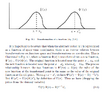
Maybe you're confused about how the group transformations act on the wavefunction. I'm not sure if it's allowed, so if not, mods should remove the screenshot, but I add a screenshot of Ballentine's chapter 3.

You see that (surpressing t)

##U(\tau) \Psi (x) = \Psi (\tau^{-1} x)##

We know that for transformations besides the boosts

##\Psi'(x') = \Psi'(\tau x) = \Psi(x)##

I.e. "the transformed wavefunction at the new point has the same value as the old wavefunction at the old point". All in the same coordinate system!

So if you now replace

## x \rightarrow \tau^{-1} x##

you get

##\Psi'(x) = \Psi(\tau^{-1} x) = U(\tau) \Psi (x)##

Conclusion:

##U(\tau) \Psi (x) = \Psi'(x)##

For the boosts you know to include the extra phase factor.
1730192530867.png
 

Attachments

  • Ballentine screenshot ch 3.png
    Ballentine screenshot ch 3.png
    23.9 KB · Views: 67
thanks for your replies. when you say

You can check this also by boosting the plane wave solution of a free particle!

are you referring to a free particle in field theory, or classical Newtonian mechanics, or in the quantum case (where Schrödinger is the governing equation so the plane wave solution has satisfied this, so it is not an extra test).
 
binbagsss said:
thanks for your replies. when you say


are you referring to a free particle in field theory, or classical Newtonian mechanics, or in the quantum case (where Schrödinger is the governing equation so the plane wave solution has satisfied this, so it is not an extra test).
The plane wave solution of the Schrödinger equation. This also solves the apparent paradox of how de Broglie's relation transform under Galilei-boosts (does the wavelength change or not?).
 
haushofer said:
##\psi'(t,x) = e^{i\phi(t,x-ut)}\psi(t,x-ut) = [1+\frac{iM}{\hbar}(ux-u^2 t + \frac{1}{2}u^2 t + \ldots)](1 - ut \frac{\partial}{\partial x} + \ldots) \psi(t,x)##


##x' = x + d \ \ \ , \ \ \ U_P \psi (t,x) = \psi'(t,x) = \psi(t, x-d) = (1 - d \frac{\partial}{\partial x} + \ldots )\psi(t,x)##
Where do the second brackets in these expansions come from, for the wave-function? Thanks
 
binbagsss said:
Where do the second brackets in these expansions come from, for the wave-function? Thanks
You mean the term ##(1 - ut \frac{\partial}{\partial x} + \ldots) \psi(t,x)##? That's just a Taylor-expansion of ##\psi(t,x-ut)##.
 
  • Like
Likes   Reactions: binbagsss
haushofer said:
You mean the term ##(1 - ut \frac{\partial}{\partial x} + \ldots) \psi(t,x)##? That's just a Taylor-expansion of ##\psi(t,x-ut)##.
Okay, many thanks I understand. I want to consider ##(BT)(TB)^{-1}##, in order to compare to the expression/formulation in the article I referenced.

So translation-boost : ##TB= (1-id(-i\frac{\partial}{\partial x}) )(1-iu(-(\frac{m}{\bar{h}}x+it\frac{\partial }{\partial x})))##

For the inverse of this can I just do ##-d \to +d ##, ##-u \to + u ##?

Thanks
 
  • #10
binbagsss said:
Okay, many thanks I understand. I want to consider ##(BT)(TB)^{-1}##, in order to compare to the expression/formulation in the article I referenced.

So translation-boost : ##TB= (1-id(-i\frac{\partial}{\partial x}) )(1-iu(-(\frac{m}{\bar{h}}x+it\frac{\partial }{\partial x})))##

For the inverse of this can I just do ##-d \to +d ##, ##-u \to + u ##?

Thanks
Yes, and use ##(TB)^{-1}=B^{-1}T^{-1}##, of course.
 
  • Like
Likes   Reactions: binbagsss

Similar threads

  • · Replies 2 ·
Replies
2
Views
1K
  • · Replies 32 ·
2
Replies
32
Views
2K
  • · Replies 14 ·
Replies
14
Views
2K
  • · Replies 4 ·
Replies
4
Views
2K
  • · Replies 6 ·
Replies
6
Views
2K
  • · Replies 10 ·
Replies
10
Views
2K
  • · Replies 6 ·
Replies
6
Views
2K
Replies
2
Views
1K
  • · Replies 4 ·
Replies
4
Views
2K
  • · Replies 3 ·
Replies
3
Views
1K