Orthogonality of timelike and null vector

  • Context: Graduate 
  • Thread starter Thread starter nomather1471
  • Start date Start date
  • Tags Tags
    Orthogonality Vector
Join the discussion
Registration is free. Ask a follow-up in this thread, or start your own.
7 replies · 8K views
nomather1471
Messages
19
Reaction score
1
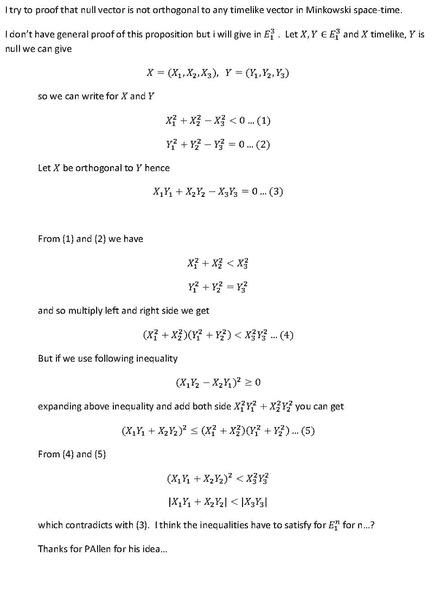
Can we show orthogonality of timelike and null vector?
u0rkg.png
 
Last edited:
Physics news on Phys.org
I just want to expand upon what George said. Let ##(M,g)## be a space-time and ##p\in M##. Furthermore, let ##X## be a time-like vector in ##T_p M## and ##Y## a non-zero vector in ##T_p M## such that ##g_p(X,Y) = 0##. Finally, let ##\{e_i \}## be an orthonormal basis for ##T_p M## so that ##X = X^i e_i## and ##Y = Y^i e_i##.

Then ##(X^2)^2 + (X^3)^2 + (X^4)^2 < (X^1)^2## and ##X^1 Y^1 = X^2 Y^2 + X^3Y^3 + X^4Y^4##.
Note this immediately implies that ##(X^1)^2 > 0## and that ##(Y^2)^2 + (Y^3)^2 + (Y^4)^2 > 0##.

Therefore [tex](X^1 Y^1)^2 \leq ((X^2)^2 + (X^3)^2 + (X^4)^2)((Y^2)^2 + (Y^3)^2 + (Y^4)^2)< (X^1)^2((Y^2)^2 + (Y^3)^2 + (Y^4)^2)[/tex] thus ##(Y^1)^2 < (Y^2)^2 + (Y^3)^2 + (Y^4)^2## i.e. ##Y## is space-like.
 
  • Like
Likes   Reactions: 1 person
A time-like vector can be Lorentz transformed to be purely time-like:[itex]x^\mu=(t,0)[/itex].
A null vector always has x=t, so they can't be orthogonal.
 
Last edited by a moderator:
WannabeNewton said:
I just want to expand upon what George said. Let ##(M,g)## be a space-time and ##p\in M##. Furthermore, let ##X## be a time-like vector in ##T_p M## and ##Y## a non-zero vector in ##T_p M## such that ##g_p(X,Y) = 0##. Finally, let ##\{e_i \}## be an orthonormal basis for ##T_p M## so that ##X = X^i e_i## and ##Y = Y^i e_i##.

Then ##(X^2)^2 + (X^3)^2 + (X^4)^2 < (X^1)^2## and ##X^1 Y^1 = X^2 Y^2 + X^3Y^3 + X^4Y^4##.
Note this immediately implies that ##(X^1)^2 > 0## and that ##(Y^2)^2 + (Y^3)^2 + (Y^4)^2 > 0##.

Therefore [tex](X^1 Y^1)^2 \leq ((X^2)^2 + (X^3)^2 + (X^4)^2)((Y^2)^2 + (Y^3)^2 + (Y^4)^2)< (X^1)^2((Y^2)^2 + (Y^3)^2 + (Y^4)^2)[/tex] thus ##(Y^1)^2 < (Y^2)^2 + (Y^3)^2 + (Y^4)^2## i.e. ##Y## is space-like.
I think you have to show that:
[tex](X^1 Y^1)^2 \leq ((X^2)^2 + (X^3)^2 + (X^4)^2)((Y^2)^2 + (Y^3)^2 + (Y^4)^2)[/tex]
 
nomather1471 said:
I think you have to show that:
[tex](X^1 Y^1)^2 \leq ((X^2)^2 + (X^3)^2 + (X^4)^2)((Y^2)^2 + (Y^3)^2 + (Y^4)^2)[/tex]

I had forgotten completely that one has the freedom to Lorentz boost to a frame wherein ##X = e_0## as stated by George and Clem above, which makes the calculation much simpler. Nevertheless, the above inequality follows directly from the Cauchy-Schwarz inequality.
 
I am student at geometry so your notation is quite different for me but thanks for everyone for all replies...