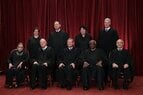
Panel of judges in Supreme Court - Odd number?
- Thread starter akerkarprashant
- Start date
-
- Tags
- Judge
Click For Summary
Discussion Overview
The discussion revolves around the composition of the Supreme Court panel of judges, specifically whether it is always an odd number to prevent tie votes. Participants explore the implications of this structure, historical context, and constitutional considerations.
Discussion Character
- Debate/contested
- Historical
- Conceptual clarification
Main Points Raised
- Some participants propose that the Supreme Court panel is always an odd number (3, 5, 7) to avoid tie votes.
- Others argue that while the intent may be to prevent ties, situations can arise where a judge recuses themselves, potentially leading to a tie.
- One participant notes that there is no constitutional requirement for the number of justices, suggesting that it could change through legislation.
- Another participant mentions the "good behavior" clause as a basis for lifetime appointments, but acknowledges that this could also be altered without a constitutional amendment.
- A historical note is made that the Supreme Court has had even numbers in the past, specifically 6 and 10 justices.
- A humorous remark is made about a fictional method for resolving ties, indicating a light-hearted tone in parts of the discussion.
- One participant expresses admiration for Justice Sonia Sotomayor, adding a personal perspective to the discussion.
Areas of Agreement / Disagreement
Participants do not reach a consensus on whether the odd number of justices is a strict requirement or merely a historical trend. Multiple competing views are presented regarding the implications of the number of justices and the potential for ties.
Contextual Notes
There are limitations regarding the assumptions about the necessity of an odd number of justices and the implications of recusal on voting outcomes. The discussion also touches on the historical context of the Supreme Court's composition without resolving the implications of these historical changes.