Pappus Theorem and Ellipsoid Fig One: Is My Integral Approach Correct?

  • Thread starter Thread starter LCSphysicist
  • Start date Start date
  • Tags Tags
    Ellipsoid Theorem
Click For Summary
SUMMARY

The discussion centers on the application of Pappus's Theorem to calculate the volume of a solid of revolution formed by an ellipse. The integral approach initially proposed by the user was incorrect as it failed to account for the conditions where the ellipse intersects the x-axis at more than one point, specifically when ##\beta < b##. The correct integral formulation, which includes the necessary adjustments to the integrand, is given as $$V = \int_{\alpha - a}^{\alpha+a} \pi\left( \left(\beta + \frac ba\sqrt{a^2 - (x-\alpha)^2}\right)^2 - \left(\beta - \frac ba\sqrt{a^2 - (x-\alpha)^2}\right)^2 \right)\,dx$$. This formulation correctly retains the ##\beta## term and leads to the volume calculation of the ellipse.

PREREQUISITES
  • Understanding of Pappus's Theorem
  • Familiarity with integral calculus
  • Knowledge of ellipses and their geometric properties
  • Ability to manipulate square root functions in integrals
NEXT STEPS
  • Study the implications of Pappus's Theorem on solids of revolution
  • Learn about the properties of ellipses and their equations
  • Explore advanced techniques in integral calculus, particularly in handling square roots
  • Investigate the geometric interpretation of volumes derived from integrals
USEFUL FOR

Mathematicians, engineering students, and anyone interested in advanced calculus and geometric applications of integrals, particularly in the context of solids of revolution.

LCSphysicist
Messages
644
Reaction score
162
Homework Statement
Be the set of points (x,y) which "figure one".
And in the semiplane y >= 0.
Show the volume of the solid obtained by rotation about the axis x, of the set A, is equal to the product of the area of the ellipsoid with the circumference generated in the rotation of the center (alpha,beta) of the ellipsoid
Relevant Equations
All below
fig one:
1594628242878.png

I just want to know if i am right in attack this problem by this integral:
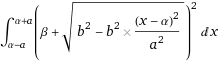
1594628250157.png
*pi

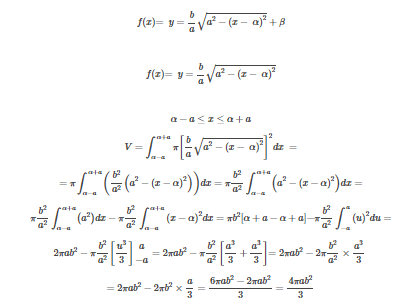
Anyway, i saw this solution:
1594628212401.png

In which it cut beta, don't know why.

So i don't know.
 
Physics news on Phys.org
The result you are asked to prove will not be true if the ellipse intersects the x-axis at more than one point, ie if ##\beta<b##. You can easily see that by considering the case where ##\beta=0## so the ellipse centre is on the x axis. The formula will give zero but the solid of revolution has positive volume.

Assuming ##\beta\ge b## the integral you suggest will not give the volume of the solid of revolution, which will be a squashed torus. It will give the volume of the convex hull of that torus. That is, it will include the space encircled by the torus as if it were part of the solid. To remove that space you need to deduct the other branch of the square root function from your integrand, which will then become:

$$\left(\beta + \frac ba\sqrt{a^2 - (x-\alpha)^2}\right)
- \left(\beta - \frac ba\sqrt{a^2 - (x-\alpha)^2}\right)$$

Examine this formula for the integrand and you will see why ##\beta## disappears.
 
  • Like
Likes LCSphysicist
andrewkirk said:
The result you are asked to prove will not be true if the ellipse intersects the x-axis at more than one point, ie if ##\beta<b##. You can easily see that by considering the case where ##\beta=0## so the ellipse centre is on the x axis. The formula will give zero but the solid of revolution has positive volume.

Assuming ##\beta\ge b## the integral you suggest will not give the volume of the solid of revolution, which will be a squashed torus. It will give the volume of the convex hull of that torus. That is, it will include the space encircled by the torus as if it were part of the solid. To remove that space you need to deduct the other branch of the square root function from your integrand, which will then become:

$$\left(\beta + \frac ba\sqrt{a^2 - (x-\alpha)^2}\right)
- \left(\beta - \frac ba\sqrt{a^2 - (x-\alpha)^2}\right)$$

Examine this formula for the integrand and you will see why ##\beta## disappears.
Hi, i returned to this question because i just remember now zz sorry
I tried again, and i almost get the result, but my integral was a little different.

While i am integrating:

1598127513169.png


f(x) is the positive root and f(x') is the negative root which you said.

The beta remains!

Seems to me the solution are integrating

1598127618915.png


Why am i wrong yet, I think i am not being able to visualize
 
You are correct, and I was wrong. The beta does not disappear.

We can rewrite your (correct) integral as:
$$V = \int_{\alpha - a}^{\alpha+a} \pi\left(
\left(\beta + \frac ba\sqrt{a^2 - (x-\alpha)^2}\right)^2
- \left(\beta - \frac ba\sqrt{a^2 - (x-\alpha)^2}\right)^2
\right)\,dx$$
We expand the two squares and cancel, to get:
$$
= 4\pi\beta\frac ba \int_{\alpha - a}^{\alpha+a}
\sqrt{a^2 - (x-\alpha)^2}
\,dx
$$
Dividing by the circumference mentioned in the OP, which is ##2\pi\beta##, gives:
$$
= 2\frac ba \int_{\alpha - a}^{\alpha+a}
\sqrt{a^2 - (x-\alpha)^2}
\,dx
$$
So it remains to prove that that is the area of the ellipse (which I think would be pretty straightforward).
 
  • Like
Likes LCSphysicist

Similar threads

  • · Replies 7 ·
Replies
7
Views
3K
Replies
4
Views
3K
Replies
3
Views
2K
  • · Replies 6 ·
Replies
6
Views
1K
  • · Replies 2 ·
Replies
2
Views
2K
  • · Replies 1 ·
Replies
1
Views
1K
  • · Replies 1 ·
Replies
1
Views
5K
Replies
1
Views
2K
Replies
9
Views
10K
Replies
13
Views
2K