Paradoxes of the Coulomb friction

  • Context: Graduate 
  • Thread starter Thread starter zwierz
  • Start date Start date
  • Tags Tags
    Coulomb Friction
Click For Summary
SUMMARY

The discussion centers on Painleve's paradoxes related to Coulomb's law of friction, specifically addressing contradictions that arise when applied to rigid body systems. A proposed paradox involves a cart with a pendulum-like rod, where the normal reaction force, calculated as N = (mg sin α) / (2(sin α - γ cos α)), can yield negative values under certain conditions, leading to an impossible scenario where the cart attracts the rod. This contradiction highlights the limitations of Coulomb friction when friction coefficients exceed specific thresholds, suggesting that high friction can lead to locking or breaking of mechanisms. The discussion also explores alternative models, such as using a spring, to resolve these contradictions.

PREREQUISITES
  • Understanding of Coulomb's law of friction
  • Familiarity with torque and normal reaction forces
  • Basic knowledge of rigid body dynamics
  • Concept of friction coefficients and their implications
NEXT STEPS
  • Research Painleve's paradoxes in detail, focusing on their implications in physics
  • Study the mechanics of rigid body systems under varying friction conditions
  • Explore the mathematical modeling of friction forces in dynamic systems
  • Investigate alternative mechanical systems, such as sprag clutches and their applications
USEFUL FOR

Physicists, mechanical engineers, and students studying dynamics and friction in rigid body systems will benefit from this discussion, particularly those interested in the complexities of frictional forces and their real-world applications.

zwierz
Messages
334
Reaction score
62
From Painleve we know that Coulomb's law of friction being applied to rigid bodies systems may produce contradictions. Painleve constructed several examples of such contradictions, so called Painleve's paradoxes, see [Painleve P. Leçons sur le frottement. P.: Hermann, 1895]. Those examples are somewhat complicated and contain big formulas.

I would like to propose a completely trivial paradox of Coulomb's friction.
fa2ec27c4008.png

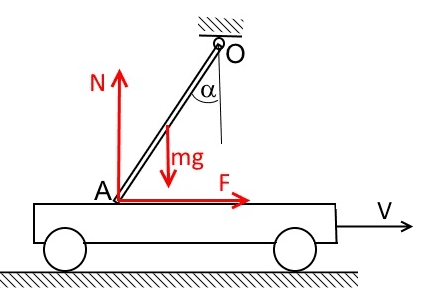
A cart moves from left to right on a horizontal road. Over the cart there is a pendulum with a fixed hing ##O## and a homogeneous rod ##OA## of mass ##m##. Rod's end ##A## rests on the cart such that the angle between the rod and the vertical is equal ##\alpha##.
Let ##N## be a normal reaction force that acts on the rod from the cart and ##F=\gamma N## be a force of friction applied to the rod; ##\gamma## is a coefficient of friction.
Applying the law of torques about the point ##O## we get
$$N=\frac{mg\sin\alpha}{2(\sin\alpha-\gamma\cos\alpha)}.$$ Thus if ##\tan\alpha<\gamma## then ##N<0## and the cart attracts the rod. That is impossible.
 
Physics news on Phys.org
zwierz said:
Thus if ##\tan\alpha<\gamma## then ##N<0## and the cart attracts the rod. That is impossible.
Why? It just means that the rod can neither sink into the cart nor leave the cart. I can think of possible ways to accomplish that.
 
  • Like
Likes   Reactions: Nidum
It means that the reaction N is directed downstairs and thus all the forces rotate the rod in the same direction (counterclockwise) but the rod remains at rest. Contradiction.
 
zwierz said:
all the forces rotate the rod in the same direction (counterclockwise)
Doesn't F rotate clockwise in this case?
 
Isn't this just a simplified linear version of a sprag clutch ?

With suitable geometry these mechanisms allow free motion in one direction and strongly retarded or stopped motion in opposite direction .
.
 
Dale said:
Doesn't F rotate clockwise in this case?
the force of friction acts in the opposite direction of relative velocity. The relative velocity is the same for both cases
 
zwierz said:
Thus if ##\tan\alpha<\gamma## then ##N<0## and the cart attracts the rod. That is impossible.
In reality this means: If friction is too high, the thing will lock or break.
 
Last edited:
we can also replace the rod with a very strong spring
 
zwierz said:
we can also replace the rod with a very strong spring
A spring will compress and rotate counter clockwise, so no contradiction.
 
  • #10
Sure, I just proposed one of the ways to change the model such that the contradiction vanishes.
In reality the rod will likely begin to jump
 

Similar threads

  • · Replies 18 ·
Replies
18
Views
3K
  • · Replies 125 ·
5
Replies
125
Views
20K
Replies
13
Views
5K
  • · Replies 20 ·
Replies
20
Views
11K
  • · Replies 28 ·
Replies
28
Views
7K
  • · Replies 16 ·
Replies
16
Views
7K
  • · Replies 175 ·
6
Replies
175
Views
27K
Replies
1
Views
2K
Replies
2
Views
19K
Replies
1
Views
7K