Particle in a box wave function problem

Click For Summary

Homework Help Overview

The discussion revolves around a wave function problem in quantum mechanics, specifically related to a particle in a potential barrier scenario. Participants are tasked with determining the wave functions across different regions and calculating the reflection and transmission coefficients as a particle beam approaches a barrier with a given energy.

Discussion Character

  • Exploratory, Conceptual clarification, Mathematical reasoning, Problem interpretation

Approaches and Questions Raised

  • Participants discuss breaking down the potential into multiple regions and solving the Schrödinger equation for each. There are questions about the correct application of wave function forms and the meaning of reflection and transmission coefficients. Some express uncertainty about their understanding of the Schrödinger equation and the implications of the potential energy on the wave function.

Discussion Status

There is an ongoing exploration of the problem with various approaches being suggested. Some participants have offered guidance on solving the Schrödinger equation and matching boundary conditions, while others are questioning their understanding of the coefficients and the complexity of their results. No consensus has been reached, but productive discussions are taking place.

Contextual Notes

Participants note the potential complexity of the problem due to the different regions and potential energies involved. There is also mention of the original poster's concerns about their grade and the clarity of instruction received in class.

shan564
Messages
5
Reaction score
0
I have a wave function problem that I need to figure out... I have a really borderline grade, so it could mean the difference between an 'A' and a 'B' in my graduate Modern Physics class.

Basically, I have to figure out the wave function and the transmission and reflection coefficients. My professor did a really crappy job of explaining this stuff in class, so I'm totally lost.

Here's the question:
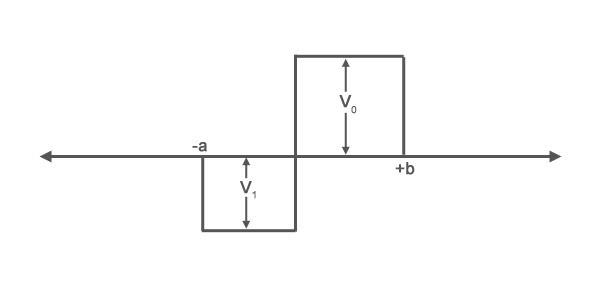
Consider a potential with the following shape:
Untitled-4.jpg

What are the wave functions for all regions of the problem is a particle beam approaches the barrier from negative infinity with an energy E? Find the reflection and transmission coefficients.
 

Attachments

  • Untitled-4.jpg
    Untitled-4.jpg
    3.9 KB · Views: 484
Last edited:
Physics news on Phys.org
Start by breaking down the potential into 4 parts, and solving the Schrödinger equation for each.
 
That's what I thought I'm supposed to do, but I'm not sure if I'm doing it right. Does that mean that I need to plug it into psi(x) = [(2/L)^(1/2)] [sin(n*pi*x/L)] ? My professor didn't do a very good job of explaining Schrödinger's equation, so I don't have a very thorough understanding of it.

Also, does "reflection" and "transmission" coefficients just mean that I need to plug it into these equations?
http://upload.wikimedia.org/math/0/f/2/0f28f1a66cd127802853761235a4ffaf.png
 
The Schrödinger equation, among many things, gives you a differential equation for Psi, of which, based on your potential energy, you can solve for Psi. I'd look it up on Wikipedia (you want the time independent form) so you can get practice solving it (it's actually not that bad for the potentials given). And for the reflection and transmission coefficients, those will not be the answer. Those are for a different potential (a single finite barrier I think, but that's just an inspective guess.)
 
You have four regions: x<-a, -a<x<0, 0<x<b, and x>b, which I will call R1, R2, R3, and R4. In each region, you solve the time-independent Schr eq. For a consant potential, the most general solution is of the form A e^(ikx) + B e^(-ikx), except possibly in R3; the solution is of this form if E>V0, but takes the form A e^(kx) + B e^(-kx) if E<V0. The value of k is generally different in each region, so you should give them all different names (eg, k1, etc.). You should figure out what they are; for example, you should find k_1=k_4=(2mE/\hbar^2)^{1/2}.

Next, you are doing a scattering problem with a particle incident from the left, so in R4 the particle should only be moving to the right; that means, in R4, the solution must be of the form G e^(i k4 x).

In R1, there is the incident wave, and a reflected wave, so we should take the wave function to be A e^(i k1 x) + B e^(-i k1 x). The reflection coefficient will then be R=|B|^2/|A|^2. The transmission coefficient will be T=|G|^2/|A|^2.

In R2 and R3, we use C e^(i k2 x) + D e^(-i k2 x) and E e^(i k3 x) + F e^(-i k3 x) (for the E>V0 case; if you solve this one, you can get the solution to the E<V0 case by letting k3 be imaginary, but you must know whether it's real or imaginary before taking absolute values to get R and T).

Now, at each of three boundaries between regions (x=-a, x=0, and x=b), the wave function and its first derivative must match. You can save yourself a lot of trouble by solving this ONCE: consider a match between A e^(i k x) + B e^(-i k x) on the left and C e^(i k' x) + D e^(-i k' x) on the right, at x=L. This will give you two equations that relate A and B to C and D. It's useful to write these in matrix form:
\begin{pmatrix} A \\ B \end{pmatrix}=\begin{pmatrix} \ldots &amp; \ldots \\ \ldots &amp; \ldots \end{pmatrix}\begin{pmatrix} C \\ D \end{pmatrix}
where the entries in the square matrix will depend on k, k', and L.

Now do this at each boundary, writing the column vector (A,B) as a matrix times (C,D), then (C,D) as a matrix times (E,F), then (E,F) as a matrix times (G,0). Then you can write (A,B) as the product of three matrices times (G,0). Multiply out the three matrices, and you have A as something times G, and B as something times G. G then cancels out when you compute R=|B|^2/|A|^2 and T=|G|^2/|A|^2, so you might as well just set G=1.

And you're done!
 
Last edited:
Thanks a lot! So basically, the first step is to figure out each k and solve the equation for psi? I guess that k2 and k3 are the same as k1 and k4, except that I replace "E" with "V-E", right?
 
shan564 said:
Thanks a lot! So basically, the first step is to figure out each k and solve the equation for psi? I guess that k2 and k3 are the same as k1 and k4, except that I replace "E" with "V-E", right?
The values of k come from solving the (Time Independent) SE. k1 and k4 will be the same, but k2 and k3 will have one or two (depending on how big E is) important differences.
 
Avodyne said:
Multiply out the three matrices, and you have A as something times G, and B as something times G.

OK... I got this far and I corroborated my answer with a classmate's.

Here's my latest problem... I multiplied out the three matrices using Mathematica and result (the "something" mentioned above in bold) was ridiculously long. I was expecting some of the things to cancel out, but it didn't seem to work out that way. This answer seems too complicated... am I doing something wrong or is this it?
 
It should be pretty long, especially since you're transmitting through different potentials, with different signs, and with different widths--doesn't leave much room for things to cancel out. I can't say for sure whether or not your answer is correct, but that it should be long.
 

Similar threads

  • · Replies 7 ·
Replies
7
Views
3K
  • · Replies 19 ·
Replies
19
Views
3K
  • · Replies 15 ·
Replies
15
Views
4K
  • · Replies 12 ·
Replies
12
Views
2K
  • · Replies 1 ·
Replies
1
Views
3K
  • · Replies 3 ·
Replies
3
Views
2K
  • · Replies 26 ·
Replies
26
Views
4K
  • · Replies 43 ·
2
Replies
43
Views
6K
  • · Replies 9 ·
Replies
9
Views
2K
  • · Replies 2 ·
Replies
2
Views
3K