Particle on a ring (components in the postion basis)

Click For Summary
SUMMARY

The discussion focuses on solving quantum mechanics tasks related to a particle on a ring, specifically tasks b and g. The wave function is expressed as $$\psi=\frac{1}{\sqrt{N}} \sum\limits_{k}^{} \psi_k$$, and the calculation of the inner product $$\braket{\vec{e}_j|\psi}$$ is explored. The participants clarify the implications of the uncertainty principle, concluding that the particle can be equally probable at all positions on the ring, despite initial confusion regarding the significance of specific locations.

PREREQUISITES
  • Understanding of quantum mechanics principles, particularly wave functions and eigenstates.
  • Familiarity with the mathematical representation of quantum states, including inner products and summation notation.
  • Knowledge of the uncertainty principle and its implications in quantum systems.
  • Basic grasp of Fourier series and their application in quantum mechanics.
NEXT STEPS
  • Study the derivation of the wave function for a particle on a ring using Fourier series.
  • Learn about the implications of the uncertainty principle in quantum mechanics.
  • Explore the concept of eigenstates and eigenvalues in quantum systems.
  • Investigate the mathematical techniques for calculating inner products in quantum mechanics.
USEFUL FOR

Students and professionals in quantum mechanics, physicists working with wave functions, and anyone interested in the mathematical foundations of quantum systems.

Lambda96
Messages
233
Reaction score
77
Homework Statement
see screenshots
Relevant Equations
none
Hi,

I have problems with the task part b and g

To solve the task, we have received the following information
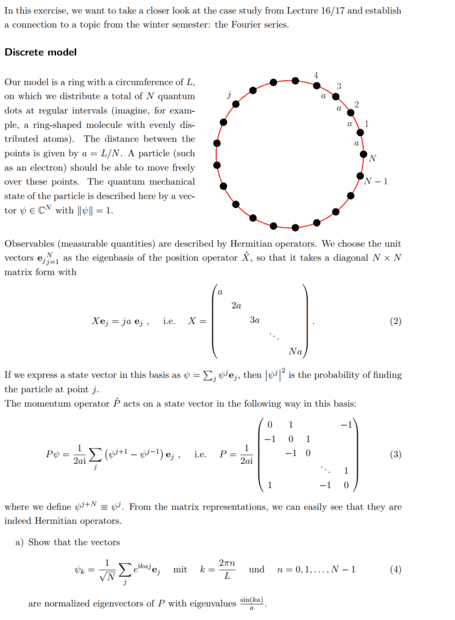
Bildschirmfoto 2023-06-14 um 19.14.36.png


Task b
Bildschirmfoto 2023-06-14 um 20.03.21.png


First, I wrote down what the state ##\psi## looks like

$$\psi=\frac{1}{\sqrt{N}} \sum\limits_{k}^{} \psi_k$$
$$\psi=\frac{1}{\sqrt{N}} \sum\limits_{k}^{} \frac{1}{\sqrt{N}} \sum\limits_{j}^{} e^{ikaj} \vec{e}_j$$

Then I to calculate ##\psi^j=\braket{\vec{e}_j|\psi}##.

$$\braket{\vec{e}_j|\psi}=\vec{e}_j^{\dagger} \cdot \frac{1}{\sqrt{N}} \sum\limits_{k}^{} \frac{1}{\sqrt{N}} \sum\limits_{j}^{} e^{ikaj} \vec{e}_j$$

$$\braket{\vec{e}_j|\psi}=\vec{e}_j^{\dagger} \cdot \frac{1}{N} \sum\limits_{k}^{} \sum\limits_{j}^{} e^{ikaj} \vec{e}_j$$
Now I unfortunately do not know how to proceed further. But I don't understand, if all momentums are equally probable, why the particle should be 100% at location N and not at other locations like 1 and 2 and so on. What makes the point N so special that the particle should be there in contrast to the other points?

To solve task g, we have received the following information
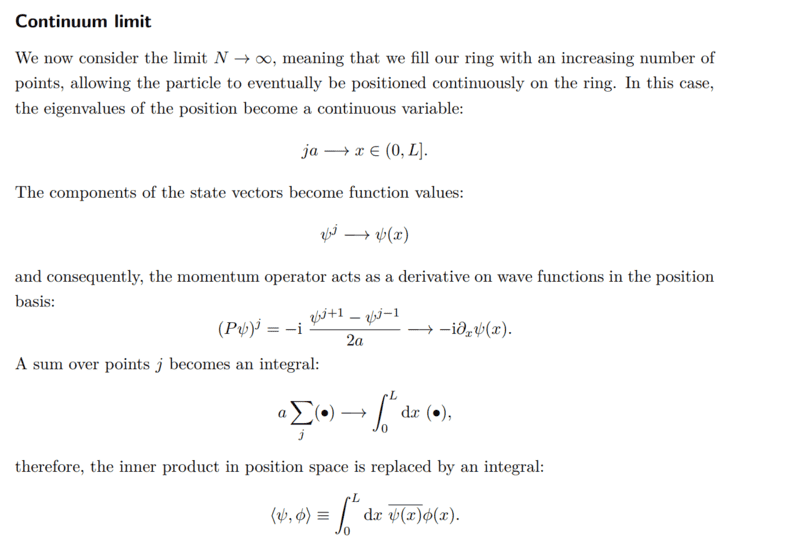
Bildschirmfoto 2023-06-14 um 19.25.16.png


Task g
Bildschirmfoto 2023-06-14 um 19.15.43.png

If I understood the task correctly, then the wave function is collapsed, to the eigenvector of the momentum operator, more precisely to ##\psi_0##. The wave function has with 100% the eigenvalue of ##\psi_0## after the uncertainty principle, the uncertainty would have to become extremely large concerning the position, which means that the particle can be everywhere on the ring and thus the probability for each position is equally large.
 
Last edited:
Physics news on Phys.org
Lambda96 said:
$$\braket{\vec{e}_j|\psi}=\vec{e}_j^{\dagger} \cdot \frac{1}{\sqrt{N}} \sum\limits_{k}^{} \frac{1}{\sqrt{N}} \sum\limits_{j}^{} e^{ikaj} \vec{e}_j$$
In the second sum on the right, you should change the summation index ##j## to some other symbol so that the summation index is not confused with the ##j## in ##\vec{e}_j^{\dagger}##. For example, you could write $$\braket{\vec{e}_j|\psi}=\vec{e}_j^{\dagger} \cdot \frac{1}{\sqrt{N}} \sum\limits_{k}^{} \frac{1}{\sqrt{N}} \sum\limits_{l}^{} e^{ikal} \vec{e}_l$$
 
  • Like
Likes   Reactions: Lambda96
Thanks TSny for your help 👍, I have now changed the index of the summation from ##j## to ##l## and have now calculated the following.

$$\braket{\vec{e}_j|\psi}=\vec{e}_j^{\dagger} \cdot \frac{1}{\sqrt{N}} \sum\limits_{k}^{} \frac{1}{\sqrt{N}} \sum\limits_{l}^{} e^{ikal} \vec{e}_l$$
$$\braket{\vec{e}_j|\psi}=\frac{1}{N} \sum\limits_{k}^{} \sum\limits_{l}^{} e^{ikal} \vec{e}_j^{\dagger} \cdot \vec{e}_l$$
$$\braket{\vec{e}_j|\psi}=\frac{1}{N} \sum\limits_{k}^{} \sum\limits_{l}^{} e^{ikal} \delta_{jl}$$
$$\braket{\vec{e}_j|\psi}=\frac{1}{N} \sum\limits_{k}^{} e^{ika} \delta_{j1}+e^{2ika} \delta_{j2}+ \ldots +e^{Nika} \delta_{jN}$$
$$\braket{\vec{e}_j|\psi}=\frac{1}{N} \Bigl( e^{ia} \delta_{j1}+e^{2ia} \delta_{j2}+ \ldots +e^{Nia} \delta_{jN}+e^{2a} \delta_{j1}+e^{4ia} \delta_{j2}+ \ldots +e^{2Nia} \delta_{jN}+ \ldots + e^{Nia} \delta_{j1}+e^{2Nia} \delta_{j2}+ \ldots +e^{N^2ika} \delta_{jN} \Bigr)$$

$$\braket{\vec{e}_j|\psi}=\frac{1}{N} \Bigl(\Bigl(e^{ia}+e^{2a} +\ldots+e^{Nia} \Bigr) \delta_{j1}+\Bigl( e^{2ia}+e^{4ia}+ \ldots +e^{2Nia} \Bigr)\delta_{j2}+ \ldots + \Bigl( e^{Nia}+e^{2Nia} + \ldots +e^{N^2ika} \Bigr)\delta_{jN}\Bigr)$$

Now I'm stuck 🙃

The individual entries in the brackets look almost like states ##\vec{\psi}_k##, i.e.

$$\braket{\vec{e}_j|\psi}=\frac{1}{\sqrt{N}} \Bigl(\frac{1}{\sqrt{N}} \Bigl(e^{ia}+e^{2a} +\ldots+e^{Nia} \Bigr) \delta_{j1}+\frac{1}{\sqrt{N}} \Bigl( e^{2ia}+e^{4ia}+ \ldots +e^{2Nia} \Bigr)\delta_{j2}+ \ldots + \frac{1}{\sqrt{N}} \Bigl( e^{Nia}+e^{2Nia} + \ldots +e^{N^2ika} \Bigr)\delta_{jN}\Bigr)$$

$$\braket{\vec{e}_j|\psi}=\frac{1}{\sqrt{N}} \Bigl(\vec{\psi}_1 \delta_{j1}+\vec{\psi}_2 \delta_{j2}+ \ldots + \vec{\psi}_N \delta_{jN}\Bigr)$$

Now does it mean that if, for example, ##\vec{e}_j=\vec{e}_2##, that only the state ##\braket{\vec{e}_2|\psi}=\frac{1}{\sqrt{N}} \Bigl(\vec{\psi}_2 \delta_{22}\Bigr)## remains and the particle is at location 2?
 
Lambda96 said:
$$\braket{\vec{e}_j|\psi}=\frac{1}{N} \sum\limits_{k}^{} \sum\limits_{l}^{} e^{ikal} \delta_{jl}$$
Good. Consider the sum $$ \sum\limits_{l}^{} e^{ikal} \delta_{jl}$$Since ##\delta_{jl}## equals zero for any ##l \neq j##, all of the terms in the summation are zero except for one term. So, the sum reduces to one term that can be written in terms of ##k##, ##a##, and ##j##.
 
  • Like
Likes   Reactions: Lambda96 and vanhees71
Thanks TSny for your help 👍👍

Then I can write the term as follows

$$\braket{\vec{e}_j|\psi}=\frac{1}{N}\sum\limits_{k}^{} \sum\limits_{l}^{}e^{ikal} \delta_{jl}$$
$$\braket{\vec{e}_j|\psi}=\frac{1}{N}\sum\limits_{k}^{} e^{ikaj}$$
$$\braket{\vec{e}_j|\psi}=\frac{1}{N}\Bigl( e^{iaj}+e^{2iaj}+e^{3iaj}+ \ldots +e^{Niaj} \Bigr)$$
 
Lambda96 said:
$$\braket{\vec{e}_j|\psi}=\frac{1}{N}\sum\limits_{k}^{} \sum\limits_{l}^{}e^{ikal} \delta_{jl}$$
$$\braket{\vec{e}_j|\psi}=\frac{1}{N}\sum\limits_{k}^{} e^{ikaj}$$
$$\braket{\vec{e}_j|\psi}=\frac{1}{N}\Bigl( e^{iaj}+e^{2iaj}+e^{3iaj}+ \ldots +e^{Niaj} \Bigr)$$
Good, except the sum over ##k## does not go from ##k = 1## to ##k = N##. Recall that the values of ##k## are ##k = 2\pi n /L## for ##n = 0, 1, 2, ... , N-1##.
 
  • Like
Likes   Reactions: Lambda96 and SammyS
Thanks again for your help TSny👍👍 👍, also thanks for the hint with the index ##k## 👍

Could I then write the second line as follows?$$\braket{\vec{e}_j|\psi}=\frac{1}{N}\sum\limits_{k}^{} e^{ikaj}$$

$$\braket{\vec{e}_j|\psi}=\frac{1}{N}\sum\limits_{n=0}^{N-1} e^{\frac{2i \pi n a j}{L}}$$
 
Lambda96 said:
Thanks again for your help TSny👍👍 👍, also thanks for the hint with the index ##k## 👍

Could I then write the second line as follows?$$\braket{\vec{e}_j|\psi}=\frac{1}{N}\sum\limits_{k}^{} e^{ikaj}$$

$$\braket{\vec{e}_j|\psi}=\frac{1}{N}\sum\limits_{n=0}^{N-1} e^{\frac{2i \pi n a j}{L}}$$
Yes, that looks right.
 
  • Like
Likes   Reactions: Lambda96
Thanks for your help TSny 👍👍👍
 
  • #10
You’re very welcome.
 
  • Like
Likes   Reactions: Lambda96

Similar threads

  • · Replies 1 ·
Replies
1
Views
1K
Replies
1
Views
2K
  • · Replies 4 ·
Replies
4
Views
2K
  • · Replies 1 ·
Replies
1
Views
2K
  • · Replies 0 ·
Replies
0
Views
2K
  • · Replies 1 ·
Replies
1
Views
1K
Replies
4
Views
2K
  • · Replies 13 ·
Replies
13
Views
4K
  • · Replies 2 ·
Replies
2
Views
2K
  • · Replies 6 ·
Replies
6
Views
1K

