Peanut-shaped near-Earth asteroid imaged by radar

  • Context: Undergrad 
  • Thread starter Thread starter Spinnor
  • Start date Start date
  • Tags Tags
    Asteroid Radar
Click For Summary

Discussion Overview

The discussion revolves around the radar imaging of a peanut-shaped near-Earth asteroid, specifically addressing the brightness observed in the radar images and the factors influencing it. Participants explore the implications of radar intensity, angles of reflection, and potential effects from solar radiation.

Discussion Character

  • Exploratory, Technical explanation, Debate/contested

Main Points Raised

  • One participant questions why the brightest part of the radar image is located at the upper edges of the asteroid, suggesting it may be a software effect.
  • Another participant notes that the radar emitter and receiver are in different locations, which could affect the imaging.
  • A follow-up comment acknowledges the angle formed by the emitter, reflector, and absorber is nearly zero at the distance to the asteroid.
  • One participant speculates that the observed brightness might be due to solar electromagnetic radiation in the radar range.
  • Another participant humorously suggests the asteroid resembles a dumbbell rather than a peanut and raises the possibility of a Doppler shift affecting the radar image, later retracting this idea due to confusion about the source of the radiation.

Areas of Agreement / Disagreement

Participants express differing views on the reasons behind the brightness in the radar images, with no consensus reached on the underlying causes or effects.

Contextual Notes

Participants do not fully resolve the implications of radar intensity and the effects of angles and radiation sources on the imaging process.

Spinnor
Gold Member
Messages
2,231
Reaction score
419
Why is the brightest part of the asteroid radar image below the upper edges?
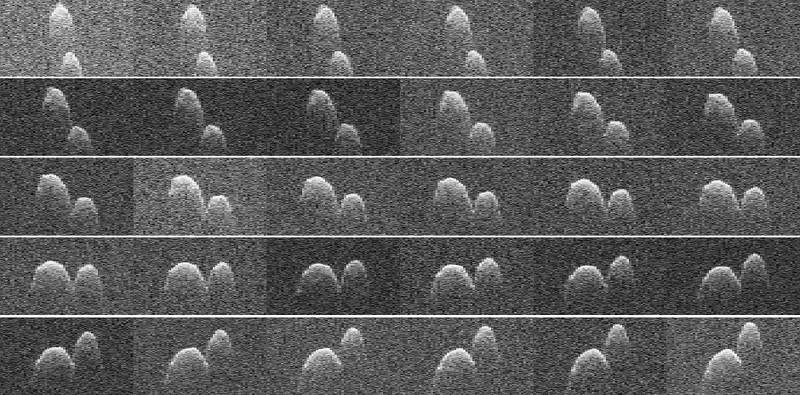
PIA19647_940x464.jpg


From,

http://astronomynow.com/2015/08/03/peanut-shaped-near-earth-asteroid-1999jd6-imaged-by-radar/

Is it a software effect? I would naively think that the greatest radar intensity would be reflected from the parts of the asteroid nearly perpendicular to our view. A Google image search shows a similar trend.

https://www.google.com/search?safe=...13.0...0...1ac.1.64.img..0.18.879.Clm93sqRtmU
 
Astronomy news on Phys.org
Well, for starters, the radar emitter and receiver are in different locations.
 
DaveC426913 said:
Well, for starters, the radar emitter and receiver are in different locations.

Right, but at the distance to the asteroid, the angle formed by the emitter, reflector, and absorber is nearly zero?
 
Yeah. It was a reach. :biggrin:

I'll bet that we are seeing solar EM radiation in the radar range.
 
  • Like
Likes   Reactions: RaulTheUCSCSlug
Looks more like a dumbbell then a peanut :biggrin: and well could it be due to something like a Doppler shift?

Edit: Nevermind I don't think it would make much sense since the radar emitter is the one emitting the rays, not the asteroid... right? Unless the asteroid is emitting radiation as well.
 

Similar threads

  • · Replies 1 ·
Replies
1
Views
1K
  • · Replies 1 ·
Replies
1
Views
1K
  • · Replies 2 ·
Replies
2
Views
2K
  • · Replies 4 ·
Replies
4
Views
6K
  • · Replies 3 ·
Replies
3
Views
2K
  • · Replies 6 ·
Replies
6
Views
4K
  • · Replies 4 ·
Replies
4
Views
3K
  • · Replies 2 ·
Replies
2
Views
5K
  • · Replies 1 ·
Replies
1
Views
3K