Parallel light rays through a sprial wave plate diverge?

Click For Summary

Discussion Overview

The discussion centers on whether parallel light rays diverge upon exiting a spiral wave plate and the implications of such divergence on the angular momentum of light. The conversation explores theoretical and conceptual aspects of light behavior in relation to the spiral wave plate design.

Discussion Character

  • Debate/contested
  • Conceptual clarification

Main Points Raised

  • One participant questions if parallel light rays diverge slightly after passing through a spiral wave plate and whether this divergence affects the angular momentum of the light.
  • Another participant argues that without an interface between glass parts, one would not expect any unusual behavior, suggesting that a straight beam is the expected outcome.
  • A third participant reiterates the point about the absence of an interface and expresses skepticism about the initial premise, implying that the expected behavior should be straightforward.
  • Another participant comments on the bending of light rays as depicted in an image, suggesting that the symmetry of the spiral wave plate should lead to predictable outcomes, and questions the logic of divergence in a homogeneous material.
  • There is a suggestion that while light may be polarized, the overall behavior of light exiting the plate does not support the idea of divergence.

Areas of Agreement / Disagreement

Participants express differing views on the behavior of light rays passing through a spiral wave plate, with no consensus reached regarding the divergence of light or its implications for angular momentum.

Contextual Notes

Participants highlight assumptions regarding the material properties of the spiral wave plate and the presence of interfaces, which may influence the discussion but remain unresolved.

Spinnor
Gold Member
Messages
2,231
Reaction score
419
Do parallel light rays diverge if ever so slightly upon exiting a spiral wave plate? See image below.
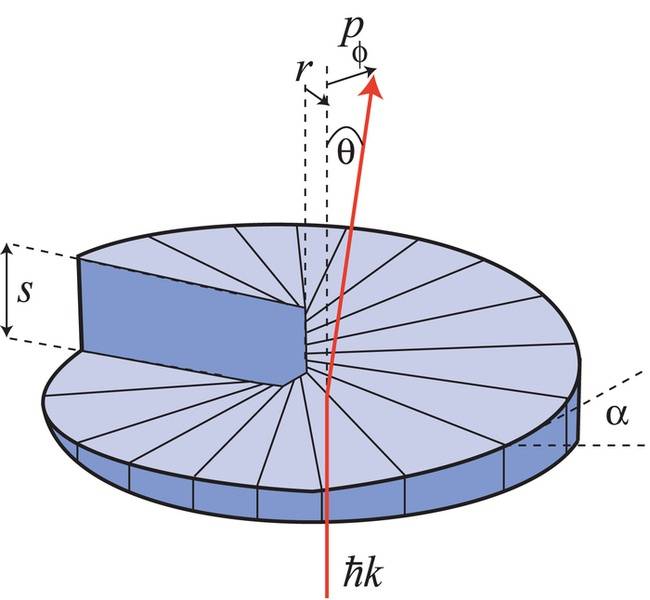
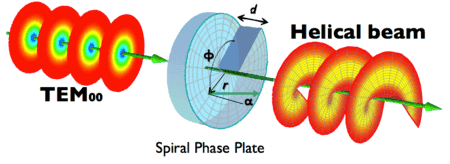
phase-plate.jpg


450px-Spiral-phase-plate.png


Images from,

https://www.google.com/search?q=spiral+phase+plate&safe=off&sa=X&es_sm=122&biw=1360&bih=649&tbm=isch&tbo=u&source=univ&ei=xEGDVcaKFYLV-AHZop_IAw&ved=0CC0QsAQ#imgrc=V_wYVTQHs9_JcM%3A;MIMazroQRD_VYM;http%3A%2F%2Fupload.wikimedia.org%2Fwikipedia%2Fcommons%2F1%2F1f%2FSpiral-phase-plate.png;http%3A%2F%2Fen.wikipedia.org%2Fwiki%2FAngular_momentum_of_light;1047;382

If there is divergence does that change the angular mementum of the light?

Thanks for any help!
 
Science news on Phys.org
If there is no interface between those glas parts where would you expect any special things but a straight beam?
It makes no sense from the very beginning.
 
Omega0 said:
If there is no interface between those glas parts where would you expect any special things but a straight beam?
It makes no sense from the very beginning.

The first image above seems to show a typical light ray bending.
 
Spinnor said:
The first image above seems to show a typical light ray bending.
Come on... the symmetry is circular and waves here are as I expect them...it seems to be homogenieous material ... you can find silly ways to bend light but in the end you will have nothing but light, may be polarized. From symmetry reasons the outcouming is nonsense. If it is homgeneous stuff.
May be harsh critics but I think Spinnor will report about it.
 

Similar threads

  • · Replies 4 ·
Replies
4
Views
2K