Perceived Speed of Objects in Space

  • Context: Undergrad 
  • Thread starter Thread starter krs1
  • Start date Start date
  • Tags Tags
    Space Speed
Click For Summary

Discussion Overview

The discussion revolves around the perceived speed of objects in space, particularly focusing on how the observation of distant celestial objects can create illusions of acceleration due to the finite speed of light. Participants explore the implications of light travel time on the perception of motion and the effects of Doppler shift on observed wavelengths.

Discussion Character

  • Exploratory
  • Debate/contested
  • Mathematical reasoning

Main Points Raised

  • One participant presents a hypothetical scenario involving a massive object moving towards Earth at a constant speed, questioning whether it would appear to accelerate due to the light travel time affecting perception.
  • Another participant asserts that the apparent speed remains constant and there is no acceleration, challenging the initial hypothesis.
  • Discussion includes the effects of Doppler shift, with participants noting that light from an object moving towards an observer will be blue-shifted, altering the perceived color of light emitted from objects like sodium bulbs.
  • Concerns are raised about calculating the speed of an object based on perceived motion, with questions about whether Doppler equations account for the light travel time and the resulting discrepancies in perceived versus actual speed.
  • A participant emphasizes the importance of considering signal travel time in measurements, using an analogy of synchronized clocks to illustrate how perception can be misleading without accounting for distance.
  • Further clarification is sought on how to measure the speed of distant objects accurately, particularly when they are moving directly towards an observer.

Areas of Agreement / Disagreement

Participants express differing views on whether the perceived speed of an object changes due to light travel time, with some asserting that it remains constant while others suggest it could appear to accelerate. The discussion remains unresolved regarding the implications of Doppler shift and the accuracy of speed calculations.

Contextual Notes

Participants acknowledge that the calculations of speed must consider the travel time of light, which complicates the interpretation of observed motion. There is an ongoing debate about the application of Doppler equations in this context.

Who May Find This Useful

This discussion may be of interest to those studying astrophysics, astronomy, or anyone curious about the effects of light travel time on the perception of motion in space.

krs1
Messages
2
Reaction score
0
I have a somewhat hypothetical scenario that I've been thinking about lately. I have a pretty basic understanding of physics and the mathematics involved but i enjoy learning about astronomy and astrophysics.

So the scenario is this, let's say an object such as a huge star or galaxy was to just 'appear' at a distance of 10 light years from Earth, and it is heading directly towards Earth at a constant speed of 1 light year every 10 years which works out to be a speed of 29,979.2458km/s (about 1/10 speed of light).

Also let's say that in this example the Earth and the observer are stationary, so the object is simply moving directly towards the observer in empty space. Let's also say that we are able to physically observe the object using a telescope.

So the light from the object will take 10 years to reach us, at which point the object would have moved closer to us by a light year. So the moment the light reaches us, we'd see the object at a distance of 10ly but its true position would be 9ly away. Now the light from its current position will only take 9 years to reach us, so as we observe the object, we would perceive it to move from 10ly to 9ly in only 9 years.
This means that the object would appear to be moving faster than it actually is. If you continue to plot this on a graph it creates two lines that intercept at the point of collision. So the difference in distance between the true position of the object and the observers perceived position of the object decreases with time until the objects collide.

To simplify further, if the object travels at 29,979.2458km/s, it will take 100 years for it to travel 10ly and collide with earth. However as the observer misses the first 10 years, it will still appear at a distance of 10ly but it will only take 90 years to travel the 10ly distance until it collides with earth. This gives us an average speed of 33,310.273km/s.

My question then is would the object appear to be accelerating towards us even though its true speed is constant? And how can you tell if what we see when we observe objects in space is accurate given that the nature of light can cause illusions like this.
I had a look into the doppler shift equations for light, the math is a little beyond my current capability however i did notice that time dilation gets taken into account, is this essentially what that part of the equation is in reference to?
 
Astronomy news on Phys.org
krs1 said:
My question then is would the object appear to be accelerating towards us even though its true speed is constant?
The apparent speed is constant as well. So no acceleration.
 
krs1 said:
...

My question then is would the object appear to be accelerating towards us even though its true speed is constant? And how can you tell if what we see when we observe objects in space is accurate given that the nature of light ...

If an object moves towards us at 0.1c the light will blue shift. A sodium light bulb radiates a lot of 589nm radiation. It looks yellow when stationary. A spaceship with sodium vapor headlights moving at 0.1c will look green because the wave is compressed to 536nm. Stars/objects could have sodium emissions but even if they do not they will have emissions(and/or absorption) from whichever elements are present. Sodium vapor tail lights would look orange because the wavelength of light is stretched from our perspective. Aliens on the ship would see their bulb is yellow at all times but they would see the bulbs in parking lots on Earth shift as they pass. Relativity adjust the amount slightly but not much at 0.1c. The sodium bulb headlights are green with or without relativity.
 
stefan r said:
If an object moves towards us at 0.1c the light will blue shift. A sodium light bulb radiates a lot of 589nm radiation. It looks yellow when stationary. A spaceship with sodium vapor headlights moving at 0.1c will look green because the wave is compressed to 536nm. Stars/objects could have sodium emissions but even if they do not they will have emissions(and/or absorption) from whichever elements are present. Sodium vapor tail lights would look orange because the wavelength of light is stretched from our perspective. Aliens on the ship would see their bulb is yellow at all times but they would see the bulbs in parking lots on Earth shift as they pass.Relativity adjust the amount slightly but not much at 0.1c. The sodium bulb headlights are green with or without relativity.
Thanks for the reply, i understand that the object would appear blueshifted, but if we were trying to calculate its speed towards us, what answer would we get considering we'd perceive it to be traveling at 33,310.273km/s when its actually traveling a bit slower at 29,979.2458km/s. Or do the doppler equations take this into account?
 
krs1 said:
Thanks for the reply, i understand that the object would appear blueshifted, but if we were trying to calculate its speed towards us, what answer would we get considering we'd perceive it to be traveling at 33,310.273km/s when its actually traveling a bit slower at 29,979.2458km/s. Or do the doppler equations take this into account?

All measurements in physics must take into account the travel time of a signal. Where the light takes a significant time to reach you, you must take this into account when describing or calculating the position of an object in your reference frame.

A more Earthbound example would be two town clocks a few miles apart. If the clocks are synchronised and chime the hour at the same time, then depending on where you are standing you may hear one clock before the other. Everyone must, however, take the distance to the clocks into account before deciding that they are not synchonised. Otherwise, someone standing next to one clock would decide that the other clock is behind and might go to fix it. But, when they reach the other clock, it would be the first clock that is now behind.

In summary, you must factor the signal travel time (whether it is sound or light) into your calculations.

The speed of the object in your example would be the ##29.9 km/s##. A calculation of a speed of ##33.3 km/s## would be wrong, because it doesn't take account of the signal travel time.
 
krs1 said:
... do the doppler equations take this into account?

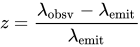
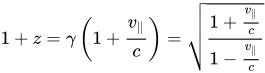
For motion completely in the radial or line-of-sight direction:
d13cfbc8e65189ef9324e78d38b21d02045b9e12

95e407722c57dda3dd2e8a44cd590ddd13599d57
for small v

v is the velocity.

6a999cd6480ab61dddeeb5372c8037c0d533f2c9


λ is the wavelength of light.

If something is moving straight at you there is no perceived motion. You could use something like parallax calculate distance and then measure the rate of change over time. When you catch a ball your eyes/brain are using parallax to measure the distance. For far away objects the parallax measurements do not work well. The change in angle would be so small that we could not detect it.
 
Last edited:

Similar threads

  • · Replies 25 ·
Replies
25
Views
3K
  • · Replies 3 ·
Replies
3
Views
2K
  • · Replies 3 ·
Replies
3
Views
2K
  • · Replies 13 ·
Replies
13
Views
3K
  • · Replies 9 ·
Replies
9
Views
2K
  • · Replies 2 ·
Replies
2
Views
2K
  • · Replies 3 ·
Replies
3
Views
2K
  • · Replies 6 ·
Replies
6
Views
2K
  • · Replies 6 ·
Replies
6
Views
3K
  • · Replies 30 ·
2
Replies
30
Views
3K