althea_saile
- 1
- 1
Hello,
I am studying geometry with an app on my phone. There was a difficult problem, which had two different explanations for solving. I correctly understood one explanation. I reviewed later without memory of the problem at all. There was an obvious attempt from what was learned previously, but I discovered something more perhaps! I creatively guessed at a new explanation due to my lack of memory. I guessed the answer correctly with a different understanding of the method solution used.
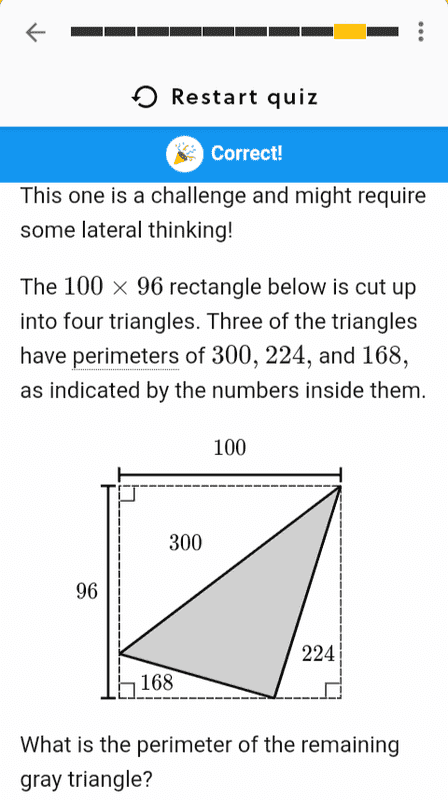 The explanation #2 that I initially answered correct: "The perimeter of the gray triangle is equal to the difference between the sum of triangle periemeters and the perimeter of the square. The perimeter of the square is 2 X 96 + 2 X 100 = 392, while the sum of the triangle perimeters is 224 + 168 + 300 = 692. The perimeter of the gray triangle is 692 - 392= 300."
Memory-less review of the problem: There seems to be some kind of relation between perimeter of a shape & smaller shape perimeters inside that encompassing shape. I don't have the know-how or tools to experiment with this theory. How do I come up with the perimeter of a random shape, with included smaller perimeters inside that shape for play at this idea--like a teacher? When, where, and why does this seem to be true? I'll note down what I CAN do, without coming up with an experiment, then search the internet. I noticed that there are 4 sides to the rectangle, which is conveniently the number of smaller shapes inside of it. Does this mean that a polygon with n-sides has a perimeter relationship to the perimeters of inscribed n-polygons summated? Another thought I had was that it would have to be n-sided polygon minus one for the summation relation of the perimeter to work... Perhaps it does but it is out of my knowledge base to test this. I searched google to no avail.Hopefully my line of thought makes sense & someone here has something to say about this please! thank you.
I am studying geometry with an app on my phone. There was a difficult problem, which had two different explanations for solving. I correctly understood one explanation. I reviewed later without memory of the problem at all. There was an obvious attempt from what was learned previously, but I discovered something more perhaps! I creatively guessed at a new explanation due to my lack of memory. I guessed the answer correctly with a different understanding of the method solution used.
Memory-less review of the problem: There seems to be some kind of relation between perimeter of a shape & smaller shape perimeters inside that encompassing shape. I don't have the know-how or tools to experiment with this theory. How do I come up with the perimeter of a random shape, with included smaller perimeters inside that shape for play at this idea--like a teacher? When, where, and why does this seem to be true? I'll note down what I CAN do, without coming up with an experiment, then search the internet. I noticed that there are 4 sides to the rectangle, which is conveniently the number of smaller shapes inside of it. Does this mean that a polygon with n-sides has a perimeter relationship to the perimeters of inscribed n-polygons summated? Another thought I had was that it would have to be n-sided polygon minus one for the summation relation of the perimeter to work... Perhaps it does but it is out of my knowledge base to test this. I searched google to no avail.Hopefully my line of thought makes sense & someone here has something to say about this please! thank you.