MartK said:
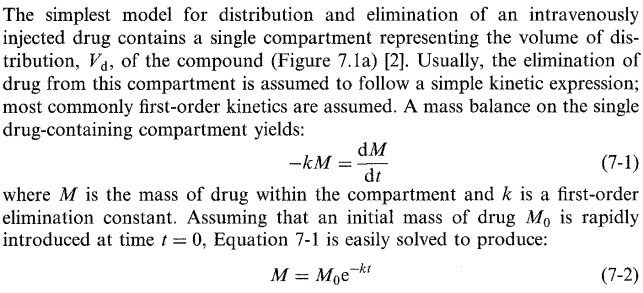
Hello! I encountered this simple model for drug distribution in a textbook, but was not able to come up with the solution myself. It's been bothering me way too much past two days... Perhaps more so because of the "Equation 7-1 is easily solved" part. Hints/help would be much appreciated!
Here's a screenshot from the book (Drug Delivery by M. Salzman). How is the equation 7-1 solved?
I'll let you into a secret - it is almost true that there is no way to solve a differential equation. When they say 'solve' what they mean is they already know the solution. Or at least the outline shape of it so they can hammer that till it becomes the exact solution. You are able to know whether anything is a solution because there
is a general way of
differentiating practically anything, any trial solution to enable you to know how to modify one to make it fit, including obtaining the constants that have to be inserted which depend on the starting conditions or other info.
So, you have to know differentiation - and also understand exponents and logs.
Then the way it is pretended to solve the above is to know that
d(e
t)/dt = e
t. Which is key to many things.
Then by a general calculus rule d(Ae
-kt)/dt = -k A e
-kt where A is an arbitrary constant
This looks like M = A e
-kt has the form to fit 7-1, yes you can find applying the above rules that it does.
To decide what A is , when t = 0, e
-kt = 1. Then M at time 0 is - k A . That is - k A = M
0
There is another way of pretending to solve the equation using logs. Do you know that d ln x/dx = 1/x ?
But basically you are asking us to write you the first chapter or two of a book on differential equations. Better find one, preferably one aimed at biologists/medics - your problem is considered the most elementary standard one.
I should maybe tone down the comments above to say that it is not just a matter of recognising solutions individually, but they come in families, and this is the most elementary of the family of "linear ordinary differential equations" which any scientist who does anything mathematical at all has to grasp.
I
hope someone can suggest the available cheap
suitable book that gets you up to speed fast enough; I have "Differentital Equations for Dummies" which might sound right but feel that's a bit too slow.