arrenio
- 1
- 1
Dear Forum Members, I am looking for someone who can help me to model the behavior of a photodiode in parallel with a capacitor. I want to model the behavior of a device that I have developed.
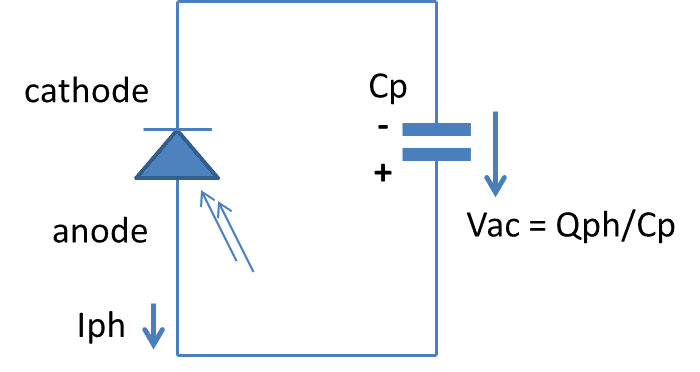
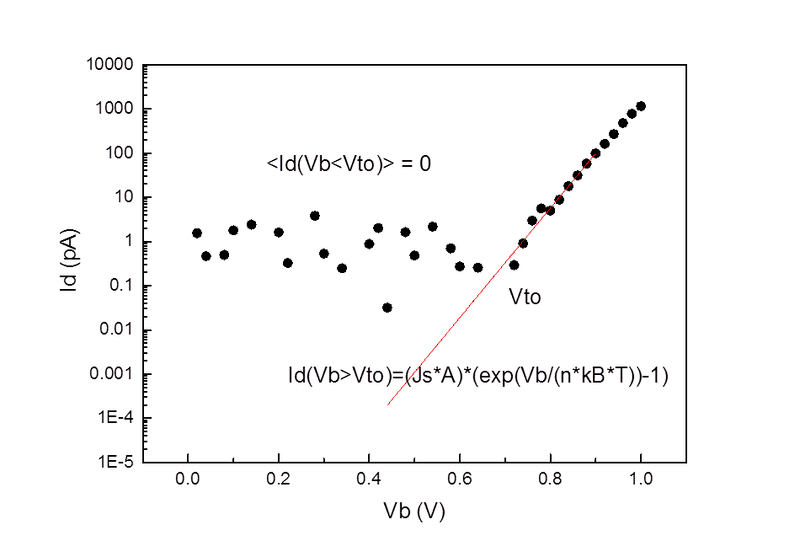
As you can see in my attached file, the photodiode shows a current-to voltage characteristic with a turn-on voltage Vto, and receives irradiation for a given time tirr. The photodiode is connected in parallel with an ideal capacitor Cp. Once the photodiode is irradiated, a photocurrent Ip flows and the capacitor starts charging. A positive voltage drop Vac arises on the capacitor, with a sign so that the photodiode is forwardly biased. At a certain irradiation dose (i.e., after a certain irradiation time) the accumulated charge on the capacitor will produce a voltage drop > Vto, and a forward current will flow on the photodiode, so that voltage drop Vac is limited by such a current. Once irradiation stops, given the photodiode has a zero leakage current, the device keeps the photogenerated charge on the capacitor, but the behavior is not linear vs. irradiation time, due to the discharge of photogenerated charge above Vto.
Can someone help me in modeling such a behavior?
thank you!
schematic and experimental IV curve of the photodiode
As you can see in my attached file, the photodiode shows a current-to voltage characteristic with a turn-on voltage Vto, and receives irradiation for a given time tirr. The photodiode is connected in parallel with an ideal capacitor Cp. Once the photodiode is irradiated, a photocurrent Ip flows and the capacitor starts charging. A positive voltage drop Vac arises on the capacitor, with a sign so that the photodiode is forwardly biased. At a certain irradiation dose (i.e., after a certain irradiation time) the accumulated charge on the capacitor will produce a voltage drop > Vto, and a forward current will flow on the photodiode, so that voltage drop Vac is limited by such a current. Once irradiation stops, given the photodiode has a zero leakage current, the device keeps the photogenerated charge on the capacitor, but the behavior is not linear vs. irradiation time, due to the discharge of photogenerated charge above Vto.
Can someone help me in modeling such a behavior?
thank you!
schematic and experimental IV curve of the photodiode