Discussion Overview
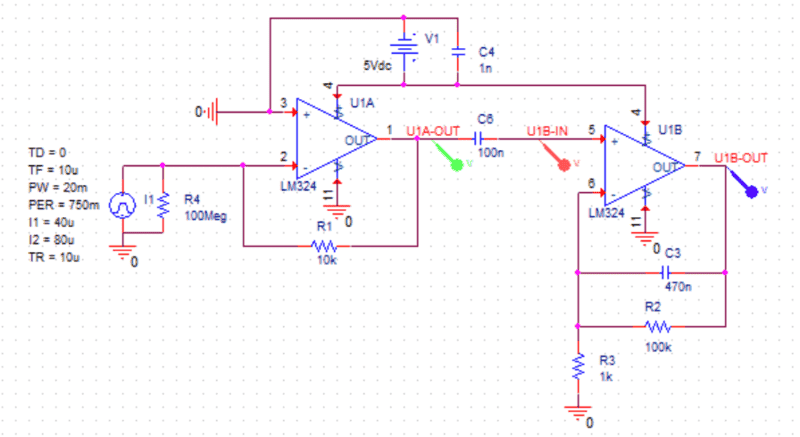
The discussion revolves around a photodiode circuit design aimed at removing a DC offset while processing small, periodic signals. Participants explore various circuit configurations, including the use of capacitors, op-amps, and comparators, to achieve the desired signal processing without affecting low-frequency gain. The context includes theoretical considerations and practical challenges in designing an optical heart pulse monitor.
Discussion Character
- Technical explanation
- Conceptual clarification
- Debate/contested
- Experimental/applied
Main Points Raised
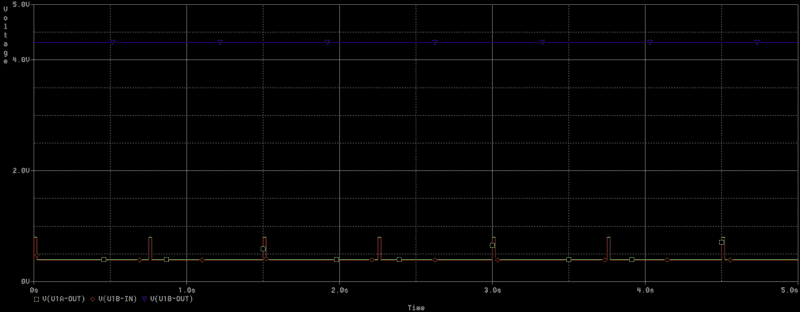
- One participant describes a circuit with a transimpedance amplifier and a low pass filter, aiming to remove a variable DC offset using a capacitor, but encounters issues with the output voltage not reaching 0V.
- Another participant suggests that the + input to the op-amp requires DC bias, indicating that an open circuit at this point is problematic.
- There are suggestions that connecting the photodiode's cathode to a negative rail could improve bandwidth performance, although one participant notes the absence of a negative rail in their design.
- A participant mentions that adding a resistor in parallel with the op-amp input corrects some issues but expresses concern about affecting low-frequency gain.
- Some participants propose using a comparator circuit to square the light pulses and adjust the threshold slowly to mitigate offset drift.
- Discussion includes the potential use of a microcontroller for digitizing the output and applying digital filtering, although one participant emphasizes the need for an all-analog circuit up to the PLL function.
- Participants discuss the modulation of the light source to improve the signal-to-noise ratio and the design of an averaging filter, with one participant reporting an increasing DC level through stages of their circuit.
Areas of Agreement / Disagreement
Participants express varying opinions on circuit design strategies, including the use of capacitors, op-amps, and comparators. There is no consensus on the best approach to achieve the desired signal processing, and multiple competing views remain regarding the circuit topology and methods to handle the DC offset.
Contextual Notes
Participants note limitations related to the absence of a negative rail, the need to maintain low-frequency gain, and the challenges of increasing DC levels through circuit stages. The discussion reflects a variety of assumptions and conditions that may affect the proposed solutions.
Who May Find This Useful
Readers interested in photodiode circuit design, analog signal processing, and those working on similar applications such as optical heart pulse monitoring may find this discussion relevant.