Physics momentum problem -- Collision between 2 blocks that stick together

Click For Summary
The discussion focuses on solving a physics problem involving the collision of two blocks that stick together. The user successfully calculated momentum (P) and kinetic energy (KE) for parts A and B, obtaining values of 0.45 kg*m/s and 4.05 J, respectively. For part C, the user is advised to consider the conservation principle relevant to collisions, specifically that momentum is conserved. It is suggested to ignore any effects from a spring during the collision due to the negligible time involved. Understanding these principles is crucial for solving the remaining parts of the problem.
Inwoodspaki
Messages
1
Reaction score
0
Homework Statement
A small cube, with a mass of 25 g, slides along a frictionless horizontal surface at a constant speed of 18 m/s until it collides with, and sticks to, a large wooden 3.5 kg block. The large block is attached to the left end of a spring with a spring constant of 100 N/m as shown above.

a. What is the momentum of the cube before the collision?
b. What is the kinetic energy of the cube before the collision?
c. *Find the speed of the combined cube and block system just after the collision.
d. *Find the kinetic energy of the cube-block system just after the collision.
e. *What is the maximum potential energy that can be stored in the spring due to this collision?
f. *How far will the cube-block system move before it stops?
Relevant Equations
KE = 1/2 mv^2
P= mv

maybe D = (KE) / (m)(g) ?
So far I found the answer for a and b, but when I attempted to do the other ones I was completely lost.
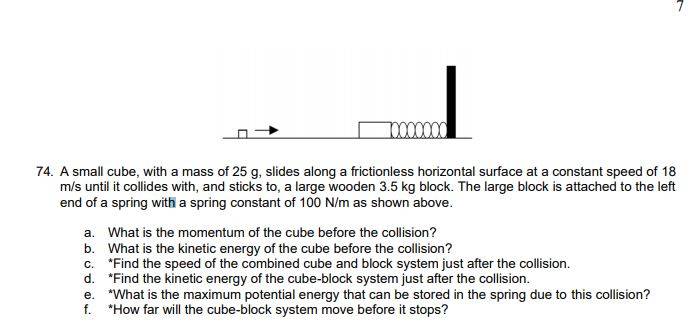
74 momentum problem.JPG


A.) P= MV
M = 25g = .025kg
V = 18

.025 * 18 = .45kg*m/s

B.) KE= 1/2 mv^2
1/2 (.025)(18)^2
4.05 J
 
Physics news on Phys.org
For c) what general principle of mechanics might be relevant? Hint: you're looking for something that is conserved throughout the collision.
 
In case this is what is blocking you...
You should consider the collision process as taking negligible time. This means that the spring has only a negligible effect during it, so you ignore the spring when answering c.
 
The book claims the answer is that all the magnitudes are the same because "the gravitational force on the penguin is the same". I'm having trouble understanding this. I thought the buoyant force was equal to the weight of the fluid displaced. Weight depends on mass which depends on density. Therefore, due to the differing densities the buoyant force will be different in each case? Is this incorrect?

Similar threads

  • · Replies 4 ·
Replies
4
Views
2K
  • · Replies 4 ·
Replies
4
Views
919
Replies
1
Views
2K
Replies
10
Views
3K
  • · Replies 6 ·
Replies
6
Views
2K
Replies
21
Views
2K
  • · Replies 16 ·
Replies
16
Views
4K
Replies
19
Views
3K
Replies
1
Views
1K
  • · Replies 22 ·
Replies
22
Views
4K