Physics momentum problem -- Collision between 2 blocks that stick together

Click For Summary
SUMMARY

The discussion focuses on solving a physics momentum problem involving a collision between two blocks that stick together. The calculations for momentum (P = MV) and kinetic energy (KE = 1/2 mv²) are provided, with specific values of mass (25g or 0.025kg) and velocity (18 m/s) leading to a momentum of 0.45 kg*m/s and a kinetic energy of 4.05 J. The conversation emphasizes the conservation principle relevant to the collision, suggesting that participants should consider the negligible time of the collision and ignore external factors such as a spring during the analysis.

PREREQUISITES
  • Understanding of basic physics concepts such as momentum and kinetic energy
  • Familiarity with the formulas P = MV and KE = 1/2 mv²
  • Knowledge of conservation principles in mechanics
  • Ability to perform unit conversions (grams to kilograms)
NEXT STEPS
  • Study the conservation of momentum in inelastic collisions
  • Explore the implications of negligible time in collision analysis
  • Learn about energy transformations during collisions
  • Investigate the role of springs in collision dynamics
USEFUL FOR

Students studying physics, educators teaching mechanics, and anyone interested in understanding collision dynamics and conservation laws.

Inwoodspaki
Messages
1
Reaction score
0
Homework Statement
A small cube, with a mass of 25 g, slides along a frictionless horizontal surface at a constant speed of 18 m/s until it collides with, and sticks to, a large wooden 3.5 kg block. The large block is attached to the left end of a spring with a spring constant of 100 N/m as shown above.

a. What is the momentum of the cube before the collision?
b. What is the kinetic energy of the cube before the collision?
c. *Find the speed of the combined cube and block system just after the collision.
d. *Find the kinetic energy of the cube-block system just after the collision.
e. *What is the maximum potential energy that can be stored in the spring due to this collision?
f. *How far will the cube-block system move before it stops?
Relevant Equations
KE = 1/2 mv^2
P= mv

maybe D = (KE) / (m)(g) ?
So far I found the answer for a and b, but when I attempted to do the other ones I was completely lost.
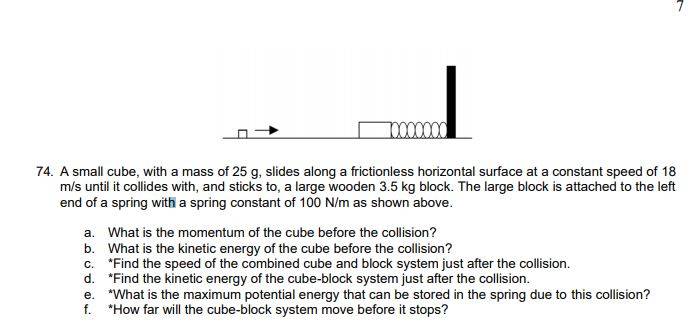
74 momentum problem.JPG


A.) P= MV
M = 25g = .025kg
V = 18

.025 * 18 = .45kg*m/s

B.) KE= 1/2 mv^2
1/2 (.025)(18)^2
4.05 J
 
Physics news on Phys.org
For c) what general principle of mechanics might be relevant? Hint: you're looking for something that is conserved throughout the collision.
 
In case this is what is blocking you...
You should consider the collision process as taking negligible time. This means that the spring has only a negligible effect during it, so you ignore the spring when answering c.
 

Similar threads

  • · Replies 4 ·
Replies
4
Views
2K
  • · Replies 4 ·
Replies
4
Views
1K
Replies
1
Views
2K
Replies
10
Views
3K
Replies
21
Views
3K
  • · Replies 6 ·
Replies
6
Views
2K
  • · Replies 16 ·
Replies
16
Views
4K
Replies
19
Views
3K
Replies
1
Views
1K
  • · Replies 22 ·
Replies
22
Views
4K