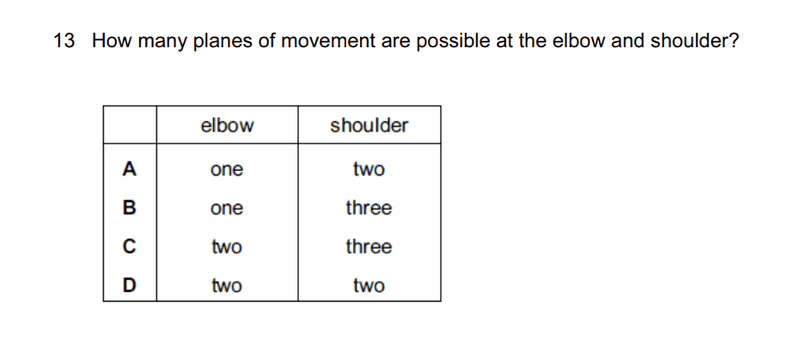
Planes of motion for the elbow and shoulder

  • Thread starter Thread starter lioric
  • Start date Start date
  • Tags Tags
    Motion Planes
Click For Summary
SUMMARY

The discussion centers on the classification of the shoulder joint's planes of movement, specifically addressing an O-Level question from the May/June 2012 paper 5090. Participants assert that the shoulder is a ball-and-socket joint capable of movement in three planes: sagittal, frontal, and transverse. However, confusion arises from a marking scheme indicating only two degrees of freedom. The consensus is that while the shoulder can rotate, this does not constitute an additional plane of movement, leading to a debate on the definitions and expectations set by standardized exams.

PREREQUISITES
  • Understanding of joint types, specifically ball-and-socket joints.
  • Knowledge of anatomical planes: sagittal, frontal, and transverse.
  • Familiarity with degrees of freedom in biomechanics.
  • Experience with standardized testing formats in biology and physics.
NEXT STEPS
  • Research the biomechanics of ball-and-socket joints.
  • Study the anatomical planes of movement in detail.
  • Examine the concept of degrees of freedom in human anatomy.
  • Review standardized testing practices and their impact on student understanding.
USEFUL FOR

Students preparing for O-Level examinations, educators teaching anatomy and biomechanics, and anyone interested in the complexities of joint movement and standardized testing challenges.

lioric
Messages
335
Reaction score
26
1. Homework Statement
IMG_0597.PNG


This is an olevel question from paper 5090 may/june 2012 paper 12 question number 24 (the snapshot is from another question paper) the answer in the marking scheme is A which clearly I cannot understand. I thought shoulder joints have 3 planes of movement

Homework Equations


No equations theory question

The Attempt at a Solution


I believe that the shoulder is a ball and socket joint which has 3 planes of movement
I don't get why the marking scheme says A
 

Attachments

  • IMG_0597.PNG
    IMG_0597.PNG
    10.9 KB · Views: 1,624
Last edited by a moderator:
Physics news on Phys.org
"Planes of movement" seems a bit ambiguous.
I would describe it as degrees of freedom.
The shoulder has two degrees of freedom. It is able to move a point on the upper arm along a two-dimensional surface - in particular, along a section of the surface of a sphere.
 
.Scott said:
"Planes of movement" seems a bit ambiguous.
I would describe it as degrees of freedom.
The shoulder has two degrees of freedom. It is able to move a point on the upper arm along a two-dimensional surface - in particular, along a section of the surface of a sphere.

But wouldn't this be more appropriate
Flexible and extension occur in sagittal plane, adduction and abduction occur in medio-lateral axis, medial rotation and lateral rotation occur in transverse axis. So, shoulder joint is a triaxial joint and there are three planes of movement
 
lioric said:
But wouldn't this be more appropriate
Flexible and extension occur in sagittal plane, adduction and abduction occur in medio-lateral axis, medial rotation and lateral rotation occur in transverse axis. So, shoulder joint is a triaxial joint and there are three planes of movement

Also look at the examines report for biology 5090 oct nov 2012 paper 3

IMG_0598.JPG

It says that shoulder has 3 planes of movement
Now I'm confused
 

Attachments

  • IMG_0598.JPG
    IMG_0598.JPG
    47.1 KB · Views: 841
I am not sure about your sources and, like @.Scott answer exemplifies, you need to consider previously defined terms.

As presented you are correct - 3 planes - x, y, and z. Period. There is no other answer unless the definitions given differ. Or the base question makes assumptions I cannot see.

Studying old exams is NOT always a short cut to success. If this was on a standardized exam, it had a fixed set of expected and required sources - textbooks or whatever course material (or syllabus ). So, if you do not know or cannot know the prerequisites, then poring every every detail in every answer is going to cause confusion. You are confused, right?
 
jim mcnamara said:
I am not sure about your sources and, like @.Scott answer exemplifies, you need to consider previously defined terms.

As presented you are correct - 3 planes - x, y, and z. Period. There is no other answer unless the definitions given differ. Or the base question makes assumptions I cannot see.

Studying old exams is NOT always a short cut to success. If this was on a standardized exam, it had a fixed set of expected and required sources - textbooks or whatever course material (or syllabus ). So, if you do not know or cannot know the prerequisites, then poring every every detail in every answer is going to cause confusion. You are confused, right?

I'm confused because I know it's 3 planes but the answer says two
I know my syllabus and the theory
But when a standardized test paper say something different I became confused.
Btw this is not to study for an exam but a question a student brought to me because of the conflict due to the answers of the paper

I just wanted to know if either of you guys saw something in the question that I did not see.
I'm happy to see that I'm on the same page as you guys
Thank you
 
lioric said:
1. Homework Statement
View attachment 227151

This is an olevel question from paper 5090 may/june 2012 paper 12 question number 24 (the snapshot is from another question paper) the answer in the marking scheme is A which clearly I cannot understand. I thought shoulder joints have 3 planes of movement

Homework Equations


No equations theory question

The Attempt at a Solution


I believe that the shoulder is a ball and socket joint which has 3 planes of movement
I don't get why the marking scheme says A
I don't know whether my knowledge would be enough to answer this question
But, logically speaking I have drawn the possible plane of motion(don't know whether I have missed anything) for the shoulder and the elbow.
The shoulder is movement is restricted to 2 planes and I think the ability of our shoulders to rotate does not necessarily add another additional plane of motion since it rotates itself on the same plane.
I really don't know if that makes any sense.
1529648328133.jpg


Sent from my Redmi Note 4 using Physics Forums mobile app
 

Attachments

  • 1529648328133.jpg
    1529648328133.jpg
    15.1 KB · Views: 1,051
  • Like
Likes   Reactions: lioric
jishnu said:
I don't know whether my knowledge would be enough to answer this question
But, logically speaking I have drawn the possible plane of motion(don't know whether I have missed anything) for the shoulder and the elbow.
The shoulder is movement is restricted to 2 planes and I think the ability of our shoulders to rotate does not necessarily add another additional plane of motion since it rotates itself on the same plane.
I really don't know if that makes any sense. View attachment 227182

Sent from my Redmi Note 4 using Physics Forums mobile app
So I guess it's like the analog stick in the joypad
It is a ball and socket joint and the analog stick has x-axis and y-axis but the rotation is not an axis
Thank you very much
 
lioric said:
So I guess it's like the analog stick in the joypad
It is a ball and socket joint and the analog stick has x-axis and y-axis but the rotation is not an axis
Thank you very much
My pleasure, hope that helps you[emoji4]
 

Similar threads

Replies
34
Views
2K
  • · Replies 2 ·
Replies
2
Views
2K
  • · Replies 1 ·
Replies
1
Views
1K
  • · Replies 3 ·
Replies
3
Views
2K
  • · Replies 12 ·
Replies
12
Views
4K
  • · Replies 8 ·
Replies
8
Views
2K
Replies
3
Views
3K
  • · Replies 61 ·
3
Replies
61
Views
10K
  • · Replies 7 ·
Replies
7
Views
2K
  • · Replies 21 ·
Replies
21
Views
3K