Plastic-Eating Worms Could Inspire Waste-Degrading Tools

  • Thread starter Thread starter Beelzebub
  • Start date Start date
  • Tags Tags
    Tools
Click For Summary

Discussion Overview

The discussion centers on the potential of wax moth larvae to degrade polyethylene, a common plastic, and the implications for waste management. Participants explore the efficiency of these larvae in breaking down plastics, the feasibility of cultivating them for this purpose, and concerns about their ecological impact.

Discussion Character

  • Exploratory
  • Debate/contested

Main Points Raised

  • Some participants highlight that wax moth larvae can consume and degrade polyethylene at a notable rate, referencing a study where they consumed 92 milligrams of plastic in 12 hours.
  • Others mention that the breakdown of plastic is not solely due to chewing, as experiments showed that ground larvae can also degrade plastic films through enzymes.
  • One participant expresses interest in cultivating the larvae to address plastic waste but raises concerns about their potential status as an invasive species.
  • Another participant notes the significant amount of plastic waste generated, suggesting that billions of larvae would be needed to make a meaningful impact on the problem.
  • Some participants express optimism about the larvae's potential to help reduce pollution, while others remain skeptical about the practicality of using them on a large scale.

Areas of Agreement / Disagreement

Participants generally agree on the larvae's ability to degrade polyethylene but have differing views on the feasibility and ecological implications of cultivating them for waste management. The discussion remains unresolved regarding the practicality of using wax moth larvae as a solution to plastic waste.

Contextual Notes

There are limitations regarding the assumptions about the ecological impact of introducing wax moth larvae into new environments and the scale required to effectively combat plastic waste. The discussion does not resolve these uncertainties.

Beelzebub
Messages
20
Reaction score
4
Wax moth larvae can consume and degrade polyethylene at an impressive rate

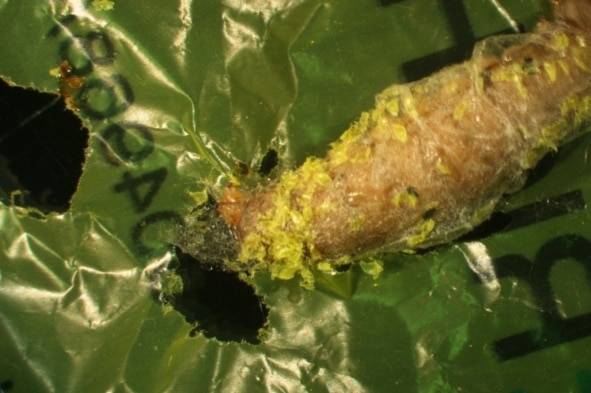
Researchers in Spain and England recently found that the larvae of the greater wax moth can efficiently degrade polyethylene, which accounts for 40 percent of plastics. The team left 100 wax worms on a commercial polyethylene shopping bag for 12 hours, and the worms consumed and degraded about 92 milligrams, or roughly 3 percent, of it. To confirm that the larvae’s chewing alone was not responsible for the polyethylene breakdown, the researchers ground some grubs into a paste and applied it to plastic films. Fourteen hours later the films had lost 13 percent of their mass—presumably broken down by enzymes from the worms’ stomachs.
E6884874-E861-4C40-8F3033CBE2DD43C1.jpg


https://www.scientificamerican.com/article/plastic-eating-worms-could-inspire-waste-degrading-tools/

 
  • Like
Likes   Reactions: BillTre
Biology news on Phys.org
Beelzebub said:
To confirm that the larvae’s chewing alone was not responsible for the polyethylene breakdown, the researchers ground some grubs into a paste and applied it to plastic films. Fourteen hours later the films had lost 13 percent of their mass—presumably broken down by enzymes from the worms’ stomachs.

I'm never taking part in one of their studies... ?:)
 
  • Like
Likes   Reactions: Beelzebub
I would consider trying to grow the catepillers, to eat plastic shopping bags, if the bags weren't already eliminated from the Eugene area where I live.

Wonder if they would be an invasive species.
 
  • Like
Likes   Reactions: Beelzebub
BillTre said:
I would consider trying to grow the catepillers, to eat plastic shopping bags, if the bags weren't already eliminated from the Eugene area where I live.

Wonder if they would be an invasive species.

Well, I hope they would since apparently, we would need a whole lot of them to combat the plastic waste problem. But at least it gives some hope. :)

These creatures, the larvae of the greater wax moth (Galleria mellonella), can devour polyethylene, which along with the closely related polypropylene is the main type of plastic found in waste. But you’d need an awful lot of them to make a significant dent on the plastic waste problem. The UK alone discards almost 2m tonnes of this stuff every year. At the rate of consumption reported by the researchers – one worm gets through about two milligrams of plastic a day – you’d need billions of caterpillars eating constantly all year round to deal with that.

https://www.theguardian.com/commentisfree/2017/apr/25/plastic-eating-bugs-wax-moth-caterpillars-bee