Potential difference of a battery

Click For Summary

Homework Help Overview

The discussion revolves around calculating the potential difference between two points in a circuit involving resistors and a battery. Participants are exploring the effects of an open and closed switch on the potential difference, DeltaV, and are attempting to apply Ohm's Law and concepts of voltage dividers.

Discussion Character

  • Exploratory, Conceptual clarification, Mathematical reasoning, Problem interpretation, Assumption checking

Approaches and Questions Raised

  • Participants discuss how to determine the resistance values needed to calculate DeltaV, questioning the application of Ohm's Law and the configuration of resistors in the circuit. There are attempts to derive current values and voltage drops across specific resistors, as well as considerations of series and parallel resistor combinations.

Discussion Status

The discussion is active with various interpretations being explored. Some participants provide calculations and reasoning for their results, while others question the validity of those results and the assumptions made in the calculations. There is no explicit consensus on the correct approach or final values, indicating ongoing exploration of the problem.

Contextual Notes

Participants are navigating constraints such as the total supply voltage of 24V and the specific resistor values in the circuit. There is mention of potential confusion regarding the roles of different resistors when the switch is open versus closed, as well as the implications of using Thevenin's Theorem.

Linus Pauling
Messages
187
Reaction score
0
1. What is the potential difference DeltaVab between points a and b when the switch is open? Closed?
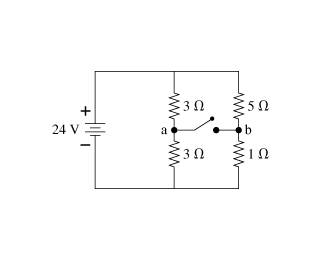
32.P56.jpg

2. DeltaV = IR
3. I solved I for the battery, which is 8A. What do I use for my R value to solve for DeltaV between a and b, though? I tried, for example, DeltaV = IR = 8A*6ohms = 48V. I guess I'm confused as to what I use for R to calculate the potential at each point, which are the values I use to get my answer. Could someone explain this to me conceptually? For the potential at A, for example, I tried multiplying the current (8A) by 3ohms because the current flows through that 3ohm resistor to get to point A...
 
Physics news on Phys.org
What intermediate steps did you use , to get 8 Amp with the switch open ?
you considered R_left = 6 Ohm , and R_right = 6 Ohm ...
so : what's the voltage across R_left ? Voltage across R_right?
how much of this 8 Amp goes where ? (this charge is conserved, you know)

V = I R is a statement about ONE device .
 
3+3=6, 1+5=6. Then, inverse of [(1/6)+(1/6)] = 3. 24/3=8A.

It's correct.
 
The voltage across the bottom left resistor = the supply voltage times 3 divided by (the sum of the two series left resistors) .

So it is 24 * 3 / (3 + 3) volts.

Similarly,
The voltage across the bottom right resistor = the supply voltage times 1 divided by (the sum of the two series right resistors) .

So, it is 24 * 1 / (5 +1 ) volts.

Then, what is the voltage between the points a and b since the bottoms of these resistors are joined?
 
vk6kro said:
The voltage across the bottom left resistor = the supply voltage times 3 divided by (the sum of the two series left resistors) .

So it is 24 * 3 / (3 + 3) volts.

Similarly,
The voltage across the bottom right resistor = the supply voltage times 1 divided by (the sum of the two series right resistors) .

So, it is 24 * 1 / (5 +1 ) volts.

Then, what is the voltage between the points a and b since the bottoms of these resistors are joined?

Are you saying the voltage difference is 12V - 4V = 8V? Also, why do we care about the bottom left and right resistors specifically, since the current flows through the top two resistors to get to points a and b before reaching the bottom two resistors?
 
Linus Pauling said:
Are you saying the voltage difference is 12V - 4V = 8V? Also, why do we care about the bottom left and right resistors specifically, since the current flows through the top two resistors to get to points a and b before reaching the bottom two resistors?

Yes, that is right.

This is just two voltage dividers.

In each voltage divider the voltage across each lower resistor is equal to (the resistance of that resistor divided by the total resistance) times the supply voltage.

You could say the current in the left two resistors is 24 V / 6 ohms = 4 amps, so the voltage across the lower resistor is 4 amps * 3 ohms or 12 volts. (Ohm's Law)

Then the current in the right side is 24 volts / 6 ohms = 4 amps. So, the voltage across the 1 ohm resistor is 4 amps * 1 ohm or 4 volts.

So, the difference in voltage at a - b is 8 volts.
a is at +12 volts relative to the negative supply and b is at +4 volts relative to the negative supply.

The first method is much quicker, though.

You could read about voltage dividers here :
http://en.wikipedia.org/wiki/Voltage_divider
 
Thank you!

Now, what is deltaV between points a and b when the switch is closed? In this case, the top two (3 and 5 ohm) resistors are in parallel, as are the bottom two (3 and 1 ohm). The equivalent resistor for each of those pairs are in series with one another, so the current must be the same into and out of them. Solving I for the top two resistors:

[(1/3)+(1/5)]-1=1.875.
I = V/R = 24V / 1.875ohm = 12.8A

Then, V for point a: V = IR = (12.8A)(3ohm) = 38.4V

for point b: V = (12.8A)(1ohm) = 12.8V

deltaV = 25.6 V... is this correct?

Also, in solving for a and b, I used the resistance of the bottom two resistors. If I use the two, I get a deltaV of the same magnitude but opposite sign (-25.6V). What does this mean?

EDIT: turns out 25.6V is incorrect...?
 
When the switch is closed, the voltage between a and b is zero.
The switch has zero resistance so any current flowing in it cannot produce a voltage across it.


You are not asked to work out the current flowing in the switch.

I think you were trying to use Thevenin's Theorem to work it out. However if you did, you would have the two 3 ohm resistors in parallel and the 5 and 1 ohm resistors in parallel and then put these in series with the 8 volts you worked out earlier.

It is not possible to develop 38.4 volts or 25.6 volts anywhere in a circuit that only has 24 volts as a supply and only resistors in the circuit.
So, this should give you a clue that something is wrong.
 

Similar threads

  • · Replies 7 ·
Replies
7
Views
2K
  • · Replies 3 ·
Replies
3
Views
2K
  • · Replies 7 ·
Replies
7
Views
2K
  • · Replies 3 ·
Replies
3
Views
2K
Replies
4
Views
2K
  • · Replies 9 ·
Replies
9
Views
2K
  • · Replies 3 ·
Replies
3
Views
2K
  • · Replies 9 ·
Replies
9
Views
2K
Replies
9
Views
1K
  • · Replies 2 ·
Replies
2
Views
2K