Potential due to a rod with a nonuniform charge density

Click For Summary
SUMMARY

The discussion focuses on calculating the electric potential due to a rod with a nonuniform charge density. Participants derive expressions for the potentials at points A and B, specifically $$V(B)=\alpha k\int_0^L\frac{x}{\sqrt{b^2+\left(x-\frac{L}{2}\right)^2}}dx+C$$ and $$V(A)=\alpha k\left(L+d\ln\left(\frac{d}{L+d}\right)\right)+C$$. Discrepancies in integration results and dimensional analysis are highlighted, with one participant noting that fixing the total charge at Q leads to an infinite result as L approaches zero. The importance of using variables as necessary is emphasized throughout the discussion.

PREREQUISITES
  • Understanding of electric potential and charge density concepts
  • Proficiency in calculus, particularly integration techniques
  • Familiarity with hyperbolic functions, specifically arsinh
  • Knowledge of dimensional analysis in physics
NEXT STEPS
  • Study the derivation of electric potential for nonuniform charge distributions
  • Learn advanced integration techniques, especially for variable limits
  • Explore the properties and applications of hyperbolic functions in physics
  • Review dimensional analysis methods to verify physical equations
USEFUL FOR

Physics students, electrical engineers, and anyone involved in electrostatics or potential theory will benefit from this discussion.

archaic
Messages
688
Reaction score
214
Homework Statement
A rod of length ##L## lies on the x-axis such that its left tip is at the origin. It's charged and has a nonuniform charge density ##\lambda=\alpha x##, where ##\alpha>0##.
What is the potential at a point ##B## on its bisector? (Use the following as necessary: α, k, L, b, and d.)
Relevant Equations
$$dV=k\frac{dq}{r}$$
I'm not sure I understand why I need to use ##d##.. Maybe they want me to have the potential be zero at ##A##?
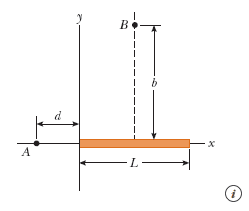
Screenshot_2020-09-15_08-49-38.png

In any case, I have found$$V(B)=\alpha k\int_0^L\frac{x}{\sqrt{b^2+\left(x-\frac{L}{2}\right)^2}}dx+C=\frac{\alpha kL}{2}\ln\left(\frac{\sqrt{L^2+4b^2}+L}{\sqrt{L^2+4b^2}-L}\right)+C$$and$$V(A)=\alpha k\int_0^L\frac{x}{d+x}dx+C=\alpha k\left(L+d\ln\left(\frac{d}{L+d}\right)\right)+C$$
 
Last edited:
Physics news on Phys.org
archaic said:
I'm not sure I understand why I need to use ##d##..
In any case, I have found$$V(B)=\alpha k\int_0^L\frac{x}{\sqrt{b^2+\left(x-\frac{L}{2}\right)^2}}dx+C=\frac{\alpha k}{2}\ln\left(\frac{\sqrt{L^2+4b^2}+L}{\sqrt{L^2+4b^2}-L}\right)+C$$
It says to use the variables as necessary. If it is not necessary don’t use it.

I get a different result for the integration. Yours seems to be dimensionally wrong.
I also tried checking yours by fixing the total charge at Q and letting L tend to zero. I got that it tends to infinity as ##\frac {kQ}{Lb}## instead of tending to ##\frac {kQ}{b}##.
 
Last edited:
haruspex said:
It says to use the variables as necessary. If it is not necessary don’t use it.

I get a different result for the integration. Yours seems to be dimensionally wrong.
I also tried checking yours by fixing the total charge at Q and letting L tend to zero. I got that it tends to infinity as ##\frac {kQ}{Lb}## instead tending to ##\frac {kQ}{b}##.
I forgot a factor of ##L##.. It's fixed now. Thank you!
You probably have found ##\alpha kL\,\mathrm{arsinh}(\frac{L}{2b})##, they're similar.
That's not the desired result, though..
 

Similar threads

Replies
1
Views
1K
  • · Replies 3 ·
Replies
3
Views
984
  • · Replies 12 ·
Replies
12
Views
2K
  • · Replies 12 ·
Replies
12
Views
2K
Replies
1
Views
2K
  • · Replies 5 ·
Replies
5
Views
1K
Replies
8
Views
1K
Replies
28
Views
2K
  • · Replies 3 ·
Replies
3
Views
2K
  • · Replies 11 ·
Replies
11
Views
907