gl0ck
- 85
- 0
Hello, I've solved some questions for my exam tomorrow. Since I do not have any answers to the questions, could you please confirm if it is correct?
I have questions on the last problem. Also I will post more questions, just I am working on them now.
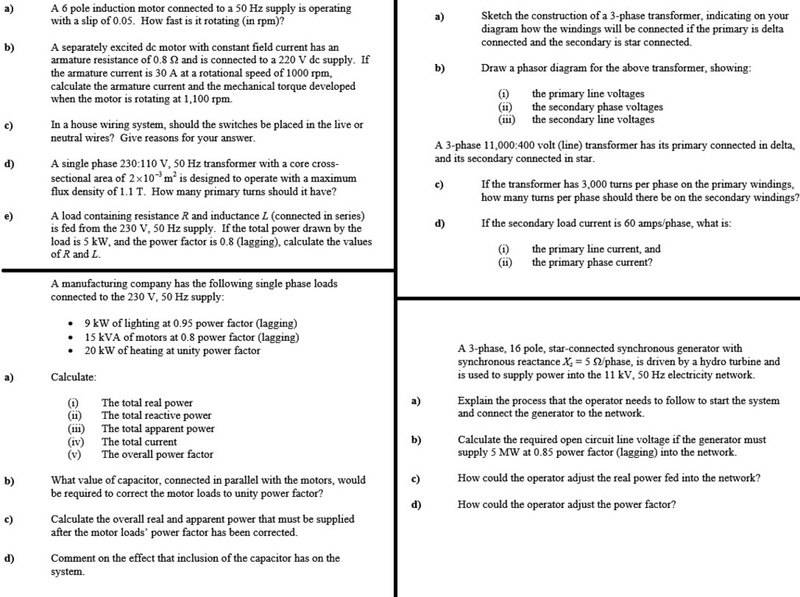
Question 1:
a) [itex]6 Pole ->3 pairs. N_{speed} = 1000 rpm;<br /> w_r = w_o (1-s)<br /> w_r = 950 rpm[/itex]
b)
[itex]V_a = E + R_a x I_a -> E = 205V at 1000 rpm[/itex]
[itex]at 1100 rpm E = \frac{1000}{1100} x 205 = 186V[/itex]
[itex]So,~ from~the~formula~for~V_a~we~get,~ 220 = 186 + I_a x 0.5 -> I_a = 67.27[/itex]
c)
Switches are put on the Live wire, then when it is open the load is connected to the neutral line (0v) , so anyone touching it would NOT get a shock.
If the switch is on the neutral wire, then when it is open the load is connected to the live wire, so anyone touching it would get a shock.
Question 2:
Using the equation
[tex]S = Pcos(\theta)~ and~ Q = Ptan(\theta)[/tex]
a)
i)Total Real Power = [tex]9kW+20kW+12kW = 41kW[/tex]
ii)[tex]2.96kVAr+9kVAr = 11.96kVAr<br /> iii) [tex]S = \sqrt{41^2+11.96^2} = 42.7kVA[/tex]<br /> iv) [tex]S = VxI[/tex] So, [tex]I = 185.7A[/tex]<br /> v) Total power factor [tex]\frac{kW}{kVA} = \frac{41}{42.7} = 0.96[/tex]<br /> <br /> b)<br /> [tex]Q = \frac{V^2}{Xc}[/tex] [tex]Xc = 0.01923 Ohms[/tex][tex]C = 166μF[/tex]<br /> c)<br /> Here I have some ideas, but the value for P gets really big so I am confused if it correct. If we use the same equation from the beginning of the question [tex]Q = Ptan(\theta), P = 685kW[/tex] compared to 41kW .<br /> <br /> d)<br /> Capacitors are used to supply reactive power Q locally, rather than deliver it from the source over the transmission and distribution network. This reduces transmission losses and voltage drops.<br /> <br /> Question 3:<br /> <br /> c) [tex]\frac { V_2}{V_1} = \frac{N_2}{N_1} = 11 000 x N_1 = 230 x 3000 ~->~ N_1 = 63~ turns[/tex]<br /> d) Here I don't know how to find the [tex]I_L[/tex] and [tex]I_{phase}[/tex]<br /> the only thing that I can relate is the fact that the primary has delta connection, so [tex]I_L = \sqrt{3}I_{phase}[/tex]<br /> Which means that the line currents of secondary and primary should be the same and just the Phase current of the primary will be different -> 34.64 A<br /> <br /> Question 4:<br /> To synchronise, the generator voltage must have the same magnitude, frequency and phase as the grid.<br /> It has to be speed up to the 375rpm,<br /> And then increase the field current If until the generator output = 11 kV (line). [Note that the generator is open circuit at this stage, therefore E = Vgenerator = 11 kV.] Check for correct phase, then close circuit breaker S1 to connect to grid. The generator is now synchronised, but no power is being transferred yet.<br /> <br /> b)<br /> By the angle between phase voltage and phase EMF.<br /> <br /> I have similar example in the notes but it uses the 11kV as a Line voltage, which doesn't make any sense to me. Why should they ask to calculate it, when it is given. It must be something else.<br /> d) the power factor can be adjusted by [tex]I_f[/tex]Any feedback is much appreciated!<br /> Thank you ![/tex]
I have questions on the last problem. Also I will post more questions, just I am working on them now.
Question 1:
a) [itex]6 Pole ->3 pairs. N_{speed} = 1000 rpm;<br /> w_r = w_o (1-s)<br /> w_r = 950 rpm[/itex]
b)
[itex]V_a = E + R_a x I_a -> E = 205V at 1000 rpm[/itex]
[itex]at 1100 rpm E = \frac{1000}{1100} x 205 = 186V[/itex]
[itex]So,~ from~the~formula~for~V_a~we~get,~ 220 = 186 + I_a x 0.5 -> I_a = 67.27[/itex]
c)
Switches are put on the Live wire, then when it is open the load is connected to the neutral line (0v) , so anyone touching it would NOT get a shock.
If the switch is on the neutral wire, then when it is open the load is connected to the live wire, so anyone touching it would get a shock.
Question 2:
Using the equation
[tex]S = Pcos(\theta)~ and~ Q = Ptan(\theta)[/tex]
a)
i)Total Real Power = [tex]9kW+20kW+12kW = 41kW[/tex]
ii)[tex]2.96kVAr+9kVAr = 11.96kVAr<br /> iii) [tex]S = \sqrt{41^2+11.96^2} = 42.7kVA[/tex]<br /> iv) [tex]S = VxI[/tex] So, [tex]I = 185.7A[/tex]<br /> v) Total power factor [tex]\frac{kW}{kVA} = \frac{41}{42.7} = 0.96[/tex]<br /> <br /> b)<br /> [tex]Q = \frac{V^2}{Xc}[/tex] [tex]Xc = 0.01923 Ohms[/tex][tex]C = 166μF[/tex]<br /> c)<br /> Here I have some ideas, but the value for P gets really big so I am confused if it correct. If we use the same equation from the beginning of the question [tex]Q = Ptan(\theta), P = 685kW[/tex] compared to 41kW .<br /> <br /> d)<br /> Capacitors are used to supply reactive power Q locally, rather than deliver it from the source over the transmission and distribution network. This reduces transmission losses and voltage drops.<br /> <br /> Question 3:<br /> <br /> c) [tex]\frac { V_2}{V_1} = \frac{N_2}{N_1} = 11 000 x N_1 = 230 x 3000 ~->~ N_1 = 63~ turns[/tex]<br /> d) Here I don't know how to find the [tex]I_L[/tex] and [tex]I_{phase}[/tex]<br /> the only thing that I can relate is the fact that the primary has delta connection, so [tex]I_L = \sqrt{3}I_{phase}[/tex]<br /> Which means that the line currents of secondary and primary should be the same and just the Phase current of the primary will be different -> 34.64 A<br /> <br /> Question 4:<br /> To synchronise, the generator voltage must have the same magnitude, frequency and phase as the grid.<br /> It has to be speed up to the 375rpm,<br /> And then increase the field current If until the generator output = 11 kV (line). [Note that the generator is open circuit at this stage, therefore E = Vgenerator = 11 kV.] Check for correct phase, then close circuit breaker S1 to connect to grid. The generator is now synchronised, but no power is being transferred yet.<br /> <br /> b)<br /> By the angle between phase voltage and phase EMF.<br /> <br /> I have similar example in the notes but it uses the 11kV as a Line voltage, which doesn't make any sense to me. Why should they ask to calculate it, when it is given. It must be something else.<br /> d) the power factor can be adjusted by [tex]I_f[/tex]Any feedback is much appreciated!<br /> Thank you ![/tex]
Attachments

Last edited: