Homework Helper
Gold Member
- 1,734
- 824
Reading a book "Simply AI" (from DK !) came across this diagram.
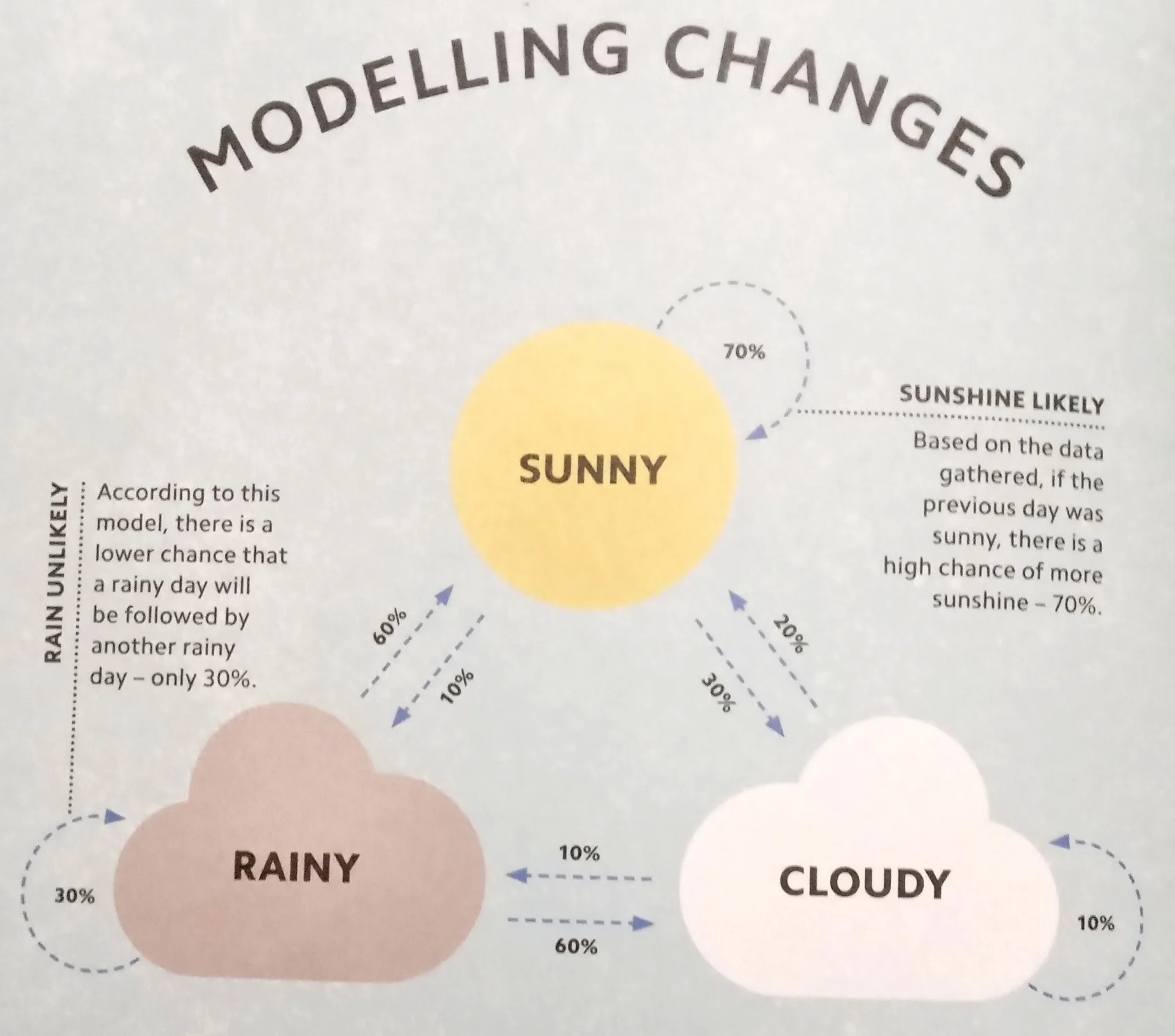
I know I'm old and out of practice, but these probabilities don't make sense to me.
The text implies that these are states in a Markov chain, but the probabilities mean the three states cannot be mutually exclusive. So (to me) this cannot show a complete set of Markov states, which would have to include states like "rain and cloud", "sun and cloud", "sun rain and cloud". Then this diagram would be confusing, because the three states shown cannot be "sun only", "rain only", "cloudy only".
Anyhow, I'd be interested if anyone can explain this diagram. I suspect that being a DK publication, it's not intended to be taken too seriously, so maybe there is no explanation.
Attachments
