Probability that current could pass through

  • Context:
  • Thread starter Thread starter pp123123
  • Start date Start date
  • Tags Tags
    Current Probability
Join the discussion
Ask a follow-up here, or get your own question answered by working scientists, mathematicians and engineers — people, not an autocomplete.
Real named experts · corrections over time · the nuance an AI answer skips
1 reply · 2K views
pp123123
Messages
5
Reaction score
0
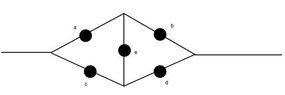
Hi guys. Here's the problem.View attachment 1981
I need to determine the probability that the current could go from left to right given that there is a probability of p for each independent switch named a,b,c,d and e.

I have tried to solve this but I have no idea which part I am getting off the right track. Here is what I am trying to do.

Case I: Assume Switch E is closed so I have a probability of
P((AB) or (CD))=P(AB)+P(CD)-P(AB and CD)=2p^2-p^4

Case II: Assume Switch E is opened so I have a probability of
P((A or C) and (B or D))=(P(A)+P(C)-P(AC))(P(B)+P(D)-P(BD))=(2p-p^2)^2

so overall probability is (1-p)(2p^2-p^4)+p(2p-p^2)^2 which could be simplified to 2p^5-5p^4+2p^3+2p^2

however some friends of mine told be that it should be p^5-5p^4+2p^3+2p^2. I hope to know what's wrong in my calculation. Thanksss!
 

Attachments

  • mathhelp.jpg
    mathhelp.jpg
    6.3 KB · Views: 124
Physics news on Phys.org
pp123123 said:
Hi guys. Here's the problem.View attachment 1981
I need to determine the probability that the current could go from left to right given that there is a probability of p for each independent switch named a,b,c,d and e.

I have tried to solve this but I have no idea which part I am getting off the right track. Here is what I am trying to do.

Case I: Assume Switch E is closed so I have a probability of
P((AB) or (CD))=P(AB)+P(CD)-P(AB and CD)=2p^2-p^4

Case II: Assume Switch E is opened so I have a probability of
P((A or C) and (B or D))=(P(A)+P(C)-P(AC))(P(B)+P(D)-P(BD))=(2p-p^2)^2

so overall probability is (1-p)(2p^2-p^4)+p(2p-p^2)^2 which could be simplified to 2p^5-5p^4+2p^3+2p^2

however some friends of mine told be that it should be p^5-5p^4+2p^3+2p^2. I hope to know what's wrong in my calculation. Thanksss!
Hi pp123123, and welcome to MHB! Short story: you are right and your friends are wrong.

Longer explanation: Your method is correct. Another (more laborious) way to do the calculation is to count the number of open switches.

If all five switches are on then the current gets through. Probability of this is $p^5$.

There are five ways in which four switches can be on, and the current gets through in each case. Probability here is $5p^4(1-p)$.

There are ten ways in which three switches can be on, and the current gets through in eight of these cases. (The only ways in which it cannot get through is if both of the switches on the left part of the circuit, or both of the switches on the right part of the circuit, are off.) Probability here is $8p^3(1-p)^2$.

There are ten ways in which two switches can be on, and the current gets through in two of these cases. (The only ways in which it can get through is if both of the switches on the upper part of the circuit, or both of the switches on the lower part of the circuit, are on.) Probability here is $2p^2(1-p)^3$.

If only one switch, or none at all, is open, then the current cannot get through.

Thus the overall probability is $p^5 + 5p^4(1-p) + 8p^3(1-p)^2 + 2p^2(1-p)^3$. When you multiply out the brackets, this simplifies to $2p^5-5p^4+2p^3+2p^2$.