Problem solving calculating area

  • Context: MHB 
  • Thread starter Thread starter einie101
  • Start date Start date
  • Tags Tags
    Area Problem solving
Click For Summary

Discussion Overview

The discussion revolves around solving a mathematical problem related to calculating the area of a square formed by fencing, given specific conditions and constraints. Participants explore the requirements for showing work in solving the problem and the educational context of such questions.

Discussion Character

  • Homework-related
  • Mathematical reasoning
  • Conceptual clarification

Main Points Raised

  • One participant presents a mathematical equation involving width (W) and length (L) related to a fencing problem.
  • Another participant questions the educational level at which such equality questions are typically taught, expressing uncertainty about the terminology used for these types of problems.
  • A participant shares their experience that in their country, this type of question is found in Grade 11, but they are unsure how it compares to Western educational systems.
  • One participant suggests that the fencing forms three sides of a square, proposing a calculation for the area based on dividing the total fencing length by three.
  • Another participant reflects on their calculations, noting a specific numerical result and expressing difficulty with the conversion from square feet to square yards, indicating a lack of familiarity with the imperial system.
  • There is a mention of the educational curriculum being either international or national, with a participant clarifying their use of the National Indonesian Curriculum.

Areas of Agreement / Disagreement

Participants express varying levels of familiarity with the mathematical concepts and educational context, indicating that there is no consensus on the specific grade level or terminology for the problem type. The discussion remains unresolved regarding the best approach to solve the problem and the educational classification.

Contextual Notes

Participants express uncertainty about the educational standards in different countries and the terminology used for mathematical problems involving equalities. There are also unresolved steps in the calculations presented, particularly regarding the conversion of area measurements.
einie101
Messages
4
Reaction score
0
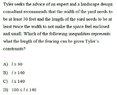
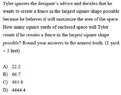
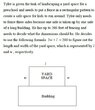
I help students a bit with their math. As a teacher I am over 35 years removed from Math so I am rusty. I had the following questions given to me by some students and I couldn't even remember.View attachment 9317View attachment 9318View attachment 9316

The students are required to show their work how to solve this problem.
 

Attachments

  • Math 1C.jpg
    Math 1C.jpg
    22.2 KB · Views: 132
  • Math 1A.jpg
    Math 1A.jpg
    29.6 KB · Views: 131
  • Math 1B.jpg
    Math 1B.jpg
    22.5 KB · Views: 128
Mathematics news on Phys.org
$2W + L = 200$

$2W = 200 - L$

condition (1) ... $W \ge 30 \implies 2W \ge 60 \implies 200-L \ge 60 \implies L \le 140$

condition (2) ... $L \ge 2W \implies L \ge 200-L \implies L \ge 100$If a square is made, each side of the fence would have what dimension in feet given the 200 ft of available fencing?

Square that dimension. Recall $9 \text{ ft}^2 = 1 \text{ yd}^2$
 
In which grade level does one normally find this kind of equality question? I simply can't remember actually ever studying this kind of question type. Is there a name for this type of question i.e. equalities? I am still at a loss on how to calculate the 2nd question.
Thank you again.
 
Last edited:
einie101 said:
In which grade level does one normally find this kind of equality question? I simply can't remember actually ever studying this kind of question type. Is there a name for this type of question i.e. equalities? Thank you again.

In my country, it's for Grade 11. Dunno how that applies to Western countries, though.
 
Monoxdifly said:
In my country, it's for Grade 11. Dunno how that applies to Western countries, though.
I'm in Jakarta presently . .. is that using an International curriculum (i.e. Cambridge/Oxford etc.) or the National Indonesian Curriculum (I see you are in Indonesia).
 
einie101 said:
... I am still at a loss on how to calculate the 2nd question.

200 ft of fencing form three of the four equal sides of the square with the fourth side being the side of the building.

Each side of fence is $\dfrac{200}{3} \text{ ft}$

area of the square formed is $\left(\dfrac{200}{3}\right)^2 \text{ ft}^2$

remember you’ll need to convert square feet into square yards ... I supplied the conversion relationship in my initial post
 
The answer is supposed to be 493.8 . . . if I take (200/3)2 = 66.67 * 66.67 = 4444.4 then divide this number by 9 I get the answer . . . I was not remembering this step . . . boy my math muscles are weak. The difficulty to add insult to injury is that over here in Asia the imperial system is unfamiliar . . .
 
Last edited:
einie101 said:
I'm in Jakarta presently . .. is that using an International curriculum (i.e. Cambridge/Oxford etc.) or the National Indonesian Curriculum (I see you are in Indonesia).

I see. I was wondering because your profile says that your location is in Jakarta but it has a Canadian flag.
It's the National Indonesian Curriculum.
 

Similar threads

  • · Replies 10 ·
Replies
10
Views
2K
  • · Replies 2 ·
Replies
2
Views
2K
  • · Replies 10 ·
Replies
10
Views
2K
  • · Replies 1 ·
Replies
1
Views
2K
  • · Replies 2 ·
Replies
2
Views
1K
  • · Replies 12 ·
Replies
12
Views
3K
  • · Replies 4 ·
Replies
4
Views
2K
  • · Replies 8 ·
Replies
8
Views
2K
  • · Replies 3 ·
Replies
3
Views
2K
Replies
2
Views
2K