Problem with my Venturi operated Drum Vac

  • Thread starter Thread starter kunalvanjare
  • Start date Start date
  • Tags Tags
    Drum Venturi
Click For Summary

Discussion Overview

The discussion revolves around a problem with a compressed air venturi-operated drum pump designed for liquid transfer. Participants explore various aspects of the system's design, including the float mechanism intended to prevent overflow, and the challenges faced when the float is sucked up, blocking the venturi. The conversation includes suggestions for modifications and troubleshooting strategies.

Discussion Character

  • Exploratory
  • Technical explanation
  • Debate/contested
  • Experimental/applied

Main Points Raised

  • Some participants suggest making the float tube longer to position the float farther from the venturi.
  • Others propose creating a longer, heavier float that would still float on the liquid but would be less likely to be sucked up.
  • Increasing the size or number of holes above the float is recommended to improve flow and prevent the float from being sucked up.
  • Reducing the diameter of the hole under the float is suggested to enhance the float's stability.
  • Concerns are raised about the power of the compressed air supply potentially being too strong, which could lift the float prematurely.
  • Participants discuss the possibility of adding weight to the float or modifying its design to improve performance.
  • One participant mentions that increasing the number of holes above the float has improved the situation but has led to water leaking past the float into the venturi.
  • Suggestions include using a round float design and considering the use of a U trap to catch fluid leakage.
  • Some participants mention the design of flapper valves as a potential model for improving the float mechanism.
  • Others note that high differential pressure and flow rates at startup may cause premature stoppage, suggesting throttling the valve to mitigate this issue.

Areas of Agreement / Disagreement

Participants express a variety of suggestions and hypotheses regarding the float mechanism and the venturi system, indicating that there is no consensus on a single solution. The discussion remains unresolved, with multiple competing views and approaches presented.

Contextual Notes

Participants acknowledge limitations in their understanding of the system's specific design and performance characteristics, which may affect the applicability of their suggestions. There are also references to potential issues with the float seating and the influence of foam on liquid behavior.

kunalvanjare
Messages
80
Reaction score
2
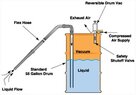
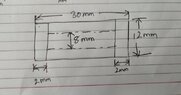
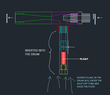
Hey guys, I have built a Compressed air venturi operated Drum Pump for my garage. The system consists of a horizontal venturi tube with a pipe (shut-off tube) that is inserted into the Drum. Turning on the venturi creates vacuum in the drum and thus liquid is sucked from outside and is collected in the drum automatically. This pipe contains a float which moves up-down. Purpose of the float is to block the venturi when the liquid reaches up to the highest level in the drum to prevent overflow of the liquid from the drum. Since it is a purely compressed air operated system, there are no electricals and hence no switches. Attached are photos depicting my system, the float & a standard Exair Drum Vac.

Now, the problem I am facing here is that when I turn on the venturi, the vacuum sucks up the float and blocks the venturi immediately thereby stopping the vacuum generation process in the drum. Releasing the pressure causes the float to fall down in the pipe to its original position and ONLY then the system works (i.e liquid rises and the float rises along with the liquid and blocks the venturi when the drum is full).

The material used for the float is either Nylon/Teflon (don't know which as we have a bunch of either rods available with us) and the shut-off tube is SS304. What can I do to ensure the float ONLY rises up in the pipe along with the liquid? I am worried if I increase the weight of the float, it might not float on water and will remain seated at the bottom of the pipe.

I cannot invest a lot of money on an Exair system as we're a small shop and have most of these parts handy. I feel like I am missing something rudimentary here and some guidance will be really helpful. Thanks!
 

Attachments

  • Assembly.png
    Assembly.png
    4.9 KB · Views: 255
  • Drum Vac.jpg
    Drum Vac.jpg
    9.9 KB · Views: 242
  • Float.jpeg
    Float.jpeg
    33.6 KB · Views: 221
Engineering news on Phys.org
Some things to try:

1) Make the float tube longer so the float is farther away from the venturi.
2) Make a longer float. It will be heavier, so won't get sucked up so easily, but will still float on the liquid.
 
jrmichler said:
Some things to try:

1) Make the float tube longer so the float is farther away from the venturi.
2) Make a longer float. It will be heavier, so won't get sucked up so easily, but will still float on the liquid.
@jrmichler Thanks for that. Both these suggestions require making a new shut-off tube as I don't have a lot of space to play with in the current one to accommodate a longer float.

I have been speaking to some people and they've asked me to try increasing the size of the holes above the float AND/OR reduce the diameter of the hole under the float (bottom of the shutoff tube). Would appreciate your views on this. Thanks.
 
More hole area above the float will help. That could be more holes or larger holes.

Reducing the diameter of the hole under the float will help, as will increasing the clearance between the float and the tube.

And you can do all of the above.
 
kunalvanjare said:
Thanks for that. Both these suggestions require making a new shut-off tube as I don't have a lot of space to play with in the current one to accommodate a longer float.
This problem can't just be your's; other users will have it too. Did you try approaching the manufacturer?
Is your compressed air supply just too powerful? The initial Venturi (suck) pressure must not be so great that the air flow round the cut off float lifts its weight. Most of the air will presumably go through the holes in the side of the upper part of the tube (is that what the diagram shows?).
Without help from the suppliers (or the documentation?) you have to do some experimentation.
If you drill and tap a small hole in the bottom of the float and insert a long screw then you can feel - or even measure the available force. If it's only marginally too much then hang a weight under the float - using the screw you already fitted. You say you are short of space but the barrel is massive and you have loads of headroom.
Basically you have to do some experimentation; PF can't think the problem out without some performance measurements. I would try floats of various diameters - the air flow is obviously too constricted at present. Details of the seating of the float into the neck at the top are important. How much smaller could the float be made yet still block the exit?
Apologies if I have misunderstood the system. Shame I can't be there to look at the thing working (or not!).
 
Many float switches have a range of floats (for liquids of different specific gravities). The heaviest float (that will still float) is typically the best choice. It is often possible to add weight to a float if the initial choice was wrong (I don't want talk about how I know this). If that doesn't fix the problem, you will probably have to reduce/limit the gas flow or modify the float body.
 
  • Informative
Likes   Reactions: sophiecentaur
We increased the number of holes above the float and that has made a visible difference! The float does not get sucked up upon starting the air supply through the venturi.

We've observed another problem though. Some water leaks past the float and enters the venturi which then throws it out along with the compressed air. So I guess we're going to have to change the design of the float & the tube. Will a round float(like a ball) work? Something similar to what you find in an NRV?
 
The float may not be seating properly. Could there be some grit?
If you insert a U trap between Venturi and the tank valve then fluid leakage can be caught in that.
it sounds like your compressor is too beefy. You could experiment with a tap in series with the HP supply.
 
I don't know if it's feasible for your design, but:

That's a common problem. If you put a 'fat spot' (low velocity) in the suction line between the valve and the venturi, you can trap out bulk liquid. Float-operated valves almost never 'perfectly' exclude water. If the water is smaller particles, you may need a coalescing filter - it depends on your specific situation. In any case, you want to arrange things so that trapped/precipitated liquids will gravity-drain back to the tank.
 
  • Like
Likes   Reactions: sophiecentaur
  • #10
Look at the design of the 'flapper valve' (flush valve) in a toilet tank. The kind commonly in residential use in the USA, a tank mounted on the bowl with a handle on the side of the tank to flush. It is a conical, pliable, rubber cup that fits in the tank drain and raised when the flush handle is operated.

A possible problem with this approach (and others) is the vacuum may hold it in place when the fluid level drops.

Cheers,
Tom
 
  • #11
Tom.G said:
Look at the design of the 'flapper valve' (flush valve) in a toilet tank.
That's an example of a system that's used by everyone yet which works very well and reliably. In more than fifty years of house ownership, I have only come across two (very minor) failures. The pressure involved is only low, of course (about 0.03Bar).
The OP should really be taking this back to the supplier, rather than looking for solutions from PF; there are too many unknowns for us to deal with with much hope of success. We may well find out that the wrong specific device was asked for or supplied in the first place.

Here's a thought, though. Is there foam on top of the liquid in the barrel? That could be relevant to how well the valve works.
 
  • #12
Can't help with foam or leaking seals but the premature stoppage is from high differential pressure and high flow rate on initial start. Throttling the valve, allowing the drum to develop some negative pressure before full venturi supply usually avoids this problem. No mods needed.
 

Similar threads

  • · Replies 8 ·
Replies
8
Views
3K
Replies
1
Views
1K
  • · Replies 16 ·
Replies
16
Views
4K
  • · Replies 19 ·
Replies
19
Views
6K
  • · Replies 2 ·
Replies
2
Views
4K
Replies
18
Views
3K
Replies
9
Views
2K
  • · Replies 2 ·
Replies
2
Views
3K
Replies
5
Views
2K
  • · Replies 14 ·
Replies
14
Views
3K