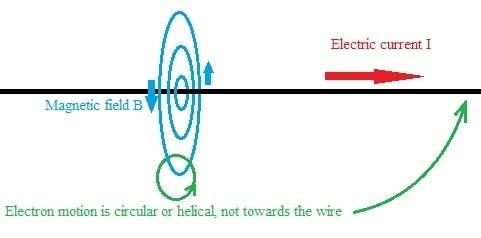
This is a great example for why Purcell has too much pedagogics in his approach. It's much simpler to introduce special relativity before starting electrodynamics and introduce electrodynamics as the full set of Maxwell equations as the outcome of about a century of careful investigations concerning electricity and magnetism, culminating in the comprehensive understanding of the subject in terms of the field paradigm by Faraday and its mathematical foundation by Maxwell. Then it's very clear, how the quantities behave under proper orthochronous Poincare transformations, and as soon as you formulate the complete electrodynamical and mechanical problem in a relativistic way, there are no apparent paradoxes.
A simple straight wire (or even two parallel wires) with DC is, however, not as trivial a task as it is almost always treated, because if you want to make it fully relativistic, you have to take into account the Hall effect and use a kind of "two-fluid picture". The classical "Jellium model" is of course fully sufficient to get a principle picture.
Of course, the preferred frame of reference in this model is the restframe of the wires. The model consists of a "rigid" homogeneous positively charged background (the ions making up the lattice of the metal) and a fluid consisting of the conduction electrons. For a DC current you have a stationary problem, i.e., everything is time-independent. The full set of macroscopic Maxwell equations under the simplifying assumption that ##\epsilon=\mu=1## read
$$\vec{\nabla} \cdot \vec{B}=0, \quad \vec{\nabla} \times \vec{E}=0,$$
$$\vec{\nabla} \times \vec{B}=\vec{j}, \quad \vec{\nabla} \cdot \vec{E}=\rho.$$
Now we have the constitutive equations
$$j^{\mu}=Ze n_+ u_+^{\mu} -e n_- u_-^{\mu}.$$
$$\vec{j}=\sigma \left (\vec{E} + \frac{\vec{v}} \times \vec{B} \right).$$
This you can solve with the ansatz ##\vec{j}=j \Theta(a-\rho) \vec{e}_z##, ##\vec{u}_+=0##. Note that ##n_+## and ##n_-## are scalar particle densities, i.e., measured in the (local) restframe of each of the fluids. There is no common rest frame of both fluids of course!
Then it's immideately clear that you need the magnetic field in Ohm's Law, i.e., taking into account the Hall effect self-consistently, to make everything relativistically consistent although for the typical household currents it's totally negligible since ##\vec{u}_-## is tiny even on everyday scales of speeds.
However, with this fully relativistic solution there is no problem anymore with relativistic covariance, and you can boost to any frame you like, particularly also to the frame where the conduction electrons are at rest and the positive ions are moving.