Leonardo Machado
- 56
- 2
I'm writing a program to compute an ODE solution of the Kepler's problem based on Runge-Kutta 4th order method and today I've past the whole day trying to made it work, but I've failed, maybe you could help me to kill the problem ?
The solutions is cartesian.
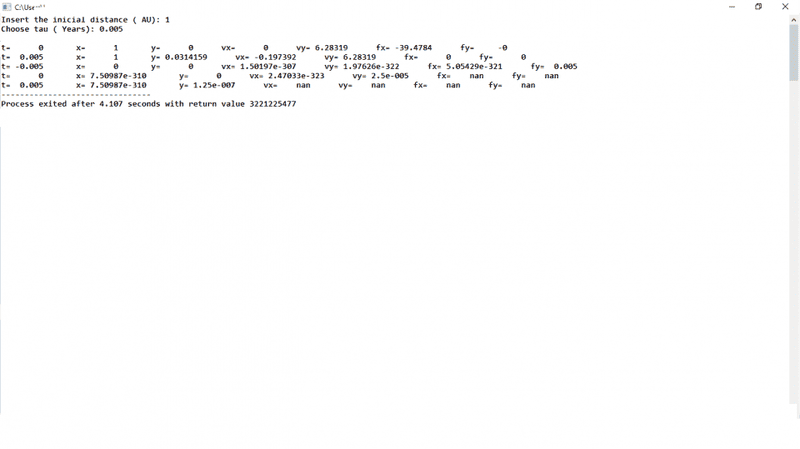
Look like when it takes n=1 there is some error that make the force in x and y equals 0, as you can see in this print screen, also it crashes on n=5 :c
I would be gratefull if you help me.
The solutions is cartesian.
Code:
int main(){

    int n;

    double tau, x[4][200], xk[4], f[4][200], GM, PI = 3.14159265;

    double f1[4], f2[4], f3[4], f4[4] ;

    GM = 4 * pow ( PI, 2);

    x[2][1]= 0;

    x[3][1]= 0;

    count << "Insert the inicial distance ( AU): " ;
    cin >> x[1][1];

    count << "Choose tau ( Years): " ;
    cin >> tau;

    //Circular mov condition

    x[4][1]= sqrt ( GM / sqrt ( pow ( x[1][1], 2) + pow ( x[2][1], 2)));


    for ( n=1 ; n <= 199 ; n++) {

        // Definitions of runge-kutta parametres F1, F2, F3 e F4

        xk[1]=0;
        xk[2]=0;
        xk[3]=0;
        xk[4]=0;

        f[1][n]= x[3][n] + xk[3];

        f[2][n]= x[4][n] + xk[4];

        f[3][n]= -GM * (x[1][n] + xk[1]) / pow ( sqrt (  pow ( x[1][n] + xk[1], 2) + pow ( x[2][n] + xk[2], 2)), 3);

        f[4][n]= -GM * (x[2][n] + xk[2]) / pow ( sqrt (  pow ( x[1][n] + xk[1], 2) + pow ( x[2][n] + xk[2], 2)), 3);


        f1[1]= f[1][n];
        f1[2]= f[2][n];
        f1[3]= f[3][n];
        f1[4]= f[4][n];


        xk[1]=0.5*tau*f1[1];
        xk[2]=0.5*tau*f1[2]/2;
        xk[3]=0.5*f1[3];
        xk[4]=0.5*tau*f1[4];

        f2[1]= f[1][n];
        f2[2]= f[2][n];
        f2[3]= f[3][n];
        f2[4]= f[4][n];

        xk[1]=0.5*tau*f2[1];
        xk[2]=0.5*tau*f2[2];
        xk[3]=0.5*tau*f2[3];
        xk[4]=0.5*tau*f2[4];

        f3[1]= f[1][n];
        f3[2]= f[2][n];
        f3[3]= f[3][n];
        f3[4]= f[4][n];

        xk[1]=0.5*tau*f3[1];
        xk[2]=0.5*tau*f3[2];
        xk[3]=0.5*tau*f3[3];
        xk[4]=0.5*tau*f3[4];

        f4[1]= f[1][n];
        f4[2]= f[2][n];
        f4[3]= f[3][n];
        f4[4]= f[4][n];

        xk[1]=0;
        xk[2]=0;
        xk[3]=0;
        xk[4]=0;


        x[1][n+1]= x[1][n] + tau/6*(f1[1]+f4[1]+2*(f2[1]+f3[1]));
        x[2][n+1]= x[2][n] + tau/6*(f1[2]+f4[2]+2*(f2[2]+f3[2]));
        x[3][n+1]= x[3][n] + tau/6*(f1[3]+f4[3]+2*(f2[3]+f3[3]));
        x[4][n+1]= x[4][n] + tau/6*(f1[4]+f4[4]+2*(f2[4]+f3[4]));

        count << endl
            << "t= " << setw (6) << tau*(n-1)
            << setw (10) << "x= " << setw (6) << x[1][n]
            << setw (10) << "y= " << setw (6) << x[2][n]
            << setw (10) << "vx= " << setw (6) << f[1][n]
            << setw (10) << "vy= " << setw (6) << f[2][n]
            << setw (10) << "fx= " << setw (6) << f[3][n]
            << setw (10) << "fy= " << setw (6) << f[4][n];


      }
}
Look like when it takes n=1 there is some error that make the force in x and y equals 0, as you can see in this print screen, also it crashes on n=5 :c
I would be gratefull if you help me.
Last edited by a moderator: