"Programmable" Robot Maze: Possible Paths?

  • Context: Undergrad 
  • Thread starter Thread starter mishima
  • Start date Start date
  • Tags Tags
    Robot
Click For Summary

Discussion Overview

The discussion revolves around the concept of creating a programmable robot maze, inspired by the board game "Quoridor." Participants explore the mathematical question of determining the number of possible paths a robot can take through a maze with varying constraints, including the size of the board and the placement of walls.

Discussion Character

  • Exploratory
  • Mathematical reasoning
  • Technical explanation

Main Points Raised

  • One participant proposes building wall pieces for a robot maze based on the game "Quoridor" and seeks to calculate possible paths across different board sizes.
  • Another participant suggests that without specific limitations, there can be either zero or an infinite number of paths due to the potential for looping.
  • A participant clarifies that they are considering paths from the perspective of the environment, suggesting to discard loops that do not contribute to reaching the goal.
  • One participant notes that the constraint of not using a field twice complicates the problem, recommending backtracking as a method to find all solutions.
  • There is a query about additional constraints that could simplify the problem for manual calculations, along with the possibility of using computer programs for backtracking.
  • Another participant confirms the existence of computer programs that can assist in solving such problems and suggests limiting movement directions as a way to simplify calculations.

Areas of Agreement / Disagreement

Participants express differing views on the nature of paths in the maze, particularly regarding the implications of looping and constraints. There is no consensus on the best approach to calculating paths or the necessary constraints to apply.

Contextual Notes

The discussion includes assumptions about the nature of movement and pathfinding in mazes, as well as the potential complexity introduced by wall placements and movement restrictions. Specific mathematical steps and definitions are not fully resolved.

mishima
Messages
576
Reaction score
43
There is a board game called "Quoridor" (http://en.wikipedia.org/wiki/Quoridor) where you build walls in such a way that your enemy is impeded and you are helped. I would like to build some similar pieces out of wood large enough to allow my students' robots to have a "changeable" maze they could test out pathfinding and such with.
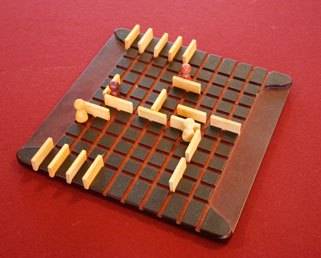
quoridorBoard.jpg


The wall pieces can only touch 2 squares (not 3). For my purposes, there can be any number of walls allowed. (in the game, each player gets 10 walls and can either move or place a wall each turn)

My math question is how many possible paths are there:
a: That lead from one side to the other with the original 81 square board.
b: On an easier to physically construct 3x6 board.
c: How to find max paths for an m x n board
 
Mathematics news on Phys.org
Without further limitations, there are always 0 or an infinite number of paths. You can keep moving in circles n times, for every integer n, and then go to the other side (if possible, otherwise there is no path).
 
I understand what you are saying. I suppose I was thinking of the path from the perspective of the environment, instead of the moving object. Let's discard loops that do not add to the progress of the object toward its goal. The robots do tend to loop multiple times in reality, but that isn't important.
 
"A field cannot be used twice"? In general, that will give a complicated problem, and something like backtracking is probably the best way to find all solutions.
 
Are there other constraints possible that might make it a more casual (scratch paper) problem? Or are there computer programs that facilitate the backtracking process?
 
There are computer programs, sure.
To find some number with pen&paper, you could add the requirement that moves are only allowed in specific directions (like "down" and "left"), or find some clever ways to reduce the full problem to smaller sub-problems depending on the wall positions (if there are enough walls).
 

Similar threads

  • · Replies 18 ·
Replies
18
Views
3K
  • · Replies 6 ·
Replies
6
Views
3K
  • · Replies 9 ·
Replies
9
Views
3K
  • · Replies 13 ·
Replies
13
Views
2K
  • · Replies 2 ·
Replies
2
Views
3K
  • · Replies 1 ·
Replies
1
Views
2K
  • · Replies 4 ·
Replies
4
Views
3K
  • · Replies 23 ·
Replies
23
Views
3K
  • · Replies 1 ·
Replies
1
Views
2K
  • · Replies 3 ·
Replies
3
Views
2K