Proof of Commutator Operator Identity

Click For Summary

Discussion Overview

The discussion revolves around proving a commutator operator identity relevant to the harmonic oscillator in quantum mechanics. Participants explore methods to complete the proof, particularly focusing on mathematical induction and the properties of commutators.

Discussion Character

  • Exploratory
  • Mathematical reasoning

Main Points Raised

  • One participant seeks assistance in proving a commutator operator identity.
  • Another suggests using mathematical induction, assuming that k is a natural number.
  • There is a request for clarification on the approach to mathematical induction.
  • Participants discuss the basic statements needed for induction, including specific commutator identities.
  • A later reply provides a representation of the commutator in terms of differential operators acting on smooth functions.

Areas of Agreement / Disagreement

The discussion does not reach a consensus, as participants express varying levels of understanding regarding mathematical induction and its application to the proof.

Contextual Notes

Some participants express uncertainty about mathematical induction and its steps, indicating a potential gap in foundational knowledge necessary for the proof.

Peter Yu
Messages
19
Reaction score
1
TL;DR
Proof of Commutator Operator Identity used in Harmonic Oscillator of Quantum Mechanics
Hi All,
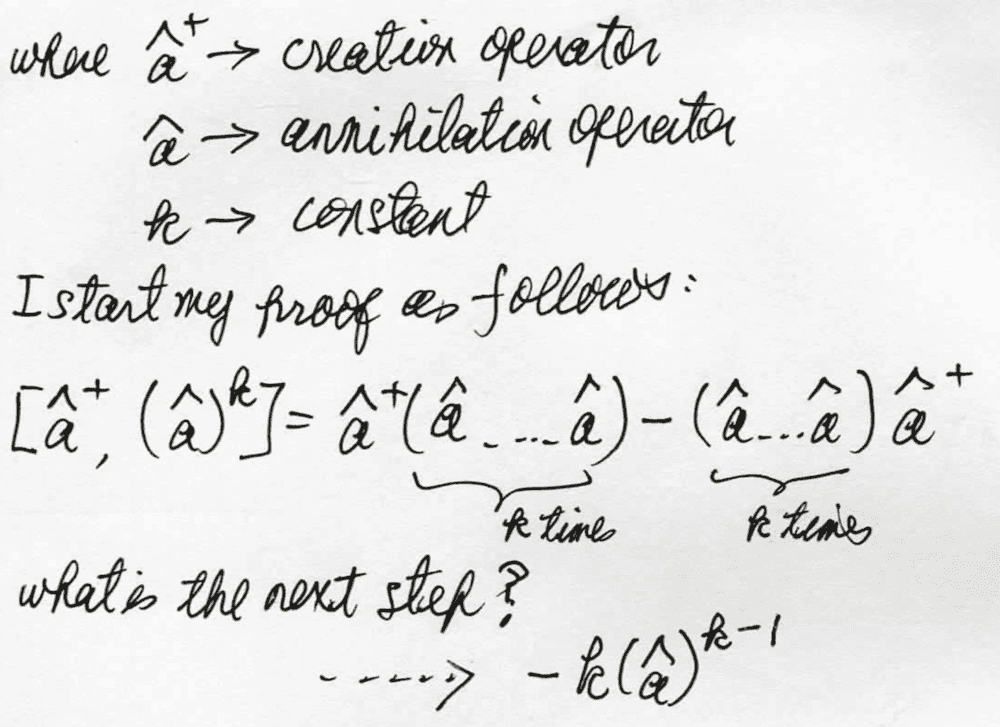
I try to prove the following commutator operator Identity used in Harmonic Oscillator of Quantum Mechanics. In the process, I do not know how to proceed forward. I need help to complete my proof.
Many Thanks.

1583139943257.png


1583139999911.png
 

Attachments

  • 1583140001145.png
    1583140001145.png
    131.4 KB · Views: 273
Physics news on Phys.org
Well, If ##k## is a natural number (which seems to be an asumtion in your proof) I would recommend you to use mathematical induction.
 
  • Like
Likes   Reactions: vanhees71
Thank you for your response.
Can you enlighten me on the approach.
 
Do you know what mathematical induction is?
 
Sorry I do not know. Can you give me some hints.
 
Peter Yu said:
Sorry I do not know. Can you give me some hints.
https://en.wikipedia.org/wiki/Mathematical_induction

Essentially, is to prove only two easier statements:
$$\left[\hat{a}^\dagger, \hat{a}\right]=-\hat{a}^0$$ and $$\left[\hat{a}^\dagger, \hat{a}^k\right]=-k\hat{a}^{k-1}\Longrightarrow \left[\hat{a}^\dagger, \hat{a}^{k+1}\right]=-(k+1)\hat{a}^{k}$$
 
  • Like
Likes   Reactions: vanhees71 and PeroK
Peter Yu said:
\big[ \hat{a}^{\dagger} , \left( \hat{a}\right)^{k}\big] = - k \left( \hat{a}\right)^{k - 1}
You can easily show that the commutator \big[ \hat{a}^{\dagger} , \hat{a} \big] = -1 has the following representation \hat{a} \to a \ \mbox{id}_{C^{\infty}} , \ \ \hat{a}^{\dagger} \to - \frac{d}{da} ,
acting on the space C^{\infty} of smooth functions of the variable a. So, for any function f(a) \in C^{\infty} and any p \in \mathbb{R}, you have \big[ \hat{a}^{\dagger} , (f(a))^{p} \ \mbox{id}_{C^{\infty}} \big] = - p \ (f(a))^{p-1} \ \frac{df}{da} \ \mbox{id}_{C^{\infty}} .
 
  • Like
Likes   Reactions: dextercioby

Similar threads

  • · Replies 12 ·
Replies
12
Views
1K
  • · Replies 14 ·
Replies
14
Views
2K
  • · Replies 7 ·
Replies
7
Views
1K
  • · Replies 2 ·
Replies
2
Views
1K
  • · Replies 17 ·
Replies
17
Views
3K
  • · Replies 18 ·
Replies
18
Views
5K
  • · Replies 19 ·
Replies
19
Views
3K
  • · Replies 8 ·
Replies
8
Views
1K
  • · Replies 9 ·
Replies
9
Views
2K
  • · Replies 33 ·
2
Replies
33
Views
4K