Proof of the generalized Uncertainty Principle?

Click For Summary
SUMMARY

The discussion revolves around the proof of the generalized uncertainty principle, specifically focusing on the relations presented in equation (4.20): $$(\Delta\;C)^{2} = \bra{\psi}A^{2}\ket{\psi}$$ and $$(\Delta\;D)^{2} = \bra{\psi}B^{2}\ket{\psi}$$. Participants clarify that the inequality $$\lvert \langle [C,D] \rangle \rvert^2 \le 4 \langle C^2 \rangle \langle D^2 \rangle$$ holds for any two Hermitian operators, including C and D. The derivation concludes with $$\lvert \langle [A,B] \rangle \rvert^2 \le 4 (\Delta A)^2 (\Delta B)^2$$, indicating a potential typo in the original proof regarding the use of operators A and B instead of C and D.

PREREQUISITES
  • Understanding of Hermitian operators in quantum mechanics
  • Familiarity with expectation values and their calculations
  • Knowledge of the generalized uncertainty principle
  • Proficiency in mathematical notation used in quantum mechanics
NEXT STEPS
  • Study the derivation of the generalized uncertainty principle in quantum mechanics
  • Learn about the properties of Hermitian operators and their implications
  • Explore the significance of commutation relations in quantum mechanics
  • Review the mathematical foundations of expectation values in quantum states
USEFUL FOR

Quantum physicists, students of quantum mechanics, and researchers interested in the mathematical foundations of the uncertainty principle will benefit from this discussion.

patric44
Messages
308
Reaction score
40
Homework Statement
i am trying to proof the generalized uncertainty principle , and i am stuck at some point
Relevant Equations
(ΔC)^2 = <φ|A^2|φ>
hi guys
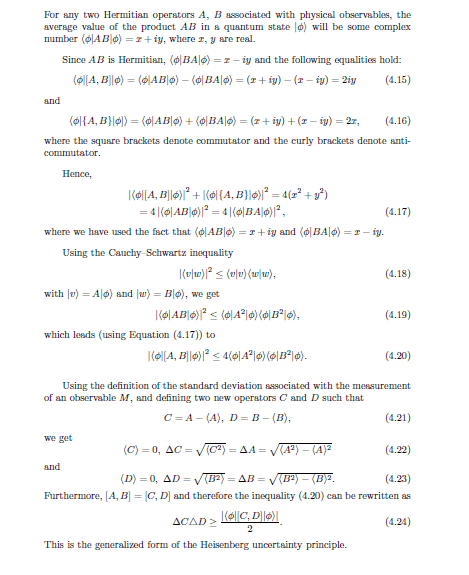
i am trying to follow a proof of the generalized uncertainty principle and i am stuck at the last step :
uncertanity.png

i am not sure why he put these relations in (4.20) :
$$(\Delta\;C)^{2} = \bra{\psi}A^{2}\ket{\psi}$$
$$(\Delta\;D)^{2} = \bra{\psi}B^{2}\ket{\psi}$$
i tried to prove these using the difination of the expectation value and had no success! any help will be appreciated, thanks.
 
Physics news on Phys.org
Inequality (4.20) holds for any two hermitian operators. In particular, it holds for C and D. So you have
$$\lvert \langle [C,D] \rangle \rvert^2 \le 4 \langle C^2 \rangle \langle D^2 \rangle.$$ Then you can use (4.22) and (4.23) to write the righthand side in terms of ##\Delta A## and ##\Delta B##. And since [A,B] = [C,D], you end up with
$$\lvert \langle [A,B] \rangle \rvert^2 \le 4 (\Delta A)^2 (\Delta B)^2 .$$ Divide by 4 and take the square root to finish the derivation.

I'm wondering if the author meant to use A and B in (4.24) instead of C and D. There's also a pretty obvious typo in (4.23).
 
  • Like
Likes vanhees71, Delta2, patric44 and 1 other person
vela said:
Inequality (4.20) holds for any two hermitian operators. In particular, it holds for C and D. So you have
$$\lvert \langle [C,D] \rangle \rvert^2 \le 4 \langle C^2 \rangle \langle D^2 \rangle.$$ Then you can use (4.22) and (4.23) to write the righthand side in terms of ##\Delta A## and ##\Delta B##. And since [A,B] = [C,D], you end up with
$$\lvert \langle [A,B] \rangle \rvert^2 \le 4 (\Delta A)^2 (\Delta B)^2 .$$ Divide by 4 and take the square root to finish the derivation.

I'm wondering if the author meant to use A and B in (4.24) instead of C and D. There's also a pretty obvious typo in (4.23).
thanks so much it becomes clear now :smile: , i guess the author meant ##A,B##
 
  • Like
Likes vanhees71 and Delta2

Similar threads

  • · Replies 2 ·
Replies
2
Views
1K
  • · Replies 1 ·
Replies
1
Views
2K
  • · Replies 8 ·
Replies
8
Views
3K
  • · Replies 3 ·
Replies
3
Views
2K
  • · Replies 2 ·
Replies
2
Views
2K
Replies
4
Views
1K
Replies
2
Views
2K
  • · Replies 0 ·
Replies
0
Views
1K
  • · Replies 8 ·
Replies
8
Views
2K
Replies
1
Views
2K