Proof that the solutions are algebraic functions

  • Context:
  • Thread starter Thread starter mathmari
  • Start date Start date
  • Tags Tags
    Functions Proof
Join the discussion
Registration is free. Ask a follow-up in this thread, or start your own.
1 reply · 1K views
mathmari
Gold Member
MHB
Messages
4,984
Reaction score
7
Hey! :o

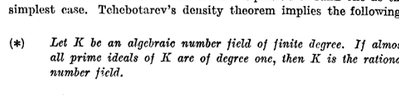
I am looking at the following:

View attachment 5008

View attachment 5009

View attachment 5010 View attachment 5011

View attachment 5012 I haven't really understood the proof...

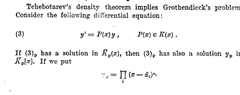
Why do we consider the differential equation $y'=P(x)y$ ? (Wondering)

Why does the sentence: "If $(3)_{\mathfrak{p}}$ has a solution in $\overline{K}_{\mathfrak{p}}(x)$, then $(3)_{\mathfrak{p}}$ has also a solution $y_{\mathfrak{p}}$ in $\overline{K}_{\mathfrak{p}}[x]$." stand? (Wondering)
 

Attachments
  • id.PNG
    id.PNG
    37.7 KB · Views: 143
  • gr.PNG
    gr.PNG
    14 KB · Views: 139
  • tche.PNG
    tche.PNG
    10.2 KB · Views: 144
  • tcheg1.PNG
    tcheg1.PNG
    12 KB · Views: 146
  • tcheg2.PNG
    tcheg2.PNG
    27.1 KB · Views: 152
Physics news on Phys.org
mathmari said:
Why do we consider the differential equation $y'=P(x)y$ ?

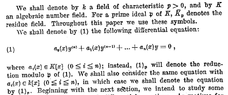
Since the proof for Grothedieck's problem stands for $n=1$, we consider a differential equation of the form $\alpha_0(x)y'+\alpha_1(x) y=0, \alpha_i(x)\in K[x]$.
So $\alpha_0(x)y'+\alpha_1 (x) y=0 \Rightarrow \alpha_0(x)y'=-\alpha_1(x)y \Rightarrow y'=P(x)y$, where $P(x)=-\frac{\alpha_1(x)}{\alpha_0(x)}\in K(x)$.

Is this correct? (Wondering)
mathmari said:
Why does the sentence: "If $(3)_{\mathfrak{p}}$ has a solution in $\overline{K}_{\mathfrak{p}}(x)$, then $(3)_{\mathfrak{p}}$ has also a solution $y_{\mathfrak{p}}$ in $\overline{K}_{\mathfrak{p}}[x]$." stand? (Wondering)

$\overline{K}$ is the algebraic closure, right?

We have that any polynomial in a field $K[x]$ factors into linear factors in the algebraic closure $\overline{K}[x]$. Does this hold also for the elements of a field of fraction $K(x)$?

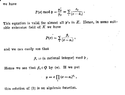
Also how do we conclude that $\beta_i \in \mathbb{Q}$ ? (Wondering)