Prove: Quadratic Inequality of Points on Semicircle O

  • Topic:
  • Thread starter Thread starter Albert1
  • Start date Start date
  • Tags Tags
    Geometry Proof
Join the discussion
Registration is free. Start your own thread to ask a follow-up.
2 replies · 2K views
Albert1
Messages
1,221
Reaction score
0
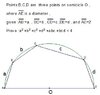
AE is a diameter of a semicicle O,points B,C,D are three points on this semicicle
Given :AB=a ,BC=b ,CD=c ,DE=d ,and AE=2
please prove :
$a^2+b^2+c^2+d^2+abc+bcd < 4$
View attachment 968
 
Attachments
  • semicircle.jpg
    semicircle.jpg
    13.3 KB · Views: 155
Last edited:
Mathematics news on Phys.org
Because of the symmetry between the pairs $(a,d)$ and $(b,c)$, we may reduce the problem to one of two variables:

Prove:

$$a^2+b^2+ab^2<2$$

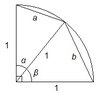
where $a$ and $b$ are found from the following diagram:

View attachment 971

Using the Law of Cosines, we find:

$$a^2=2-2\cos(\alpha)$$

$$b^2=2-2\cos(\beta)$$

Since $\alpha$ and $\beta$ are complementary, we now have the objective function in one variable (after dividing through by 2):

$$f(\alpha)=2-\left(\cos(\alpha)+\sin(\alpha) \right)+\sqrt{2-2\cos(\alpha)}\left(1-\sin(\alpha) \right)<1$$

Differentiating with respect to $\alpha$ and equating to zero, we may find the critical value(s) (using a numeric root-finding technique) on the relevant interval:

$$\alpha\approx1.06048703739259044748$$

Thus, checking the end-points of the interval, we find:

$$f(0)=1$$

$$f(1.06048703739259044748)\approx0.767829392509715815674068$$

$$f\left(\frac{\pi}{2} \right)=1$$

Thus, we may conclude that for $$0<\alpha<\frac{\pi}{2}$$ we must have:

$$f(\alpha)<1$$

which is what we needed to show.
 
Attachments
  • albert01.jpg
    albert01.jpg
    4.7 KB · Views: 138
Albert said:
AE is a diameter of a semicicle O,points B,C,D are three points on this semicicle
Given :AB=a ,BC=b ,CD=c ,DE=d ,and AE=2
please prove :
$a^2+b^2+c^2+d^2+abc+bcd < 4$
https://www.physicsforums.com/attachments/968
connecting AC, and CE ,from law of cosine:

$AC^2=a^2+b^2-2ab\, cos B=a^2+b^2+2ab\,cos \angle AEC>a^2+b^2+abc(1)$

likewise :

$CE^2>c^2+d^2+bcd(2)$

now using pythagorean theorem (1)+(2) we have :

$AC^2+CE^2=AE^2=4>a^2+b^2+c^2+d^2+abc+bcd$