Discussion Overview
The discussion revolves around proving that the function f(x) = 2 + x - tan-1(x) does not have a fixed point. Participants explore the implications of the derivative condition |f'(x)| < 1 and the potential existence of fixed points, particularly focusing on the equation y = 2 + y - tan-1(y).
Discussion Character
Main Points Raised
- One participant claims to have found a fixed point at y = tan(2), suggesting the original question may be incorrect.
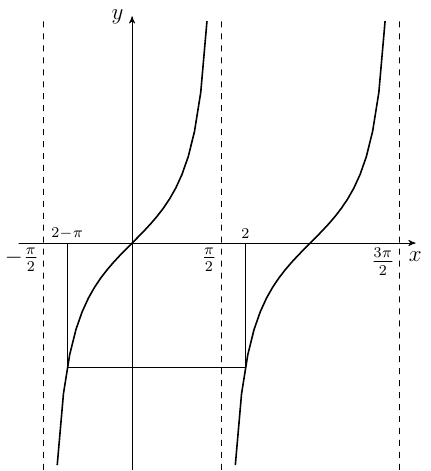
- Another participant hints that tan-1(tan(2)) does not equal 2, implying a need for further clarification on the fixed point concept.
- A later reply explains that due to the periodic nature of the tangent function, there are infinitely many x values for each y, but the arctangent function returns principal values within a specific interval, leading to tan-1(tan(2)) = 2 - π.
Areas of Agreement / Disagreement
Participants express disagreement regarding the existence of a fixed point, with some asserting that the function does have one while others challenge this claim based on the properties of the arctangent function.
Contextual Notes
Participants note the importance of understanding the principal values of the arctangent function and the implications of periodicity in the tangent function, which may affect the determination of fixed points.
Who May Find This Useful
This discussion may be useful for those studying fixed point theorems, properties of trigonometric functions, and their inverses, particularly in the context of calculus and mathematical analysis.